




The Mercedes-Benz E-Class is a success story with a strong tradition. One of its ancestors is the Mercedes-Benz 170 V, which was presented to the world in February 1936. Driving comfort, downsizing and lightweight construction: these are just some of the key features of this vehicle, which also impresses with its new four-cylinder engine and the large amount of space in a compact size.

Ultra-modern upper mid-range vehicle
February 15, 1936 is an important day for Mercedes-Benz. At the International Automobile and Motorcycle Exhibition (IAMA) in Berlin, the brand unveiled the fundamentally newly developed 170 V (W 136), a highly modern vehicle in the upper mid-size class. It would play a decisive role for the then Daimler-Benz AG both before and after the Second World War - production was only discontinued in August 1953.

In the 170 V, the developers completely rethought the car in a comparatively compact format. The basis is an X-oval tube frame, which is more torsion-resistant and also 80 kilograms lighter than a corresponding box frame. Overall, the total weight is reduced by 100 to 120 kilograms (depending on the body structure) compared to its direct predecessor, the Mercedes-Benz 170 (W 15) from 1931. A new four-cylinder engine with a displacement of 1.7 liters and 28 kW (38 hp) provides the drive - it has two fewer cylinders, but significantly more power than the previous six-cylinder engine with 24 kW (32 hp). This makes the newcomer a pioneer of today's downsizing. The top speed of the 170 V is also 18 km/h higher than its predecessor.
Ample space and "floating engine"
The 170 V is an extremely comfortable vehicle. This is due, for example, to the independent suspension, but also to the spacious interior, which exceeds that of the 170 thanks to the longer wheelbase. This also contributes to driving comfort: Many experts attest to the 170 V's smooth running and high long-distance qualities. The sophisticated engine mounts also play their part in this. The "floating engine", as it is officially called, is mounted in the frame at two points so that the axis of vibration runs through the center of mass. The result is a vibration behavior of the four-cylinder that comes close to that of a six-cylinder.

The Mercedes-Benz 170 V is available in numerous body variants which, taken as a whole, reflect the tastes of the time: Two-door sedan, four-door sedan, four-door convertible sedan, roadster, convertible A, convertible B and open-top touring car. A panel van is available for commercial applications. In addition, the 170 V serves as the basis for sporty derivatives and military versions.

The package of its outstanding features made the Mercedes-Benz 170 V a great success right from the start. By the end of the original production run in 1942 due to the war, 91,048 units had been produced. This makes it the brand's most successful passenger car to date.
Paving the way for a new beginning after the Second World War
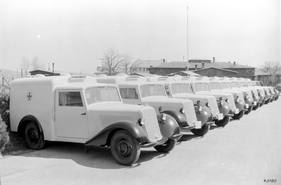
After the Second World War, Germany lay in ruins and production at the then Daimler-Benz AG came to a standstill. However, the company received a production permit from the occupying power as early as the end of 1945. From May 1946, panel vans, flatbeds and ambulances were built on the basis of the 170 V, which were particularly important in everyday life at the time. Passenger cars were also produced again from July 1947, and constant development work kept the 170 V up to date. After the war, the company produced another 49,367 vehicles of this type before production was discontinued in August 1953. This results in a proud total of 140,415 units.

The people behind the Mercedes-Benz 170 V
There was a large team behind the 170 V presented in 1936. Initially, the head of development was Dr. Hans Nibel, whose sudden death in November 1934 was followed by Max Sailer in the same position. Since the company merger to form Daimler-Benz AG in 1926, Albert Heess has been responsible for all vehicle engines as Head of Design and Chief Engineer, and thus also for the development of the four-cylinder M 136 engine used in the 170 V. Max Wagner was already working at Benz & Cie. as head of vehicle design and chief engineer under Nibel; both were already advocates of independent suspension at the time. The early work under Wagner's aegis resulted in the 170 V, including the X-oval tube frame. As head of testing at the time, Fritz Nallinger was responsible for getting the new mid-range car ready for series production. Under him, a young engineer supervised the project, who would also remain a well-known figure: Rudolf Uhlenhaut.