



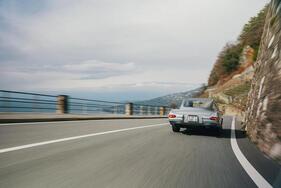
In March 1964, Automobili Lamborghini was still an absolute newcomer in the automotive world. The company had only been founded a few months earlier, and in October 1963 Lamborghini presented its first prototype, the 350 GTV, designed by Franco Scaglione and built by Turin coachbuilder Sargiotto. The production car derived from this one-off was the 350 GT, which was presented at the Geneva Motor Show in March 1964.
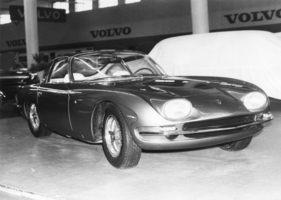
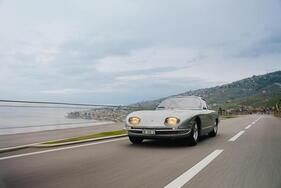
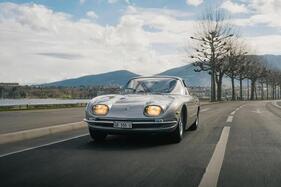
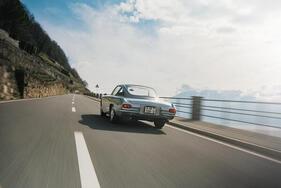
60 years after this debut, Automobili Lamborghini is now returning to the streets of Geneva with its oldest existing production car, the 350 GT with the second chassis number, to celebrate the history of its first production model, a car that laid the foundations for the DNA of the car manufacturer from Sant'Agata.
Presentation of the production model in Geneva in March 1964
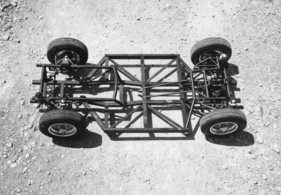
Automobili Lamborghini's sales history began in 1964 with the presentation of the 350 GT at the Geneva Motor Show. From that moment on, customers were able to purchase a car with the iconic bull on the hood for the first time. The 350 GT can look back on a fast-paced and equally extraordinary history. The frame and chassis were designed by the then very young engineer Giampaolo Dallara, who is now regarded as the best chassis builder in the world.
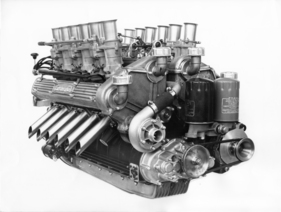
The V12 with a displacement of 3.5 liters and four overhead camshafts was developed by designer Giotto Bizzarrini as a racing engine and then adapted for road use in the 350 GT by engineer Paolo Stanzani - a figurehead in the history of Automobili Lamborghini and for GT vehicles worldwide.
The design and production of the aluminum body were entrusted to the Milan-based company Carrozzeria Touring, which was considered the ultimate in coachbuilding in the early 1960s and was famous for its sports cars with luxury equipment.
Successful model
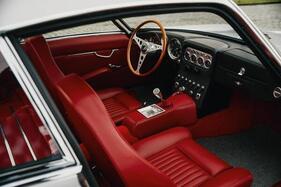
Lamborghini's first production model was a great success right from the start and attracted the attention of numerous media representatives present in Geneva. The extremely high-quality interior of the 350 GT impresses with its extensive use of leather and chrome and is characterized by the 2+1 configuration with two front seats and a central rear seat. But its technology is just as impressive as its design: the independent wheel suspension and the powerful 320 hp engine were pioneering at the time. The engine had a magnetic effect on visitors to the trade fair and Ferruccio Lamborghini himself demonstrated the car to onlookers, future customers and journalists at the stand.
A few months later, Lamborghini's V12 for the 400 GT was bored out to four liters and, in this new configuration, became the mainstay of success for the car manufacturer from Sant'Agata Bolognese. Over the next 40 years, the same geometry was used again and again in various positions and development forms and became one of the most important symbols of Lamborghini's DNA. It is used as a longitudinal front engine in the 400 GT, Islero, Jarama, Espada and LM002, as a transverse mid-engine in the Miura and as a longitudinal mid-engine in the Countach and Diablo.
Sports car for show and music stars
The first 350 GT was delivered to drummer Giampiero Giusti from Livorno, who was at the height of his success at the time with the band "I 5 di Lucca", which would later become one of the most important jazz groups in Italy as the "Quartetto di Lucca". Thus began a close relationship between Lamborghini and the world of show business, with many actors and singers becoming fans of the car manufacturer. The 350 GT's first film role was in the 1967 Columbia Pictures film "Make me cold, I'm freezing", directed by Francesco Maselli and starring a pair of crooks played by the celebrated Monica Vitti and Jean Sorel.
The Geneva Salon 350 GT was destroyed
The vehicle exhibited at the Lamborghini stand in Geneva in 1964 was the very first 350 GT with chassis number 101 in Verde Ginevra Metallizzato (green) with a white interior. The vehicle later used as the Muletto for development and endurance testing was unfortunately destroyed in a rear-end collision at a traffic light.
The oldest surviving production model
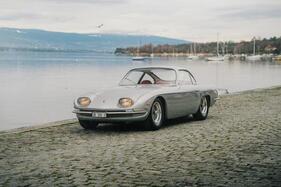
However, its immediate successor with the second chassis number in metallic gray with a red interior, which left the factory in Sant'Agata Bolognese on August 15, 1964 and was delivered to Geneva, has survived the test of time.
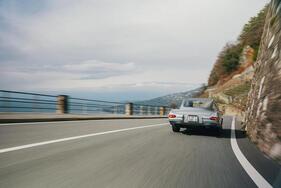
Today, this 350 GT is the oldest Lamborghini production car still in existence and has been perfectly restored and certified by Polo Storico. This year, Automobili Lamborghini wants to pay tribute to its history with a dynamic comeback on the streets of Geneva, where it made its debut 60 years ago.
Technical data 350 GT (1964-1965)
- Engine: L351, twelve-cylinder V-engine with 60° bank angle, installed as longitudinal front engine Bore x stroke: 77 x 62 mm Displacement: 3464 cc
- Maximum output: 320 hp at 7000 rpm
- Valve control: 2 valves per cylinder, two overhead camshafts per cylinder bank, chain drive
- Supply: 6 Weber twin carburettors type 40 DCOE Lubrication: Wet sump lubrication
- Gearbox: Five-speed ZF gearbox + reverse gear
- Frame: Tubular frame
- Suspension: Independent suspension, coil springs, telescopic dampers
- Brakes: Disc brakes on all four wheels
- Electrical system: 12 V Wheelbase: 2550 mm
- Track width: front and rear 1380 mm
- Dimensions L x W x H in mm: 4470 x 1720 x 1220
- Weight: 1100 kg
- Tires: Pirelli 205/15
- Units produced: 135
