


The naturally aspirated V12 engine has been at the heart of Lamborghini's most prestigious model series since 1963. In fact, to date only two versions have been produced for the super sports cars. The first engine, effectively a racing unit, was designed by Giotto Bizzarrini. It made its debut in the first Lamborghini, the 350 GT, after being tuned for more "civilian" road use. The second engine was a completely new design, with the technical concepts remaining unchanged, and was introduced in the Aventador, which was launched in 2011. It represented a huge step forward for the company in terms of technology and set new standards in terms of performance and reliability.
Of course, the first engine was modified and developed several times during its lifetime to increase performance and later significantly reduce fuel consumption and emissions. Between 1963 and 2010, it was installed in every conceivable way: initially as the front engine in the 350 GT, 400 GT and Espada. During development, aluminum was used for the cylinder heads, crankcase and pistons to reduce its weight to 232 kilograms. It was then installed in the Miura as a mid-engine rotated 90 degrees in a transverse direction. Later, starting with the Countach, it was rotated a further 90 degrees to a longitudinal position in the rear to improve weight distribution.

As the engine size increased from 3.5 liters in the 350 GT to 6.5 liters in the Murciélago, it became increasingly important to reduce the weight of the engine. New materials for the engine components made it possible to reduce the weight, while newly introduced technologies enabled a lower installation position in the chassis. With the takeover of Lamborghini by Audi, reliability and ease of maintenance became just as important as exhaust emissions and performance. Today, the V12 forms the heart of the Lamborghini Aventador and the Essenza SCV12, the car for the racetrack, in which it produces 830 hp.
The beginning of a legendary legacy
Since its inception, and even more so since it was installed in Lamborghinis, the V12 engine has been considered the most noble and prestigious powerplant of all. Bizzarrini created a V12 that was supposed to give the company the opportunity to enter the world of racing. Instead, Ferruccio Lamborghini decided to use it as the production engine for his new model. Thus began a love affair that continues to this day.

"The history of Lamborghini begins with the V12," explains Maurizio Reggiani, former Chief Technical Officer of Lamborghini. "In the 1960s, the V12 was clearly the pinnacle of technology, luxury and sportiness in any vehicle."
After the 350 GT and its derivatives such as the Espada, the V12 was installed in the Miura in 1965, the Countach in 1971 and the Diablo in 1990, before finally finding a home in the Murciélago. This engine demonstrated its full versatility when it was installed in the LM 002, Lamborghini's first super SUV, in 1986. At that time, it already had a displacement of up to 5.2 liters. A special, unique version of the LM 002 was also built with a 7.2-liter V12 engine with 700 hp, which is normally used in offshore racing boats.
The individual vehicle models with V12 engines have already been reported on previously: Lamborghini 350 GT, Lamborghini 400 GT, Lamborghini Espada, Lamborghini Miura, Lamborghini Countach, Lamborghini Diablo, Lamborghini Murciélago & Lamborghini LM 002.

Radical rethink
Thanks to the double overhead camshaft for each cylinder bank, which was used for the first time in engines for production vehicles, it was possible to widen the V-angle of the engine and thus lower the center of gravity. In the Miura, the decision was made to use a transversely mounted mid-engine in order to achieve better weight distribution and shorten the wheelbase of the vehicle. The gearbox and differential housing were integrated into the drivetrain, which helped to make the overall design of this legendary super sports car more compact.

Weight distribution is crucial
To further improve the weight distribution compared to the Miura, the designers used the same engine for the Countach, but in a different arrangement. They moved it to the center position and rotated it a further 90 degrees, i.e. 180 degrees compared to the first 350 GT. In this way, the gearbox was mounted in front of the engine, practically "in the cockpit". In its final version, the displacement of the Countach had increased to 5.2 liters. With the 1986 model year, the Countach's V12 engine was also homologated for the American market. This milestone was achieved through the use of electronic fuel injection, which replaced carburetors in markets with stricter environmental regulations.
"The larger displacement made the engine longer, shifting the center of gravity towards the rear of the vehicle," explains Reggiani. "This made it harder to drive and more prone to oversteer. The layout was revolutionized and the engine was used to shift the car's centre of gravity. In fact, the Countach engine is the first of a generation of engines that still exist today in terms of layout and position of the powertrain in the car."

Meeting the requirements of all-wheel drive
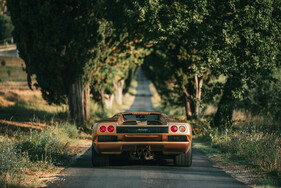
Development of the V12 began in 1985 in preparation for its use in the new Diablo super sports car. This made its debut in 1990 with a displacement increased to 5.7 liters and an output of 492 hp at 6800 rpm. In its VT version, which was presented in 1993, the Diablo was the first Lamborghini super sports car that was also available as an all-wheel drive version. The Diablo SV-R, on the other hand, was developed for use in the Super Sport Trophy, which made its debut as a support race at the 24 Hours of Le Mans in 1996. 32 Diablo SV-Rs took part in Lamborghini's largest racing program to date before the Super Trofeo was launched in 2009.
The 1998 Diablo GT was effectively the first Diablo model to incorporate the styling elements of the second generation, which was launched in 1999. It brought further important technical improvements to the engine. Of particular note was the introduction of an individual throttle valve for each cylinder, a decision dictated by the desire to improve throttle response. This change was not only significant, but also forward-looking: similar technology will be used in the new Huracán GT3, which will start racing in 2023.
New challenges with the launch of the Murciélago
Audi's acquisition of a majority stake in Lamborghini marked the beginning of a period of profound change. "Fortunately," says Reggiani, "the new owners were aware of the need for Lamborghini to maintain its identity and exclusivity. This allowed us to create a relationship between Audi and Lamborghini that set boundaries but also respected needs. From the outset, Audi understood what it could and could not ask of Lamborghini. The balance thus created allowed both companies to improve by emphasizing their differences. Lamborghini's distinctiveness, as perceived by both shareholders and the other brands in the Group, has been one of the keys to our success. What we were able to demonstrate with the development of the V12 gave us the confidence that allowed us to refine the V10 that debuted in the Gallardo. In addition, we were able to develop all our other products in an unmistakably Lamborghini way."

Under the new owner, a different approach was chosen for the development of the V12. The focus shifted from achieving high performance to volumetric efficiency in order to meet increasingly stringent regulations. An example of this is the Murciélago, which was launched in 2001 with a 6.2-liter V12 engine that produced 580 hp. In 2007, the displacement was increased to 6.5 liters, enabling an impressive output of 670 hp. In addition, the vehicle was 100 kilograms lighter and the engine, which had been revised in several parts, was equipped with dry sump lubrication with oil circulation via return pumps. This enabled Lamborghini to reduce the distance between the crankshaft and the underbody of the vehicle, thereby improving handling.
The development of the Murciélago engine enabled Lamborghini to find its own place in the world of Audi. But it was the decision to develop a new V12 from scratch after 45 years that allowed Lamborghini's developers to set new goals and exploit new opportunities.

White sheet of paper for the Aventador
"When you design an engine from scratch, you have to consider the framework conditions from the outset, which you have to be able to meet in every area of use and from every point of view," explains Reggiani. "In a way, the Aventador was the dress rehearsal for Lamborghini. With it, we had to prove that we could deliver power, weight and performance, but also guarantee the reliability required by the Group. The result speaks for itself: we sold around twice as many vehicles as forecast at the beginning - a good indicator of the Aventador's success. Despite the modifications and improvements that have been made over the years, the engine is still the same from an engineering point of view."

"When we started work on the Murciélago, we had 6.2-liter engines and an average power output of between 620 and 640 hp. With the Aventador, we already started with 6.5 liters and 700 hp. We knew that performance would have to increase by at least ten percent over the expected life of the model, which was a major challenge. We also had to take into account the Euro 5 emissions standard and the fact that we had to meet all the requirements prescribed by the Group in this first project for a new Lamborghini engine under the Audi umbrella."
The Aventador engine was introduced in 2011 and produced 690 hp at 8250 rpm with a displacement of 6.5 liters. It was modified in 2013 for the LP 700-4, in 2015 for the LP 750-4 and in 2016 for the Superveloce. With the release of the SVJ in 2019, the engine output was increased to 759 hp and to 780 hp in the 2021 Ultimae, the last road-legal Aventador. The same engine is also installed in the Essenza, a track-only vehicle that is not subject to road-legal restrictions. It produces 830 hp and is a true work of art of modern technology.

"The highest expression of our V12 was achieved with the Essenza SCV12, in which the same engine is capable of producing 830 hp," says Reggiani. "The engine is the same, but due to the elimination of the filters and soundproofing regulations, the exhaust back pressure is lower. The pressure loss of the intake filter is also lower, which means that the volumetric efficiency is higher. From a design point of view, the success of the V12 proves that a good engine can offer unique emotions and performance right from the start. Its potential can be seen in the thermodynamics and mechanical components."
The Aventador was the last Lamborghini to be powered by a pure naturally aspirated V12 engine before the next chapter opens with the hybrid in the first quarter of 2023.
