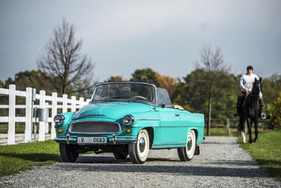


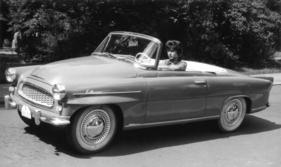

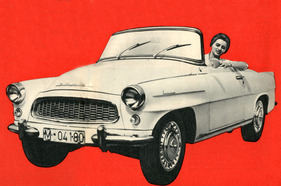
The Skoda Felicia, probably the most popular Czech convertible of all, is celebrating the 60th anniversary of its world premiere this year. On March 1, 1959, the 2+2-seater drove into the limelight for the first time at the spring fair in Leipzig. A total of 14,863 vehicles of this type rolled off the production line at the Czech Skoda plant in Kvasiny between 1959 and 1964. More than two thirds of production was exported all over the world.
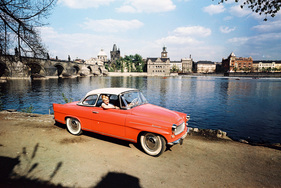
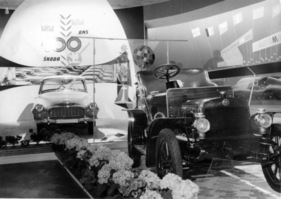
The Leipzig Spring Fair opened its doors on Sunday, March 1, 1959. Skoda's new passenger car models were the crowd-pullers of the exhibition: in addition to the Octavia, the attractive Skoda Felicia convertible was also presented to the public for the first time.
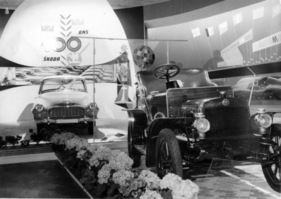
A short time later, the open-top Felicia also caused an international sensation at the Geneva Motor Show from March 12 to 22. And from April 4, 1959, Skoda even presented three examples of the new convertible at the New York Coliseum - as the world's largest automobile market, the USA was of immense importance to all manufacturers. European convertibles in particular were regarded as import hits on the other side of the Atlantic.
The predecessor of the new model was the Skoda 450, which was also available as a convertible in 1957. The type designation was derived from the number of cylinders and the engine output - the Skoda 450 had a four-cylinder engine with 50 hp. Most of the 1,010 units produced up to the model change in 1959 found enthusiasts in such demanding markets as Great Britain and the USA.
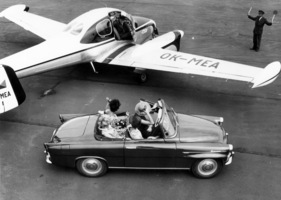
The successor with the euphonious name Felicia rolled off the production line at the Kvasiny plant and featured a number of significant technical innovations. Instead of transverse leaf springs as in the 450, the front axle of the newcomer now had coil springs. Thanks to more solid rubber silent blocks, significantly fewer vibrations were transmitted from the central tube chassis to the all-metal body. The now asymmetrically cut headlights illuminated the road better. In addition to the standard folding roof, Skoda even offered a 27-kilogram GRP hardtop as an option for the Felicia.
In the basic version, the Skoda Felicia had an unladen weight of 930 kilograms and allowed a payload of 300 kilograms. This meant that the 2+2-seater could carry four people and up to 320 liters of luggage. With a wheelbase of 2,390 millimetres, the body extended to a length of 4,065 millimetres. The petrol four-cylinder in-line engine with OHV valve control and a displacement of 1,089 cm3 was housed under the front hood and reached its peak output of 50 hp at 5,500 rpm. The maximum torque of 74.5 Nm was already available at 3,500 rpm. The convertible rolled on 15-inch wheels and reached a speed of 130 km/h, with an average fuel consumption of nine liters per 100 kilometers.
Thanks to its appealing design, the Skoda Felicia was very popular both at home and abroad. In its first year of production in 1959, almost 70 percent of the 3,251 units produced were exported. Even at motor shows in rather exotic locations such as Mexico City or Johannesburg, the chic convertible attracted a great deal of attention. One of the most famous foreign owners was one of the best professional ice hockey players of his time: the Canadian Maurice 'Rocket' Richard (1921 to 2000), team captain of the Montreal Canadiens. He was the first player in the history of the National Hockey League (NHL) to achieve the feat of scoring 50 goals in 50 NHL games.
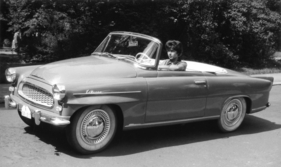
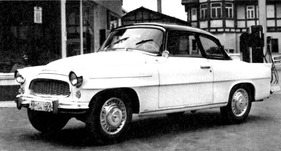
In March 1961, Skoda presented a revised Felicia in Geneva. In addition to a more striking radiator grille, the drop-shaped rear light units were particularly eye-catching. As the front seat backrests could now be folded down, the convertible even offered the option of sleeping in the vehicle. The new dashboard made of Polytex glass fiber-reinforced plastic was covered in black imitation leather, while hinged side windows in the GRP hardtop improved the air supply to the interior. A sporty feature of the new generation: by moving the gearshift from the steering column to the center tunnel, Felicia drivers could now change gears faster and more precisely. Thanks to the higher-quality 70-octane petrol, which was now available in most countries, the output of the 1.1-liter engine increased by 2 hp.
The more powerful Felicia Super appeared the following year, 1962. The 1,221 cm3 four-cylinder engine was supplied with fuel-air mixture by two downdraft carburetors from the Czechoslovakian brand Jikov. Thanks to these and other technical optimizations, customers now had 55 hp (40.5 kW) at 5,100 rpm and 82 Nm at 3,000 rpm at their disposal. With these performance data, the Felicia Super, which weighed only ten kilograms more than the base model, reached a top speed of 135 km/h on wider 5.90-15 tires.
Production of the popular Skoda Felicia model family ran parallel to the production of the equally successful Octavia Combi on the assembly lines in Kvasiny. By 1964, 14,863 Felicia and Felicia Super vehicles had been produced there before the era of Skoda models with an open body, central tube frame and the classic rear-wheel drive concept with front engine came to an end. Skoda prepared for the production of the completely redesigned rear-engine generation, which took off in the same year with the Š 1000 MB.
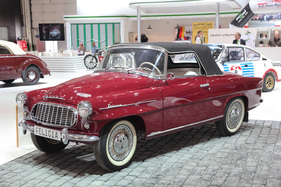
Even today, 60 years after its world premiere, the Skoda Felicia still enjoys great popularity. This is reflected not least in the growing interest of classic car collectors and the rising market prices of well-preserved examples. On the other hand, Felicia drivers at classic car events immediately sense the great enthusiasm that this model arouses among classic car fans from Western Europe to China.