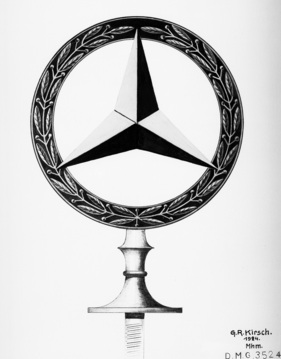
On June 28, 1926, representatives of Daimler-Motoren-Gesellschaft (DMG) and Benz & Cie. sign the contract in Mannheim to merge the two oldest automobile manufacturers in the world. Thus, exactly 90 years ago, Daimler-Benz AG and its Mercedes-Benz brand with the world-famous trademark: the three-pointed star in a laurel wreath were born. The merger creates the basis for today's Daimler company. This alone shows the lasting power of the merger at that time.

Merger after three decades of competition
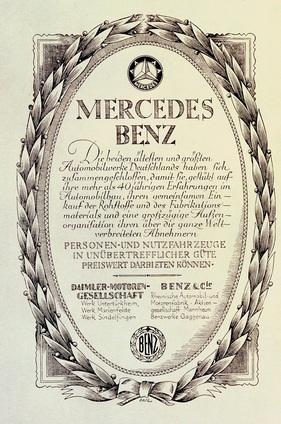
Economic conditions in Germany are difficult after the end of the First World War. This also applied to the automotive industry and affected even such renowned companies as DMG and Benz & Cie - the "two oldest and largest automobile factories in Germany", as the public announcement of the merger in 1926 put it. In the year before the merger to form Daimler-Benz AG, the two companies together produced almost 6,000 automobiles, employed more than 15,000 people and generated sales of around 104 million Reichsmarks.

The close cooperation between the companies has great potential for securing their future. A standardized model range as well as joint development, design, production and sales - these are the keywords. The manufacturers are gradually moving closer together. Both have their roots in 1886, when Carl Benz and Gottlieb Daimler independently invented the automobile. For three decades afterwards, the two companies were economic rivals with clearly differentiated brands. In 1926, the two companies merged - initially with their commercial headquarters in Berlin and plants in Mannheim and Gaggenau (Benz), Untertürkheim, Berlin-Marienfelde and Sindelfingen (Daimler). The head office of Daimler-Benz AG is located in Stuttgart-Untertürkheim from the outset. The merger is based on a community of interests formed two years earlier in May 1924, from which a joint sales company is formed in 1925.

The star rises
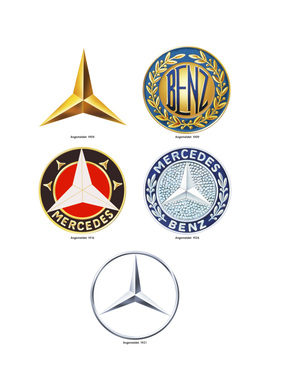
The new Mercedes-Benz brand logo, which was registered as a new trademark in February 1925, symbolizes the merger. It combines the Mercedes star from Daimler with the laurel wreath from Benz. The two original brand logos date back to 1909 and were repeatedly developed further until 1926. In this way, both companies sharpened their presence in the automotive industry's system of symbols at an early stage. In early advertisements and other publications of Daimler-Benz AG, the previous logos are therefore often present together with the new brand name Mercedes-Benz.
The strengthened corporate structure proves its worth shortly after the merger during the global economic crisis at the end of the 1920s. In addition to the synergy effect and the return to a greater vertical range of manufacture, a realigned model policy was the main contributing factor. This resulted in more compact vehicles such as the innovative Mercedes-Benz 170 (W 15) in 1931.