


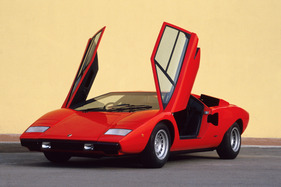

Lamborghini celebrates its V12 in 2022. The legendary twelve-cylinder engine has graced the fastest and most special models of the car manufacturer from Sant'Agata Bolognese for almost 60 years. At the end of 2022, it will roll off the production line in its final development stage as a pure combustion engine in the Aventador Ultimae.
These models include the Countach, one of the most iconic models in automotive history. It was presented in 1971 and produced in 1999 (+1) from 1973 to 1990.
But it also includes the LM 002, which went down in history as the first mass-produced high-performance off-road vehicle. Produced in 300 units from 1986 to 1993, the vehicle managed to offer the performance and driving pleasure of a Gran Turismo even off the road.
Countach, an automotive legend that has made it onto posters worldwide
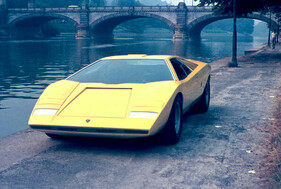
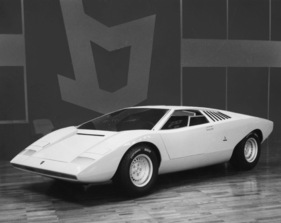
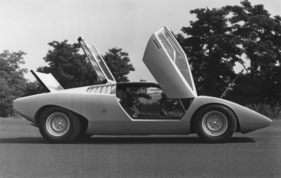
Even before its official presentation at the Geneva Motor Show in March 1971, the LP 500 wowed the world with its extreme, futuristic appearance. In fact, the exclamation "Countach", which comes from the Piedmontese dialect and emphasizes the exceptional nature of what had just been seen, only became part of the model name a few days before the official presentation. A technician from Carrozzeria Bertone uttered it after seeing the vehicle in production and could not contain his astonishment at its extraordinary appearance.
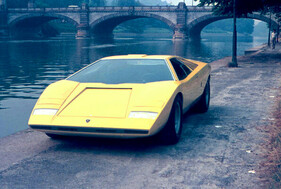
The model was presented as an "Idea Car" to find out whether the public would be interested in such an advanced and extreme vehicle. It was equipped with the 60-degree V12 engine that had already cut a brilliant figure in the Lamborghini predecessor models with a transversely mounted mid-engine. This time, however, the engine was installed longitudinally in the center position - a new technical solution from Lamborghini. Meanwhile, the displacement was increased from the usual four liters to around five liters (4971 cm3) in order to achieve an output of 440 hp.
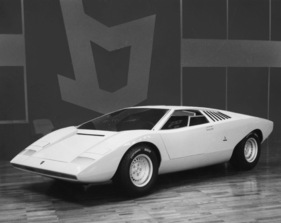
The LP 500 was so successful that Ferruccio Lamborghini decided to produce the model in series before the end of the motor show. It remained a one-off that was modified several times over the next three years as part of the grueling road tests carried out by test driver Bob Wallace. It was then destroyed in the crash tests required for type approval on March 21, 1974.
The first production Countach
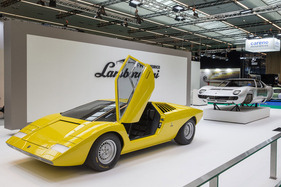
The LP 400 with 375 hp and 8000 rpm, which went into production at the end of 1973 and was equipped with the traditional four-liter engine, finally emerged from the findings of the LP 500. Due to the tunnel in the roof section, which served to improve visibility via the rear-view mirror, the model is known today as the "Periscopio".
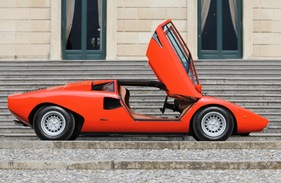
After 152 examples had been produced, the Countach LP 400 was replaced by the LP 400 S in 1978 and was given the more mature form that characterized it for the next twelve years. The "S" brought with it modifications to the frame and chassis for the optimal function of the then brand-new Pirelli P7 low-profile tires as well as some visual changes. Wheel arch trims were needed to accommodate the new, larger brakes and wider tires, while the increased power required a more aerodynamic front spoiler. Some enthusiasts then added a rear wing to complete the aerodynamic package.
All hell breaks loose on the highway
A 1979 LP 400 S made its big-screen debut in 1981 as the main character in the movie "All hell breaks loose on the highway". From then on, the Countach found its way into the bedrooms of young people around the world and adorned the walls as the favorite poster of an entire generation.
The Countach models with a five-liter engine
After 235 units had been produced, the 400 S was replaced by the LP 5000 S in 1982. This was still equipped with the legendary V12, but was enlarged to 4.8 liters (4754 cm3) and produced 375 hp at 7000 rpm.
The Quattrovalvole followed after 323 units had been produced up to 1984, which many consider to be the most successful combination of aesthetics, performance, reliability and comfort. The V12 was not only equipped with four valves per cylinder; its displacement was also increased to 5.1 liters (5167 cm3) for a maximum output of 455 hp at 7000 rpm.

The Quattrovalvole was the first version to be officially registered and imported in the USA, although the carburetors were replaced by an electronic injection system. The development of this new market opened up new sales volumes.
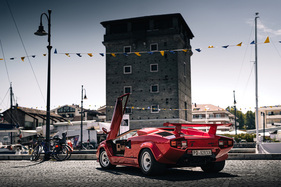
The Quattrovalvole was produced in 631 units until 1988, when it was replaced by the Countach 25 Anniversario, named to celebrate the 25th anniversary of the founding of Automobili Lamborghini.
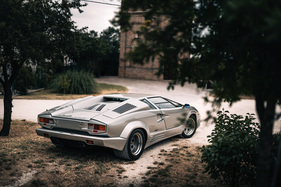
The 25 Anniversario retained the mechanicals of the Quattrovalvole, but featured improved aerodynamics, some composite body panels and a more luxurious interior. Surprisingly, the 25 Anniversario was the most produced series with 658 examples - proof of the excellence of the Countach design, which was still innovative even after 17 years of production.
The last Countach in Grigio Metallizzato (Metallic Grey) with a gray interior rolled off the production line on July 4, 1990 and went straight to MUDETEC, the carmaker's museum in Sant'Agata Bolognese.
The magic of the 1999 + 1
If you are still wondering why 1999 + 1 examples were produced, the answer is simple: the first LP 500 produced by Bertone did not have a Lamborghini chassis number, but a Bertone one. Officially, therefore, the LP 400 produced in 1973 with chassis number 1120001 is the first Countach. It was first painted red and then repainted green and had several aesthetic differences to the subsequent vehicles.
LM 002, the Lamborghini (not only) for off-road use
During the "Countach years", the management recognized the market potential of a high-performance off-road vehicle with luxury equipment. The LM 002 uses the mechanics of the Countach engine in the 5.2-liter version with 20 hp less power to avoid problems when using less refined fuel. The engine was installed longitudinally in the front, rotated by 180 degrees. An all-wheel drive transmission with central differential and reduction gear was then added.

Like the Countach, the LM 002 was built on a tubular frame, which was a complete novelty for an off-road car - normally these were reserved for racing cars or the most sophisticated sports cars. Thus was born an extraordinary car that could take on a sports sedan on the highway and hold its own even in the most demanding terrain.

This makes the LM 002 the vehicle that paved the way for the sports SUV market and the - at least spiritual - forefather of today's Lamborghini Urus. It was produced in almost equal numbers, first with carburetors and then with fuel injection, which could be easily distinguished by the "hump" on the hood: It is much more pronounced on the carburetor models.
LM 002 and lots of curiosities
One example of the LM 002 was equipped with a 700 hp V12 engine with a displacement of 7.2 liters, which was normally used in ocean-going vessels. Another was designed for endurance racing in the desert under the technical supervision of former world rally champion Sandro Munari.
There are numerous legends surrounding the LM 002, such as its ability to tow a Leopard tank or a trailer with a lucky collector's Miura on board. It owes its common nickname "Rambo-Lambo" to its muscular appearance and the fact that US actor Sylvester Stallone owned one at the time.
However, the best definition of the LM 002 comes from an Italian journalist who wrote after a test drive: "At 200 km/h, the LM 002 doesn't cut through the air. It slaps it with pride."