


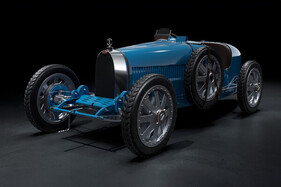
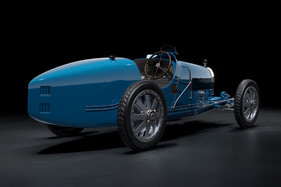


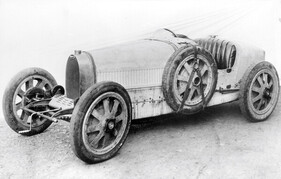
The Bugatti Type 35 was unrivaled when it was launched in 1924 and won more than 2,500 race victories during its active period - and its aesthetics, technical sophistication and outstanding handling have lost none of their fascination a century later.

In order to understand the Bugatti Type 35, one must first understand its creator, Ettore Arco Isidoro Bugatti. Without the one, the other could never have existed.

When it made its debut in 1924, the Bugatti Type 35 immediately set new standards. It introduced so many technical innovations and raised the art of motorsport to such a high level that it could only have sprung from a mind that was completely detached from the conventions and constraints of its time.
Ettore Bugatti had such a mind. He was born into a family that had been characterized by art and creativity for generations. His interests were therefore numerous and varied, and his expertise was extensive. Although he had many successful projects to his name before he created the Type 35, Ettore was not a trained engineer.

Perhaps in the case of the Type 35, the lack of classical training was an advantage rather than a hindrance. If he had been trained in traditional automobile construction, Bugatti might not have pushed the boundaries so far with the Type 35. And he would certainly not have created the many beautiful visual details that went hand in hand with the car's technical innovations. The fact that the Bugatti Type 35 broke new ground to such an astonishing and unprecedented extent was immediately apparent to all observers in 1924.

While other cars towered high, the Type 35's body sat low to the ground; while other cars were fitted with wire wheels, the Type 35 rode on cast wheels to reduce unsprung mass, with the brake drum integrated in an equally revolutionary way; and while other cars were fitted with wire wheels, the Type 35 rode on cast wheels to reduce unsprung mass, with the brake drum integrated in an equally revolutionary way.And while on other cars the rear suspension was exposed, on the Type 35 it was cleverly integrated into the elliptical aluminum alloy body. Although the understanding of aerodynamics was still in its infancy at the time, this pioneering approach helped to further reduce body drag.

Under the body of the open two-seater, every detail was considered: nothing was left to chance and almost everything represented a completely new way of thinking.
The Type 35 debuted with a two-liter in-line engine with eight cylinders and 24 valves, which was later enlarged to 2.3 liters and equipped with a supercharger. The use of a multi-piece crankshaft supported by two roller bearings and three ball bearings enabled the engine to rev up to 6000 rpm and produce 90 hp - an enormous power output for the time.

Ettore Bugatti was aware that superior performance could be achieved not only through additional horsepower, but also through weight reduction. His efforts to make every component as light as possible without compromising functionality or reliability resulted in a vehicle weight of just 750 kg.

Among the numerous measures taken was the development of a new hollow and therefore lightweight front axle with sealed ends. Unlike conventional axles, it did not run "straight" but dipped in the middle to wrap around the chassis and rose at its ends to connect to the wheel hubs.
Thanks to such innovations, both the height and the weight of the vehicle were kept low. Combined with the precise steering and lightweight chassis, which incorporated the engine as a load-bearing element, the Type 35 enabled an unprecedented level of agility, responsiveness and driving pleasure.

Optimally balanced drum brakes and a pressurized fuel tank to optimize fuel flow were further elements developed by Bugatti that enabled drivers to fully exploit the performance of the Type 35 on the road and on the racetrack and successfully defy the pursuers - more than 2500 race victories are the result.

