
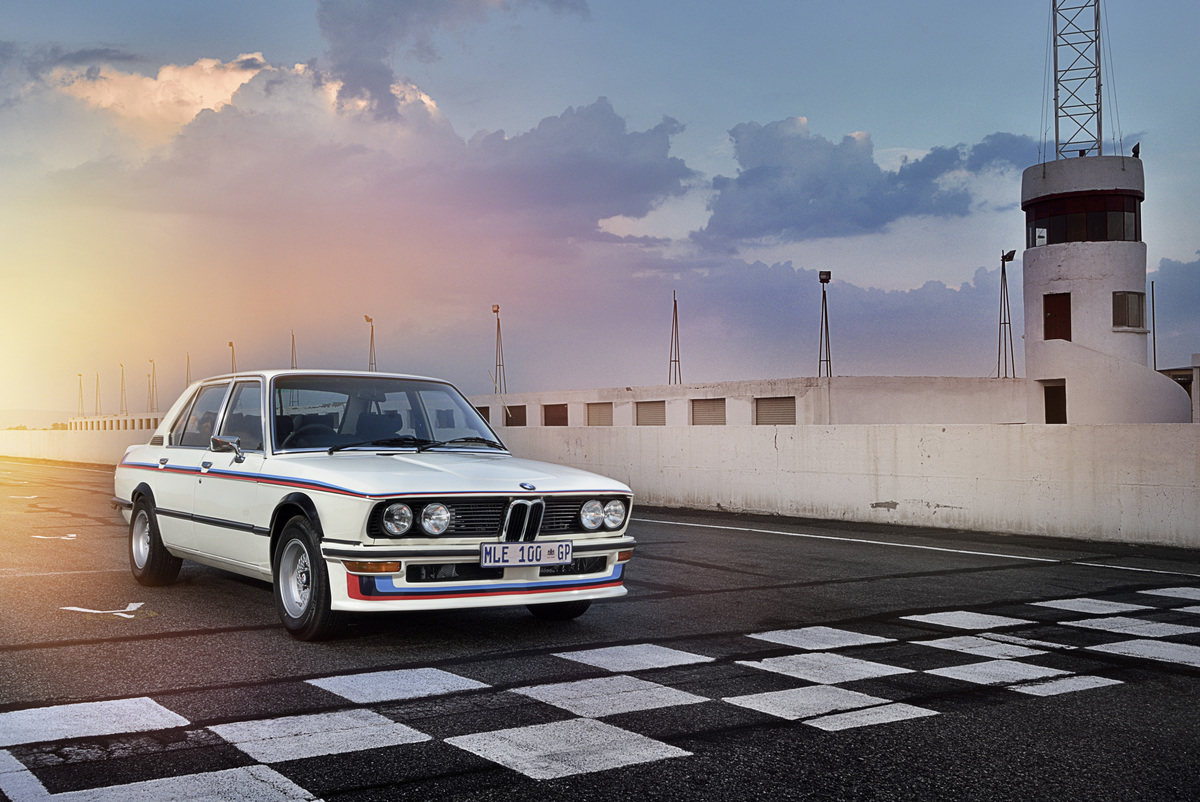


The BMW 530 MLE opened the gates to international racing fame for South Africa. So it is hardly surprising that this model is still much loved today and represents a kind of pioneering symbol. In an extensive restoration, a team of experts helped a special edition of the 530 MLE to regain its former glory. The result is something to be proud of.
Team of classic car experts and former employees
The paintwork was weathered, the technology patchy, but the memory of the BMW 530 MLE from the 1970s had never faded. Reason enough for the classic car specialists from BMW South Africa and the company Custom Restorations to restore from the ground up one of the few surviving homologation vehicles of the once unbeatable racing cars on the racetrack.

Now the BMW 530 MLE shines in new splendor and offers more reason than ever to look back on the glorious history of this special edition produced exclusively at the South African BMW plant in Rosslyn for the local market. The work on the particularly sporty BMW 5 Series was not only an encounter with the past for the classic car experts from BMW South Africa. Four former, now retired employees of the BMW Rosslyn plant, who were involved in the production of the BMW 530 MLE more than 40 years ago, were also involved in the restoration.

The beginning of the racing commitment in South Africa
The special status of the BMW 530 MLE is not least due to the fact that it marked the beginning of the brand's involvement in motor racing in South Africa. BMW had already opened its first production plant outside Germany in Rosslyn near Pretoria in 1973. Soon afterwards, sporting ambition also awoke there. In the mid-1970s, BMW Motorsport GmbH, under the management of Jochen Neerpasch, therefore prepared two racing cars based on the first-generation BMW 5 Series for participation in the Modified Production Series. For the purpose of homologation for the South African touring car competition, a road version was also developed, which was given the name Motorsport Limited Edition, or MLE for short.

The special edition was powered by a 3.0-liter inline six-cylinder engine with 147 kW/200 hp and a maximum torque of 277 Nm. This enabled the BMW 530 MLE to accelerate from zero to 100 km/h in 9.3 seconds and reach a top speed of 208 km/h. Targeted lightweight construction measures, which included the omission of air conditioning and electrically operated windows as well as hand-perforated pedals and body panels for the interior and weight-optimized light-alloy wheels, also contributed to the saloon's racing flair.

15 race wins in a row
In 1976, 110 units of this type were built; the following year, 117 BMW 530 MLEs produced exclusively for the South African market left the Rosslyn plant. The exceptionally dynamic yet fully suitable for everyday use sedan quickly attracted the attention of sports car enthusiasts between Cape Town, Pretoria and Durban, especially as the BMW 530 MLE caused a sensation on the race track right from the start. It won 15 consecutive races as early as 1976.

The high-speed saloon won the championship title in the Modified Production Series three times in a row. The BMW 530 MLE remained active on South Africa's racetracks until 1985 and became the most successful competition car ever developed on the basis of a BMW 5 Series.
BMW paved the way to success for South Africa
"At the time, the BMW 530 MLE showed how competitive sporting events could serve as an ideal setting to impress the public with the performance of new models," says Tim Abbott, CEO of BMW Group South Africa and sub-Saharan Africa. "It paved the way for BMW in South Africa to be recognized as a sporting brand and a serious motorsport player."

Extensive restoration of a special edition
The now restored BMW 530 MLE has a special history closely linked to motor racing. It was acquired as the 100th example of the special edition and belonged to Peter Kaye-Eddie, former racing driver and team manager for the BMW 530 MLE used in the Modified Production Series. With almost completely preserved substance and a matching engine and chassis number, the vehicle formed the ideal basis for a restoration that was brought to a successful conclusion within around a year, not only with sound expertise and modern technology, but also with great attention to detail and the knowledge of its former builder.

