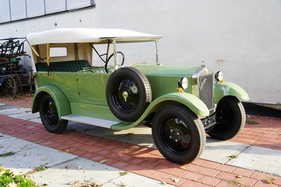


On August 25, 2026, a road trip unlike any other will begin: Robert Krickl Jr. and Sr. plan to drive from St. Pölten in Lower Austria to Monte Carlo. A full 1,000 kilometers in a 1925 Avis Type 2/3. Not just any old car, but a vehicle from the Avis brand, which was founded in 1921 and began building airplanes and cars in Brunn am Gebirge in 1924.
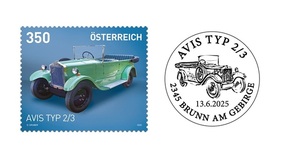
Five years ago, Krick Jr. discovered the last known example of this model in a barn—the “find of my life,” as the local historian puts it. With scientific guidance, the car was restored at Craftlab in Pitten (AT) and even made it onto the Austrian Post’s annual special stamp in the “Auto” series in 2025. At the end of the year, the Avis Type 2/3 was exhibited at the Museum of History in Lower Austria—in place of a former state limousine.
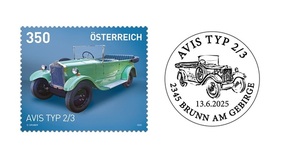
This Avis is the most commonly produced 4/20 PS small car with a boxer engine, of which there were several variants. Since production was discontinued as early as 1928, it must have been produced in only a small series. The few surviving examples, with their mixed construction, fell victim to the ravages of time amid the turmoil of World War I. In that sense, this Avis is a stroke of historical luck.
As was the fashion at the time, Avis sought to succeed in a race and thereby attract buyers. That is why, on January 19, 1926, the company sent a factory team to the Monte Carlo Rally, which had been held every winter since 1911. The Austrians were well aware that their small car was facing a David-versus-Goliath battle. The English, in particular, were developing one monster record-breaking car after another at that time.
But the showdown never actually took place: meter-high snow on the roads and Alpine passes made a trip all the way to Monaco impossible. In the end, it was nothing more than a minor achievement for having covered that distance in winter; no Avis cars were seen in the Principality in the years that followed, as the Avis brand quickly disappeared.
The failed trip to Monaco inspired Avis explorer Robert Krick to repeat the journey once more. Through four countries, across the Alps to the Mediterranean—but without snow. Although neither the original nor the historic Monte Carlo Rally takes place in the summer, the goal is to fly the flag in Monaco for the sake of tradition.

“Postponed is not canceled: we’re keeping our word and will settle our ‘national debt’—we promised that an ‘Avis’ would drive in Monte Carlo, and an ‘Avis’ will drive in Monte Carlo—albeit 100 years later than planned, but better late than never,” says Robert Krickl, project initiator, scientist, and owner of the Avis Type 2/3, which he likes to call a “rolling piece of history.”
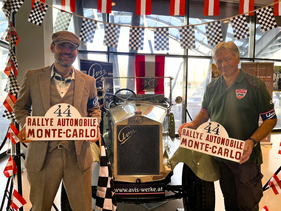
The first driver behind the wheel on the historic tour: Robert Krickl Sr., engineer, president of the umbrella organization for historic vehicles, and professional organizer of classic car rallies. The second driver is his son, who even had the sign with the original start number “44” reconstructed.

Krickl Junior explains why they’re taking on this project: “Because of its radiant symbolic power: The car and the initiative demonstrate that contemporary history is valuable, that we must not forget to preserve seemingly mundane things for posterity, and, last but not least, that it’s worth taking a look back at history to realize that, despite unfavorable external circumstances, one can make a difference in the world.”