




This car is a statement: the Auto Union Lucca stands for the technical innovation of the four rings in the 1930s. Audi Tradition has rebuilt the spectacular record-breaking car and presented it - nomen est omen - for the first time at the beginning of May in the Italian city of Lucca. On February 15, 1935, the car set a much-noticed speed record over the mile with a calculated average speed of 320.267 km/h on a straight section of the Autostrada near Lucca and achieved a top speed of 326.975 km/h. The car was completed in the spring of 2026. Completed in spring 2026, the racing saloon enriches the collection of legendary Silver Arrows in AUDI AG's historic vehicle collection.
The 1930s were characterized by an international race for records. Speed is far more than just the mundane result of a measurement - Grand Prix races and constantly newly achieved speed records are followed and celebrated almost obsessively by the media and the public. In Germany, a competition between brands, drivers and technology ensued over the years: Stern versus four rings, Caracciola and von Brauchitsch versus Stuck and Rosemeyer, front-engine versus mid-engine. Auto Union AG, founded in 1932 as a merger of Audi, DKW, Horch and Wanderer, entered its first Grand Prix season of the new 750-kilogram formula in 1934 with the 295 hp Auto Union Type A. And in the same year, it sets new speed records: On March 6, the Auto Union achieved three world records, and on October 20, five more - all set by experienced racing driver and hillclimb specialist Hans Stuck.

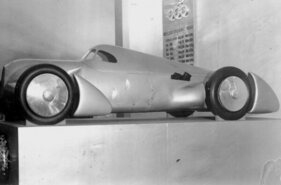
Daimler-Benz AG is in a tight spot - and follows up: Rudolf Caracciola equaled Stuck's record and, at the end of October 1934, set several international records on the highway near Gyón in Hungary in a special record-breaking car, including an average speed of 316.592 km/h with a flying start over the mile. The aim is to beat this value. The Auto Union racing engineers and mechanics were in for a "hot" winter. They were already planning the next record runs for the beginning of 1935, for which the racing car had to be further developed. Based on the vehicle used for the records in October, the experts first develop a wind tunnel model.
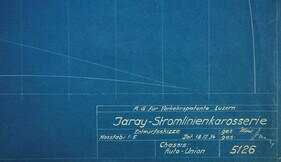
This is subjected to various measurements - first as an open version, then as a flow-optimized version with a closed cockpit. The Auto Union racing department incorporates the knowledge gained in the wind tunnel at the German Aviation Research Institute in Berlin-Adlershof into the design of the later record-breaking car, "a first in European racing car construction", as "Automobilrevue" notes at the time.
The body was finely sanded and coated with clear varnish, and the spoked wheels were fitted with windshield covers. Two circular openings at the rear serve as fresh air intakes for the carburetor system. The exhaust pipes are routed upwards at the sides and bundled in two outlets on each side. The car was already equipped with a 16-cylinder engine of the 1935 season with an increased displacement of around 5 liters, although this early version of the unit with its 343 hp did not quite reach the performance level of 375 hp achieved later in 1935. The frame and chassis still corresponded to the racing car of the 1934 season, whereas the elongated, flow-optimized silhouette with the fin-shaped rear end in conjunction with the teardrop-shaped wheel arches already stood out clearly from its racing siblings of the previous season. At the same time, the first and foremost purely technical and functional measures create an aesthetic of speed that makes the racing saloon - as the press calls the high-speed car - unique.

Record route: from Gyón in Hungary via Milan to Lucca
After just a few weeks of development work, the finished car was already in the workshop of the Auto Union racing department in Zwickau in December 1934. The first test drives on the Avus in Berlin followed on December 17 and the decision was made at the end of January 1935: The record chase was to take place in Hungary - on the very track near Gyón where Caracciola had achieved the class record over the mile with a flying start in a Mercedes the previous year. Auto Union made all the arrangements with the Hungarian Automobile Club; the powerful record aspirant arrived in Budapest on February 4, 1935. The following day, the team set off for the track some 40 kilometers to the south; the weather deteriorated rapidly. Nevertheless, two test drives were carried out on February 5. During the second run, the exhaust burns out and the tests have to be interrupted. The race organizers decide to continue the record attempts south of Milan due to the capricious weather conditions. But the conditions there were not ideal either: The targeted route is covered in snow and so the Auto Union heads even further south. A suitable route is finally found on the Florence-Viareggio road between Pescia and Altopascio near the city of Lucca.
This section of the Autostrada is ideal for record attempts - well leveled, with a grippy surface, eight meters wide and almost straight as an arrow over a length of around five kilometers. The first test drives began on February 14, 1935, with various vehicle configurations being tried out, details such as the radiator opening and wheel trim varied and data evaluated. At 9 o'clock the next morning, the car rolls onto the track near Lucca again - Hans Stuck at the wheel. And word had spread that something big could be in the offing here. The "Automobilrevue" wrote: "The new single-seater Auto Union racing car, all in light alloy streamlined bodywork, caused a great stir among the numerous personalities from the Italian sporting world who traveled to Lucca for the event. (...) Thousands of spectators followed the test drives." Official timekeepers were also on hand: the independent chronometers, as they were called at the time, measured using ultra-modern chronometers with electrically triggered photocells. Stuck makes several attempts, and adjustments are made to the racing sedan in between. With a closed radiator front - the radiator grille was covered except for a residual opening - and further optimizations in terms of aerodynamics, the ambitious project finally succeeded: On two averaged runs, the record over the mile with a flying start in International Class C is achieved with an average speed of 320.267 km/h and the measuring devices also record a speed of 320.267 km/h on one section of the return journey.In addition, the measuring devices record just 11.01 seconds on a section of the return journey in "Fahrt 3 Stuck II"; this corresponds to a brilliant speed over the kilometer of exactly 326.975 km/h - making the car the "fastest road racing car in the world".

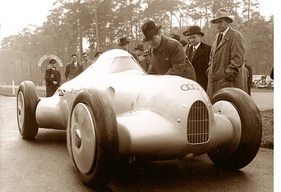
The speed spectacle offered by the imposing car and its daring driver Hans Stuck near Lucca was, of course, to be broadcast to the world immediately in order to give Auto Union a further lead in the closely timed prestige duel with the Silver Arrows from Stuttgart. Almost at the same time as the successful record-breaking drive in Lucca, an almost identical version of the record-breaking car will therefore be presented at the International Motor Show in Berlin (February 14 to 24). The striking difference to the Lucca car is the larger radiator grille. As the record over the mile had not yet been officially recognized at this time, the advertising poster produced for the show presented the Lucca car as the "fastest road racing car in the world", including the top speed of 326.975 km/h, alongside a list of the world and class records achieved by all Auto Union brands up to that point.
Use on the race track: end of May 1935 on the Avus in Berlin
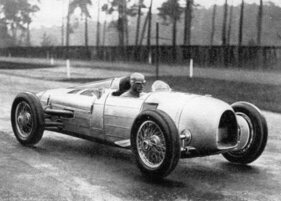
As success in motorsport must always be confirmed anew, the racing department in Zwickau immediately evaluates the data obtained in Lucca, develops it further and optimizes the vehicle. Only a few months after the record in Italy, the next appearance of the now modified Lucca car followed, this time in the company of its Berlin brother: the fifth international Avus race took place in Berlin on May 26, 1935. As it is a formula-free race and the weight restriction of 750 kg therefore does not apply, Auto Union enters the two heavier racing saloons alongside two Grand Prix cars; the starting weight (including driver) is documented as 1,030 kg. Hans Stuck and the Italian Achille Varzi drove the Grand Prix racers; the driver of the former Lucca car with starting number #3 was Prince Hermann zu Leiningen, who had been a member of the Auto Union team since the beginning of 1934. Bernd Rosemeyer, a young driver newly signed up for the 1935 season, drives the second racing saloon with the number #4 - it was at the trade fair in Berlin and was fitted with a larger radiator grille for the Avus race.

Rosemeyer reaches an impressive 290 km/h in practice and is therefore on the front row of the grid alongside Stuck in the first qualifying race. But then the right rear tire bursts when accelerating out of the north bend. Rosemeyer is able to catch the car and rolls to the side of the track; his very first outing for Auto Union in a circuit race is over after a short time. Prinz zu Leiningen and his racing saloon, the technically enhanced Lucca record car, start from row two in the second heat. Next to him is Mercedes driver Rudolf Caracciola in the #5 car, with Achille Varzi in the #2 and Manfred von Brauchitsch in the #6. The battle for the top positions is initially between the two Auto Union cars and Rudolf Caracciola. However, Auto Union ultimately had to leave the winner's circle to the competitors from Stuttgart on this race weekend: Hermann zu Leiningen's racing sedan cannot withstand the constant stress and so he also retires his car in the preliminary race due to cooling water pipe damage.

Auto Union Lucca demonstrates striving for "higher, faster, further"
The 1930s are a perfect example of how fast-paced motorsport is and how many highs and lows, successes and dramas it has to offer: In mid-February 1935, the Lucca car sets a speed record in Italy, at the end of May at the Avus race in Berlin, both racing sedans fail to finish. At the same time, both the Auto Union Lucca and its Avus variants provided the Auto Union racing team with valuable insights at the time and played an important role in the motorsport history of the four rings of the 1930s, as Stefan Trauf, Head of Audi Tradition, explains: "Audi has not yet had an Auto Union racing or record-breaking car from the early Grand Prix era in its historic vehicle collection. With the Auto Union Lucca, we are adding a highly emotional member of the Silver Arrow family to the AUDI AG collection. The Lucca record-breaking car is a particularly impressive example of the role of technology: setting new standards, being a pioneer and constantly pushing the boundaries of what is possible. It demonstrates the technical innovation of the four rings and the Vorsprung durch Technik of the 1930s. The Auto Union Lucca is a technical masterpiece, trimmed for high speed and maximum performance and at the same time a beautiful car - for me, this combination is unique."

Audi had the Auto Union Lucca rebuilt by Crosthwaite & Gardiner using historical photos and numerous other archive documents. The English restoration specialists completed the project in early 2026 after a good three years of construction. All of the components were made by hand especially for the model; in addition to the technical implementation, the production of the streamlined add-on parts such as the cockpit pulpit or the streamlined long tail was particularly complex. They fulfill their purpose: cW 0.43 - the drag coefficient of the record-breaking car measured in the Audi wind tunnel at the end of April. The project manager for the construction of the Auto Union Lucca was Timo Witt. He has been responsible for the historic vehicle collection at Audi Tradition since 2015 and previously worked as an engineer in motorsport for more than ten years. Witt: "I am impressed by the dynamism and speed with which they reacted to the competition even back then, both in the technical area, in vehicle development and in organizational terms: The weather changes and, without further ado, the whole team quickly moves on. Without this great flexibility and the ability to adapt to new situations at lightning speed, the record-breaking drive in Lucca would not have been possible." Timo Witt also explains exciting details about the vehicle construction: "Of course, we recreated the car as authentically as possible, but at the same time issues such as the longevity of the car or the highest possible efficiency in the implementation of the project were important to us." He illustrates this with two examples: Audi Tradition uses the 16-cylinder engine of the Auto Union Type C in the Lucca car because its 6-liter engine is externally indistinguishable from a 5-liter engine, making the power units interchangeable within the Silver Arrow family. In addition, the Auto Union Lucca is equipped with a number of modifications, some of which were already implemented at the Avus race in Berlin in May 1935, such as the ventilation. Timo Witt: "We have adopted these changes in the Auto Union Lucca because the vehicle would otherwise be thermally overloaded for our upcoming demonstration runs." The Auto Union Lucca can be converted into an Avus car with minor modifications to the radiator and cladding.
Whether in the Lucca or Avus configuration, the Auto Union Lucca embodies the highly emotive combination of maximum performance and elegant lines like no other in the Auto Union racing and record-breaking car family. Following its unveiling in Lucca, Italy, the racing sedan will make its first dynamic public appearance at the Festival of Speed from July 9 to 12. Goodwood - the beauty of speed is coming... !
