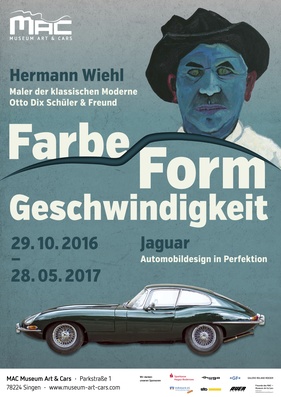
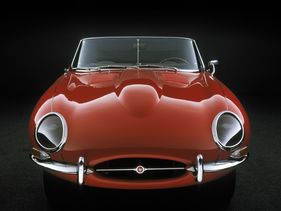
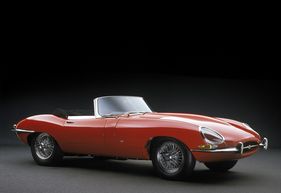
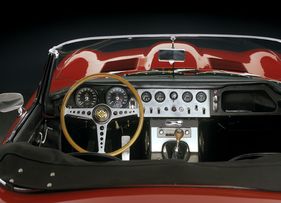
With the new exhibition "Color, Form, Speed", the MAC Museum Art & Cars in Singen Hohentwiel shows that automobiles and art, with their analogies, are witnesses of their time. Since October 29, 2016, visitors have been able to view extraordinary models of the design icon Jaguar in conjunction with the classic modernist painter Hermann Wiehl. Together, they reflect the zeitgeist of the 50s and 60s.

The evolution of Jaguar style
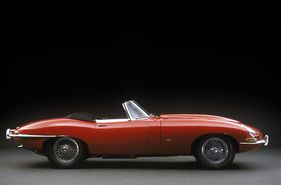
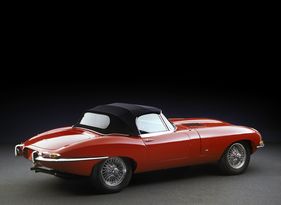
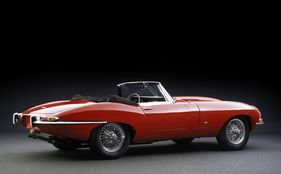
A special highlight is the long-lost Jaguar Lister Knobbly racing car. It was rediscovered by chance in a barn in the USA and is now on display, faithfully restored to its original condition. Next to it is one of the most authentic Jaguar E-Types still in existence today. The E-Type with its long front end was the style icon of the 1960s and was even elevated to the status of a work of art by the Museum of Modern Arts in New York. With these and other selected models, the style development of the car brand over the years becomes tangible.

Artists of classical modernism
Hermann Wiehl was an expert on many forms of 20th century design. The MAC Museum Art & Cars is exhibiting Wiehl's famous "Blue Self-Portrait" and a very rarely shown self-portrait by Otto Dix. Hermann Wiehl combines expressionist colors and cubist forms in his works to create exciting compositions. The Black Forest artist initially oriented himself towards naturalistic depictions and then became increasingly abstract due to the influence of Max Ackermann. By blending these different styles, he created his own language of form and color, which also reflected the changing understanding of art at the time.

The exhibition concept of art and automobile in this form is by no means commonplace. The exhibits are staged in the architecturally impressive rooms of the museum, which has also been compared to the Guggenheim Museum in Bilbao.
The exhibition can be visited in Singen until May 28, 2017. Further information can be found on the official website.