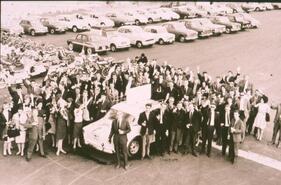








The plant in Belgium's third largest city started production in November 1965. Until then, Volvo had manufactured its vehicles exclusively in Sweden. Now the company wanted to take the step towards international expansion with the new location in the newly founded European Economic Community.
Initially, production was limited exclusively to the final assembly of vehicles. The chassis continued to be manufactured in Sweden and shipped to Belgium in large crates. At the start of production, Volvo Cars Gent employed 250 people and produced 14,000 cars in the first year.
Further development
The plant was continuously expanded in the 1970s. In addition to a body shop, a paint shop was set up, turning the site into a fully functional production plant employing several thousand people. Capacity increased to 70,000 vehicles per year, which was achieved both through the introduction of multi-shift operation and the use of production robots. In addition, the production of a wide variety of parts and components was transferred directly to the plant.

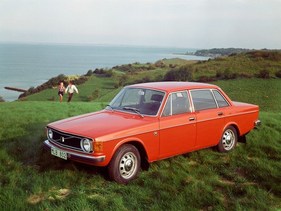
The first model to be produced in Ghent was the Volvo Amazon, followed shortly afterwards by the elegant Volvo 144 saloon. In the 1970s and 1980s, the 240/260 and 740/760 models were also produced here, reinforcing the brand's image as an edgy, versatile and, above all, safe car. The 850 series in the 1990s was followed by the S60 saloon and the V70 estate in the early 2000s. The Volvo C30, V40 and XC60 also rolled off the production line here.

The plant today
In recent years, the plant in Ghent has developed into an important pillar for the implementation of Volvo Cars' electrification strategy. In addition to the hybrid models Volvo XC40 and the Volvo V60, the all-electric models Volvo EX40, Volvo EC40 and Volvo EX30 are currently produced here. Volvo Cars Ghent was the first Volvo plant to put a fully integrated battery assembly line into operation. As a result, the site has developed into a competence center for other plants and sets standards in terms of process optimization and efficiency.
For the launch of the Volvo EX30, Volvo Cars invested around 200 million euros in the comprehensive modernization of the site. In addition to preparing for a completely new vehicle platform, almost 600 new or completely overhauled robots were integrated, the battery hall was expanded, a new production line for doors and a new assembly line for battery packs were set up. Today, the plant in Ghent is the only fully-fledged automobile production facility in Belgium. Around 200,000 cars are produced here every year.