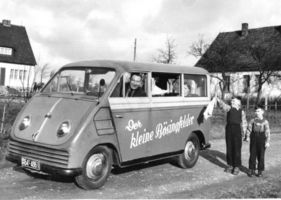
Station wagons from the company's history are the focus of Audi Tradition's appearance at this year's Techno Classica in Essen. From Wednesday, April 10 to Sunday, April 14, 2019, the world's largest classic car trade fair will provide the perfect stage for seven automotive treasures from Audi's history. The Ingolstadt-based company will be presenting itself under the motto "Space wonders - from the Schnellaster to the Avant" and will also be celebrating the 70th anniversary of the Ingolstadt site.
New start after the end of the war
At the end of the Second World War, Auto Union seemed to be dead. Expropriated by the Soviet occupying power in its home state of Saxony and removed from the Chemnitz commercial register in 1948, the company no longer really had a future. However, a future was to open up in the American occupation zone. Founded from very small beginnings in 1949 in old military buildings in Ingolstadt in Upper Bavaria, Auto Union GmbH developed into today's Audi AG within 70 years.

The first products in 1949 were the DKW Schnellaster and the DKW RT 125 W motorcycle. Both will be on display at the Audi stand in Hall 4 in Essen. The DKW Schnellaster F89 L was the first automobile produced in Ingolstadt. The design, with its pioneering front-wheel steering construction, was still based on proven pre-war technology with front-wheel drive and a two-cylinder, two-stroke engine. The reliable and uncomplicated delivery van was offered in a wide variety of body variants. These ranged from a flatbed or box van to a livestock transporter and a luxury bus.
The Schnellaster was a typical child of its time. Born out of the hardship of the early post-war years, this automobile was tailored to the needs of the reconstruction period. The new DKW RT 125 W motorcycle, "W" for "West", was basically an old acquaintance, as the RT 125 had already been developed in 1939 at the former DKW factory in Zschopau. Apart from the slightly rounder shape of the tank, it corresponded to the pre-war model with trapezoidal fork, rubber band suspension, two-stroke engine with 4.75 hp and foot-operated three-speed gearbox. The DKW RT 125 made a massive contribution to the solid development of Auto Union after the war and the flight from Saxony.

New plant in Düsseldorf
Another witness to the difficult post-war period is the DKW Meisterklasse Universal, Type F89 S from 1951. After there was no further space available for car production in Ingolstadt, Auto Union opened another plant in Düsseldorf in 1950. Of the original four brands, only DKW with its simple and robust two-stroke engines was revived due to technical feasibility. The first post-war DKW passenger car was a combination of the technology of the 1939 DKW F 8 with the streamlined body of the three-cylinder DKW F 9 planned for 1940, from which the name DKW F 89 was derived.

In addition to the Audi 80 Variant from 1967 and an Audi 100 Avant GLS (1978), two truly exotic cars can also be seen at the Techno Classica stand of Audi Tradition.

The DKW Imosa F 1000 D was a small van of which over 110,000 units were built in Spain between 1960 and 1975. The Audi Foxwagon was only available in the USA. The exhibit from 1978 is based on the first Audi 80. For the North American market, where the Audi 80 was offered under the name "Audi Fox", a station wagon version of the first Audi 80 was created at the Ingolstadt plant using body parts from the VW Passat - which was called the "Foxwagon" in the USA and sold well.
Further information about Techno-Classica Essen can be found on its website.