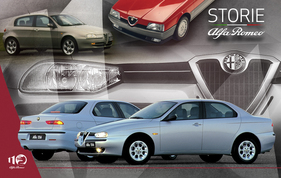


The eighth episode of the internet series "Storie Alfa Romeo" looks back at one of the most successful models in the brand's history: more than 680,000 Alfa Romeo 156s were sold between 1997 and 2005. In 1998, the Alfa Romeo 156 was also named "Car of the Year". The Alfa Romeo 156 was an extraordinary combination of sportiness, innovation and history - and thus perfectly embodied the brand's DNA. Experimental body colors in the tradition of the Alfa Romeo Montreal and the Carabo concept car. Innovative technology also made the Alfa Romeo 156 a milestone in motorsport - within ten years, the racing version won 13 international titles.

Extremely successful commercially
Almost a million people took advantage of an "open day" at Alfa Romeo dealerships to experience the premiere of a groundbreaking new sedan - the Alfa Romeo 156 - in the late fall of 1997, and what they saw was convincing. Over 100,000 orders were received within a few months. By the end of production in 2005, more than 680,000 units had been built. This figure makes the Alfa Romeo 156 one of the most commercially successful models in the brand's 110-year history.
The Alfa Romeo 156 was presented to the international press at the Centro Cultural de Belém in the Portuguese capital Lisbon. The message was clear: the Alfa Romeo 156 combines dynamic style with a perfect balance of performance and sporty handling. The new saloon was 100% in line with Alfa Romeo's philosophy. The specifications for the developers were very ambitious and the result was one of the best front-wheel drive mid-size sedans.
Alfa Romeo and front-wheel drive
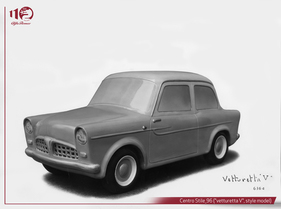
The first cars were built with rear-wheel drive, but from the very beginning the concept of front-wheel drive also fascinated the designers. This idea also buzzed around the Alfa Romeo development department in the period after the Second World War. Orazio Satta Puliga and Giuseppe Busso were convinced of the potential of this technology and launched a development program with the aim of making the Alfa Romeo 1900 mid-size saloon the brand's first vehicle with front-wheel drive.
The decision was ultimately made in a different direction. However, the idea of a small car with front-wheel drive was already born at Alfa Romeo in the early 1950s, which led to studies on various types of drivetrains in the development department. However, none of these projects reached the production phase.
A plant built for a single model
Nevertheless, front-wheel drive remained an issue. At the end of the 1960s, Alfa Romeo decided to expand its range with a small car below the Giulietta. Production figures and sales were to be increased with an additional compact model. Alfa Romeo entrusted the entire project to Rudolf Hruska. The engineer from Austria had previously been responsible for various versions of the Giulietta. Hruska's task was unique: not only was he to design a new model, but also the factory. The result was the Alfasud, Alfa Romeo's first vehicle with front-wheel drive.

The Alfasud was created both on a white sheet of paper and on a green field. It was one of those rare occasions when a car factory was designed and built solely for the production of a specific model. The vehicle in question was not subject to any technical restrictions, but had to meet predefined product targets. "The Alfasud obviously had to have front-wheel drive. And it had to be a luxurious small car, a five-seater with a very large trunk," Hruska described the project a few years later.
The 1.2-liter boxer engine with two horizontally opposed cylinders was preferred to the conventional four-cylinder in-line engine, as it was lower and better suited to the aerodynamic profile of the body. The unprecedented hatchback body improved access to the trunk. Because the fuel tank was positioned under instead of behind the rear seat bench, a volume of 400 liters remained for the trunk. This innovative, functional and also safe approach was also groundbreaking for other manufacturers.
Debut by Giugiaro
The body design of the Alfasud was the first important commission for Giorgetto Giugiaro. The young stylist invented the characteristic hatchback to take account of the restrictions on size and space. He created the link to the aerodynamic front with a clear and streamlined side line. Giugiaro's design proved to be a great commercial success.

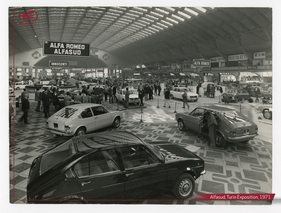
Production of the Alfasud began in 1972, the same year in which the number of Alfa Romeos ever produced passed the one million mark. The Alfasud alone was to almost double this figure. Between 1972 and 1984, 900,925 units of the small car were produced, not including the Sprint body version. To this day, the Alfasud is one of the best-selling Alfa Romeos of all time.
From rationalization to brand identity
Since 1933, Alfa Romeo had been owned by the Italian state holding company IRI (Istituto per la Ricostruzione Industriale), which sold the brand to the Fiat Group in 1986. As with almost all industrial integration processes, the first years under new ownership were mainly devoted to rationalizing the production and supply chains.
In the 1980s, the overriding theme for car manufacturers was "creating synergies". Manufacturing processes and products were increasingly standardized. Many components were shared across several models for cost reasons. Designers were obliged to adhere to strict requirements. Requirements, such as using the same door shape several times, paralyzed the creativity of the development departments.
This trend towards identical parts was not well received by the public either. Many prospective customers demanded more distinguishable models. As a result, manufacturers relaxed their design rules again, while at the same time the importance of brand identity increased again. This turning point had a strong influence on car design in the transition from the 20th to the 21st century.
Sporty handling, high engine performance, innovation (and style, of course)
For Alfa Romeo, this turnaround meant a return to its origins. The first major step in reviving the brand's uniqueness was the revival of the Alfa Corse racing division. Alfa Romeo had already been involved in motorsport for the first time in 1911, one year after its official foundation. Later, the still young Enzo Ferrari was one of the works drivers.
From 1993, Alfa Corse competed in the German Touring Car Championship (DTM). Works driver Nicola Larini immediately won the title in the Alfa Romeo 155 V6 Ti against strong domestic competition. The Italian won eleven out of twenty races in 1993, including both races on the famous Nordschleife of the Nürburgring.
In addition to sportiness, design was always a focal point of Alfa Romeo's model strategy. The 1987 Alfa Romeo 164, the brand's first front-wheel drive flagship, was designed by Studio Pininfarina. During the same period, however, the role of the in-house Centro Stile Alfa Romeo became increasingly important.

At the Arese plant, also home to the Centro Stile, the technologies, the people and the production process changed. New computerized systems for design and prototyping were introduced. The Centro Stile team was integrated into the design process of vehicle platforms and also participated in technological decisions. The strategy was: what is functional must also be beautiful, and vice versa. Style and function belong together - referred to at Alfa Romeo as "necessary beauty".
Design of an entire model series
The Centro Stile was not only responsible for the design of a single model, but of entire model ranges. In 1995, Alfa Romeo presented the 145 hatchback model, followed a year later by the Alfa Romeo 146 with a short notchback to complement the brand's range in the C-segment. This was followed by the 916 series with the Alfa Romeo GTV coupé and the Alfa Romeo Spider, whose design was developed in collaboration with Pininfarina.

The real turning point was the Alfa Romeo 156, a mid-size sedan with a style that was an extraordinary blend of performance, innovation and historical references. The characteristic Alfa Romeo radiator grille, the scudetto, dominated the design of the front of the vehicle. The striking front fenders radiated power and a firm stance on the road. The roofline and the relationship between glass and metal surfaces resembled a coupé rather than a saloon. This effect was emphasized by the handles of the rear doors, which were integrated almost invisibly into the door frames. The clean flanks emphasized the sleek and dynamic profile of the Alfa Romeo 156. "It seems to move even when it's standing still," commented Walter de Silva, head of the Centro Stile Alfa Romeo at the time.

The color palette of the Alfa Romeo 156 included experimental paint finishes previously seen in similar form on the Carabo concept car (1968) and the Alfa Romeo Montreal (1970). The designers of the Centro Stile found inspiration in the neighboring factory museum, which was housed in the same building as today. Based on the color of the 1938 Alfa Romeo 8C 2900 B on display, they invented the Nuvola Blue multi-coat paint, which makes the car sparkle with a glitter effect.

Distinctive sportiness
The Alfa Romeo 156 was also an exceptional car from a technical point of view. The task for the developers was to realize the concept of "advanced sportiness" by combining performance, lightness and good controllability. This formula has always defined the character of an Alfa Romeo.

To achieve this goal, innovative materials were used in production, including magnesium and steel sheets with different thicknesses, so-called "tailored blanks". The elaborately designed front axle featured so-called Ackermann geometry, which ensured a direct steering feel. Particular care was also taken with the mechanical tuning of the chassis, which guaranteed precise handling.
The Alfa Romeo 156 won over car fans and was the most exciting saloon of an entire era. The racing version also celebrated numerous successes in motorsport. Within ten years, the Alfa Romeo 156 won a total of 13 international titles.
The invention of common-rail direct injection
Six engine variants were offered at the launch of the Alfa Romeo 156. A V6 petrol engine was accompanied by three twin-spark units with dual ignition. This technology, which was first used by Alfa Romeo designer Giuseppe Merosi in 1914, has been the hallmark of a whole series of legendary engines from the brand over the years. In the Alfa Romeo 156, two spark plugs per cylinder were combined with four valves for the first time.
In the mid-1990s, gasoline was the most widely used fuel in Europe. But this rule was about to change - also thanks to Alfa Romeo. The Alfa Romeo 156 was the first production car in the world to use diesel engines with direct injection based on the now widely used common-rail process. The turbo diesel engines, recognizable by the abbreviation JTD, with a displacement of 1.9 or 2.4 liters, amazed experts and the public alike. For the first time, diesel engines offered performance, noise damping and comfort on a par with petrol engines.
Alfa Romeo 156 and Alfa Romeo 147 - the "Cars of the Year"
The Alfa Romeo 156 won hearts around the world. In 1998, it was the brand's first model to win the most important international "Car of the Year" award. In 2000, Alfa Romeo presented the 147 model, which was based on the same technical platform and also shared large parts of the bodywork with its big brother. The Alfa Romeo 147 was also named "Car of the Year" (2001).