


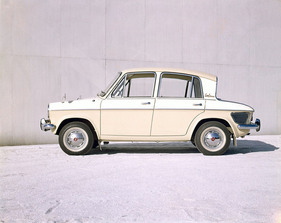


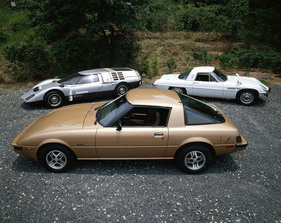
In the fall of 1931, the very first Mazda motor vehicle, the Mazda-Go, went into series production. With this three-wheeled pick-up, company patriarch Jujiro Matsuda completed the transformation of the Toyo Kogyo Group, which was initially founded in Hiroshima in 1920 as a cork manufacturer, into a technologically leading automobile manufacturer.
The first Mazda was a bold alternative to the large American trucks that were ubiquitous in Japan at the time and quickly became a success. A 358 cm3 small but efficient single-cylinder four-stroke engine with an output of just 7 kW/9 hp powered the agile vehicle with a payload of up to 500 kilograms on the flatbed. The Mazda-Go was exported to China as early as 1932 and has enjoyed absolute cult status in Japan as a green panel van since 1936.

In signal green, this Mazda provided a cheerful counterpoint to the dull grey of the Far Eastern street scene; at the same time, the paintwork symbolized the efficiency of the four-speed transmission, which reduced fuel consumption by 20 percent. As an endurance test, company founder Matsuda sent three-wheeled Mazda-Go DC and KC 1936 on a record drive over 2.The pick-ups survived the ordeal, which prompted North American dealers to apply for distribution rights.
First steps abroad
The practical vehicles also made Mazda famous in Europe from the late 1950s, particularly in Greece and Portugal. At the same time, a 30 model van range dominated the national three-wheel commercial vehicle market in Japan. Mazda had already designed its first passenger car, a compact saloon designed for driving pleasure, for mass production in 1940, but the Second World War put paid to the manufacturer's plans.

This made the 1960 antithesis to the Japanese people's car, as promoted by the Ministry of Industry in Tokyo, all the more spectacular: the Mazda R360 Coupé was not a frugal kei-car saloon in three-meter format, but a fully-fledged four-seater in a chic coupé shape and with technical delicacies such as lightweight construction and the first four-stroke engine in the segment. Mazda's first production car established itself as a record-breaking bestseller with a market share of 65 percent in the kei-car segment at times.
The model range was supplemented by compacts such as the Carol, introduced in 1961, and the Familia, which followed in 1963 and was already fighting against the image of the estate car as a commercial vehicle. In this year, Mazda celebrated the delivery of its one millionth vehicle, and the expansion of a network of international production facilities, which would later include Thailand, Mexico, China and the USA, had also begun with the opening of a plant in Korea.

Witty even under pressure
Nevertheless, the Japanese Ministry of Industry MITI no longer saw a place for Mazda in a plan to regulate the Japanese automotive industry. So it was a matter of survival and company president Tsuneji Matsuda, adopted son and successor to Mazda founder Jujiro Matsuda since 1951, felt compelled to once again develop automobiles the likes of which had never been seen before and which this time would finally make Japan known as a leading global industrial nation.
In 1961, Tsuneji Matsuda acquired a license from NSU in Germany to use the rotary piston engine. The Mazda engineers solved all the technical problems of this engine and developed completely new vehicle concepts in which the rotary engine was able to demonstrate its advantages. With legendary models such as the Cosmo Sport 110 S from 1967 as the world's first production car with a two-disc rotary engine, the lightweight R100 coupé from 1968 or the RX-2 to RX-5 models as global brand ambassadors, as well as the wedge-shaped RX-7 sports car from 1978, Mazda was the only manufacturer to bring the rotary engine to millions of units.

Global success
Above all, thanks to this technological lighthouse project, Mazda established itself as a recognized manufacturer of reliable vehicles with unconventional concepts in Europe from 1967, in the USA from 1970 and in Germany from 1972. The conventionally powered models also contributed to this success - by 1972, cumulative Mazda production had already reached five million units. Even for its first export models, the expanding car manufacturer cooperated with the Italian Carrozzeria Bertone, a collaboration that produced pioneering designs such as that of the elegant mid-range Luce series from 1966.
In 1977, it was the first Mazda 323 that adapted the idea of the modern compact class with a large tailgate, but against all expectations was initially available without front-wheel drive. A decision that was particularly well received in America, where the car was affectionately referred to as the "Mazda GLC - Great Little Car".

Four years later, the time was also ripe for front-wheel drive in the Mazda 323, but the model series, which sold over 800,000 units in Germany alone, continued to surprise, for example with the 323 F from 1989 as the first four-door coupé. In 1995, production of the 323 broke the 10 million mark, coinciding with the delivery of the 30 millionth Japanese-made Mazda. The Mazda 626, on the other hand, made headlines in the mid-range segment. "The German from Japan", as the media called the sedan equipped with all-wheel drive and all-wheel steering, was the first Japanese car to win comparative tests against premium models from southern Germany.
At this time, another icon of driving pleasure was also celebrating great success: with the MX-5, Mazda had revived the roadster in 1989, when the segment had already died out. Today, the best-selling representative of its type of all time has long been a production millionaire and is now in its fourth generation.

