


The history of Jeep, and with it the history of all off-road vehicles and SUVs, began - completely unintentionally - when neither even existed. In July 1940, the U.S. military informed American automobile manufacturers of its need for a "light reconnaissance vehicle" to replace the Army motorcycle and modified Ford Model-T vehicles of the time. The Army invited 135 manufacturers to bid for production and developed an extensive list of specifications for the new vehicle to meet. Among other things, the light reconnaissance vehicle was to have the following characteristics:
- at least 275 kilograms payload
- Wheelbase less than 190 centimetres
- Height less than 91 centimetres
- smooth-running engine from four to 80 kilometers per hour
- rectangular body
- four-wheel drive with off-road reduction
- Folding windshield
- Three individual seats
- Driving and dimming headlights
- Unladen weight less than 590 kilograms
- Track width no more than 119 centimeters
- Ground clearance at least 16.5 centimeters
Initially, Willys-Overland and American Bantam Car Manufacturing Company were the only companies to respond to the call. Soon after, however, the Ford Motor Company followed suit, and so the race for the lucrative government contract began.
Each company produced prototypes for testing purposes in the prescribed record time. American Bantam delivered its first field vehicle in just 49 days and the other two manufacturers also delivered to the army in the summer of 1940 and were commissioned to build seventy prototype vehicles.
Willys Quad prevails
It was November 1940 when the army took delivery of these vehicles at the Camp Holabird proving ground in Maryland, USA, a few miles south-east of Baltimore. Each of the three designs was heavier than the 590 kilograms required by the army. The Army quickly realized that this limit could not be met and increased it for the next round of vehicles. Further testing and evaluation led to the selection of Willys as the primary manufacturer of the new vehicles.
As a result, most of the Bantam 40 BRCs and Ford GPs produced were shipped to the UK and Russia as part of a loan and lease program. In the UK, the Ford vehicle became known as the "Blitz Buggy."
"The sun never sets on the mighty Jeep"
A number of modifications and improvements finally allowed the Willys Quad prototype to mature into the Willys MA, and later the MB. But the army and the world came to know it as: the Jeep.

Some saw the name Jeep as a contraction of the letters "GP," the abbreviation for "General Purpose." Others found the origin in "Eugene the Jeep", a very popular fable character from the Popeye comic strip at the time, who could appear anywhere in the world with magical abilities to help people. Others identify the name with the colloquial American expression "jeep" for a jack-of-all-trades who can do anything and somehow manages everything. Whatever the case, the name found its way into the American lexicon and is still used today to describe off-road vehicles. The Jeep itself became a worldwide icon of freedom thanks to its successful use in the Second World War.

Willys used the name "Jeep" as a brand name at the end of the war and had already been working for 18 months on the civilian expansion of the model range to include an off-road vehicle for agriculture, among other things. One of Willys' slogans at this time was: "The Sun Never Sets on the Mighty Jeep", referring to the world-famous Willys MB, which was in use all over the world.
The first Civilian Jeep
While Ford ceased production after the end of the war, Willys-Overland produced the first Civilian Jeep (CJ), the CJ-2A, in 1945. At first glance, the CJ can be recognized by its only seven air vents, which are still a Jeep brand feature today. The CJ-A2 was produced for four years, after which numerous improved CJ models followed.

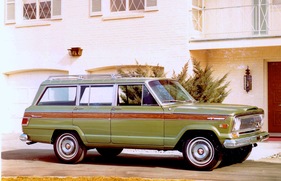
In 1953, Willys-Overland merged with the Kaiser-Frazer Corporation, which bought shares for around 63 million dollars. From then on, Willys-Overland was called Willys Motor Company and began extensive research and development to expand the Jeep product range. And as early as 1963, Jeep introduced the Jeep Wagoneer, the first automatic transmission in a four-wheel drive vehicle. For this reason alone, the Wagoneer is regarded as a pioneer of the modern SUV.

With the Jeepster Commando, Kaiser-Jeep launched four model versions on the market in 1967: pickup, convertible, roadster and station wagon. However, when American Motors Corporation (AMC) took over the Jeep brand in 1970, the Jeepster model name was dropped again. AMC's first self-designed Jeep and at the same time the first new Jeep station wagon since the Wagoneer was the Cherokee (XJ) - a great success with an ingeniously timeless design.

Wrangler for more comfort
In 1987, the compact 4x4 vehicles were still very much in demand in the growing market and so there was still demand for the practical advantages of the Jeep CJ series, but customers wanted more comfort, as offered by passenger cars. The answer was the end of the CJ series and the introduction of the Jeep Wrangler (YJ).

On August 5, 1987, about a year after the Jeep Wrangler was introduced, Chrysler Corporation purchased AMC and the well-known Jeep brand became part of Chrysler's Jeep/Eagle division. In 1998, Chrysler merged with Daimler, but the two companies separated in 2007. When Chrysler had to file for bankruptcy two years later, Jeep was taken over by Fiat.
For 75 years now, the Jeep brand - which has become a legend thanks to its robust vehicles - has stood for boundless adventure. You can find out more about Jeep's history on the website and get all the important information about the 75th anniversary. Celebrate this historic milestone with Jeep.


