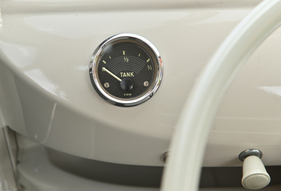
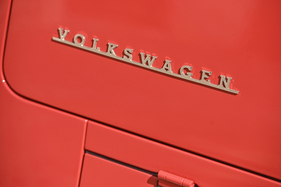
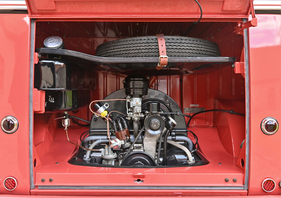
The IAA opens its doors again for the first time since the war. Volkswagen takes this opportunity to present the new vehicles on a breathtaking 1,350m2 stand. Volkswagen rebuilds parts of the assembly line of the Beetle and a previously unprecedented, almost surreal-looking light installation captivates visitors. In the media, the stand was even ennobled as the "Temple of the Volkswagen" and the concept set the tone for future exhibitions.
Sober presentation
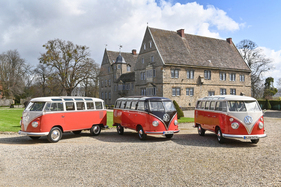
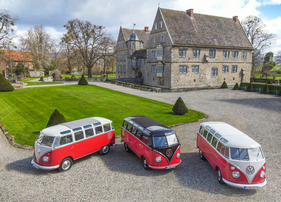
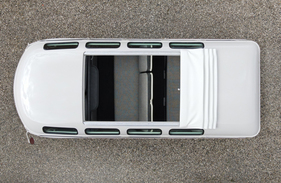
Another highlight is certainly the world premiere of the new people carrier, which Volkswagen simply calls the VW minibus "special version" at the sales launch. The differences to the conventional estate are anything but unadorned: for an initial surcharge of almost DM 3,000, the customer receives an exclusive bouquet of additional equipment. On the outside, the elegant van shines in a harmonious two-tone paint finish with attractive aluminum trim strips and front bumper. The all-round glazing with "skylights", previously only known in the bus sector, turns the 23-window van into a "glass observation bus". There is also a large folding sliding roof to match, which gives passengers in the rear the feeling of sitting in a convertible. You can hardly get closer to nature when traveling.
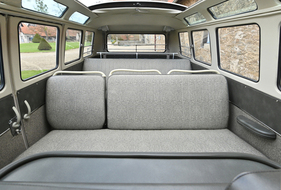
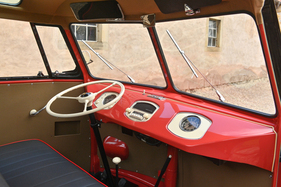
The classy interior with covered side panels and chrome trim surrounds the passengers and creates a luxurious ambience. The right musical entertainment for the small traveling party comes from a tube radio (Auto-Super model) in the dashboard, if desired. This is a genuine luxury coach in miniature format that Volkswagen has created. Fittingly, it is also marketed in the USA as the "Deluxe" microbus. In Germany, however, it was modestly referred to as a "special version" or, from 1952 onwards, as a "special model", which was just as emotionless.
When the customer decides the name of the car
However, the customer himself very quickly came up with a cool name, even if the exact derivation is unfortunately no longer exactly traceable today. Samba could have been derived from "sunroof version with special dashboard" or "special version with special equipment". At the time, it would also not have been far-fetched to refer to the exotic and joyful dance. But it was not only the vernacular that gave the luxury van this name. In the Dutch price list, it was finally officially named "Samba" in 1954.
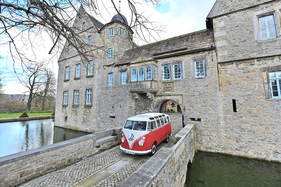
Series production of the VW "Sonderausführung" minibus began on June 27, 1951 and ended in July 1967 after almost 100,000 units had been built. The oldest known "Samba" is privately owned by a collector in the Rhineland. Almost its entire history can be documented. The owner even still has the original invoice. Compared with today's market prices, it seems almost a "gift" at DM 9,025. At that time, however, the average annual wage was only DM 3,5791.
The "Samba" Bullis are more in demand than ever, which is often reflected in the prices. In recent years, models in top condition have repeatedly achieved dizzyingly high prices at auctions. For example, the highest price achieved to date for a "Samba" was USD 302,500 (2017 at the Barrett-Jackson auction house).
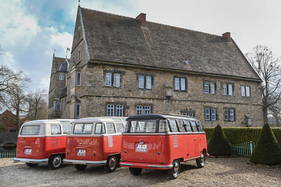
Basically, a traceable history is invaluable for the purchase of such a "special version" - "Samba", because not everything that looks like a "Samba" has been produced as such.
A few facts about the "Samba":
- The paintwork was almost always two-tone. It was only available with trim strips
- The total length of the trim strips is 1,112 cm
- It always had a clock in the dashboard
- With the M 130 option "No skylights and sunroof ex works", these features were omitted
- A Samba from the period June 1951 to early August 1963 is a so-called 23 window - the sliding window in the cab doors is counted as one window
- A Samba from the period August 1963 to July 1967 is a so-called 21 window - the corner windows are omitted due to the new wider tailgate
- The first Samba had only 18 kW/25 hp
- From 1953, the Samba was the first van to also have rear bumpers instead of bumpers
- The Plexiglas corner windows were only replaced by safety glass windows in February 1955 - in Switzerland it was therefore sometimes called the Plexibus