


It's been 70 years since the Porsche number 1 took to the road for the first time. A lot has happened since then, so it's worth taking a look back.
The first sports car
In the spring of 1948, the designs produced under the construction number 356.00.105 are realized. The first sports car under the Porsche name is created. On June 8, the prototype of the Porsche Type 356 with chassis number 356-001 is ready to drive and the Carinthian state government issues an individual license. Equipped as a mid-engined sports car with a VW engine boosted to 35 hp, the "Roadster Gmünd", weighing just 585 kg, reaches a top speed of 135 km/h.

From the very beginning, the sports car manufacturer Porsche used motor racing as a testing platform for new vehicle types. With Herbert Kaes at the wheel, the Porsche Type 356 "No.1" completes a fast demonstration lap at the city race in Innsbruck on July 11.
Cooperation with Volkswagen
In September 1948, Ferry Porsche negotiates a forward-looking contract with Heinrich Nordhoff, the Managing Director and later General Director of Volkswagenwerk GmbH, in Bad Reichenhall.

The Volkswagen factory had previously been taken over by the British military government in June 1945 and had begun automobile production under the management of Major Ivan Hirst. In addition to a future licence fee of DM 5 per VW Beetle produced, Volkswagen now undertakes to supply components for Porsche sports cars and also permits the use of the VW sales organization and service network. In return, Porsche engineers are available to advise the Wolfsburg development department.
The cooperation with Volkswagenwerk GmbH leads to various detailed improvements to the VW Beetle, of which one million units are built by 1955 alone. In 1949, Volkswagenwerk GmbH comes under the trusteeship of the Federal Republic of Germany and the state of Lower Saxony.
Convertibles with Swiss help
The first Type 356 convertible, equipped with a body by Swiss coachbuilder Beutler, is completed in February 1949. Together with the first Type 356 Coupé, Porsche exhibits the sports cars at the Geneva Motor Show on March 17, 1949.

On November 26, 1949, "Porsche Konstruktionen GmbH" is founded in Stuttgart, with Ferry Porsche and his school friend Prof. Dr. Albert Prinzing as managing directors. Only a short time later, Porsche GmbH rents a 600 square meter hall from Stuttgart-Zuffenhausen-based "Karosseriewerke Reutter & Co. GmbH" and begins preparations for the production of the Type 356. In return, Karosseriewerk Reutter receives an order for the production of 500 bodyshells in steel construction.
Series production and the conquest of America
From March 1950, the first Porsche sports cars are produced in Stuttgart-Zuffenhausen and offered at a price of DM 10,200 for the Coupé. Walter Glöckler from Frankfurt becomes the first German Porsche dealer.

Through the mediation of Swiss journalist Max Troesch, Professor Ferdinand Porsche had a decisive meeting with American automobile importer Maximilian E. Hoffman at the Paris Motor Show in October. As a representative of various European automobile brands, Hoffman had his own dealer network on the American East Coast and presented the Porsche 356 in New York that same year.

The company founder and automobile designer Prof. Dr. h.c. Ferdinand Porsche dies on January 30, 1951 at the age of 75. He is laid to rest in the funeral chapel on the family-owned Schüttgut estate in Zell am See

Motorsport successes
Motorsport is becoming increasingly important for the young car manufacturer Porsche. After a success in the International Alpine Rally by Otto Mathé the previous year, Porsche attracted international attention in June 1951 with a class victory in the 24-hour race at Le Mans. Driving a Porsche 356 SL light-alloy coupé, French Porsche importer and general agent Auguste Veuillet wins the 1.1-liter class together with Edmond Mouche.

The class victory achieved by the Paul von Guilleaume/Graf von der Mühle team in the Liège-Rome-Liège long-distance race in August 1951 is also highly regarded.
Marketing steps
The Porsche customer magazine Christophorus, the "Magazine for Friends of Porsche", is published for the first time at the beginning of 1952. The editor-in-chief is the well-known journalist and racing driver Richard von Frankenberg. Stuttgart graphic designer Erich Strenger is responsible for the artistic design.
The Porsche 356 proves its reliability at numerous racing events in 1952 and wins the German Sports Car Championship. A private Glöckler-Porsche wins the International Eifel Race at the Nürburgring at the first attempt, and Veuillet/Mouche set a new class record at the 24 Hours of Le Mans. The Liège-Rome-Liège endurance rally is also dominated by Porsche - five Type 356 cars are among the top ten.

In November 1952, automobile production begins in the new main hall of Plant 2, located near the Reutter company. At the end of the year, the management and the design and sales departments move in. The factory building was designed by Rolf Gutbrod, who had been working as a freelance architect in Stuttgart since 1946 and later achieved international renown.
Racing engine
After successful test bench runs, the four-camshaft engine (Type 547) designed by Porsche engineer Ernst Fuhrmann is presented to the public for the first time at the Paris Motor Show in 1953. In addition to the Porsche Type 550 racing car, the "Fuhrmann engine" is also used in the later Carrera versions of the 356.

In addition to the further development of the sports car types, the Porsche designers are also working on various contract developments. In the fall, the Type 534, a VW prototype with a self-supporting design and shortened wheelbase, is presented to Volkswagen General Director Heinrich Nordhoff. In December, the development of the Type 597 "Jagdwagen" begins, which is designed as a floating all-wheel drive vehicle in response to a Bundeswehr tender. However, for reasons of labor market policy, the public contract is awarded to the automobile and motorcycle manufacturer DKW.
Own trademark
From 1954, the Porsche crest adorns the hood of every Porsche brand vehicle. The trademark was designed by Ferry Porsche and Franz Xaver Reimspieß as early as 1952. At the suggestion of foreign dealers and customers, they combined the Porsche lettering created in 1951 with the Stuttgart "Rössle" and the Württemberg coat of arms.

With almost 500 employees, Porsche KG produces a total of 1853 vehicles. Among them, from September, for the first time 15 sports cars of the 356 Speedster type, a lightweight version specially designed for the US market, which becomes a sales success there with a base price of around 3000 US dollars.
Transition to the 356 A
The Porsche 356 A, equipped with the new 1.6-liter engine series, is exhibited at the International Motor Show in Frankfurt am Main in September 1955. Externally, the technically improved A series can be recognized by the curved panoramic windscreen. The top-of-the-range model, the Porsche 356 A 1500 GS Carrera, is available with a 100 hp racing engine.

Exports played an increasingly important role for Porsche KG and in 1955, with 1514 sports cars exported to North America, almost half of the annual production was sold overseas. Dissatisfaction with the Hoffman Motor Car Company's customer service eventually leads to the secondment of Porsche employee Otto Erich Filius, who sets up the first Porsche office of his own in New York in October and establishes an independent sales network with the Porsche of America Corporation (POAC).
Tractors
On January 1, 1956, "Porsche-Diesel-Motorenbau GmbH Friedrichshafen a.B." is founded in Friedrichshafen on Lake Constance as part of the Mannesmann Group. Through the mediation of Prof. Dr. Albert Prinzing, the Allgaier share capital is taken over by Mannesmann AG and transferred to the newly founded company. In the fall of the same year, production of the tractors and stationary engines now known as Porsche diesels continues in Manzell.
Overall victory at the Targa Florio
On June 10, 1956, Umberto Maglioli crosses the finish line as overall winner of the Targa Florio in a Porsche Type 550 A Spyder. This secured Porsche worldwide recognition once again, as for the first time a driver in the small car class with a displacement of less than two liters managed to beat the much stronger competition from Ferrari and Maserati.

In 1957, Rolf Goetze, Paul Ernst Strähle and Richard von Frankenberg set three international automobile records over 1000 miles, 2000 kilometers and 12 hours on the high-speed track at Monza in a Porsche 356 A Carrera Speedster.
In May, a Porsche 550 A Spyder works car takes part in the last Mille Miglia and wins the class and fifth place overall with Umberto Maglioli. In the GT class up to 1600 cc, Paul Ernst Strähle and Herbert Linge take the win in Strähle's Porsche 356 A Carrera GT.
Goodbye Speedster
The 356 A Convertible D, built by Heilbronn bodywork specialist Drauz, replaces the Porsche 356 A Speedster in August 1958. Externally, the Speedster successor can be recognized above all by its higher, reinforced windscreen and glass side windows.

In Formula 2, the Frenchman Jean Behra defeats the world elite of this racing category in Reims in the Porsche Type 718 RSK, which was actually designed for the sports car class. Further successes finally prompted company boss Ferry Porsche to agree to the development of a new Formula 2 monoposto.
From A to B
At the Frankfurt International Motor Show in September 1959, Porsche presented the 356 B model series - internally known as the "T 5" - a completely revised version of the successful 356 model, of which almost 29,000 had been produced in the meantime. A roadster variant replaced the Convertible D and rounded off the sales range at a lower price. A total of 6450 units are sold in 1959.

The year 1959 was also marked by sporting success: at the 12 Hours of Sebring, the Porsche Type 718 RSK took 3rd, 4th and 5th place overall and won the 1.5 and 2-liter displacement classes.

Victory in the German Grand Prix and second place overall with a class win in the English Tourist Trophy follow in equally superior style. The Liège-Yugoslavia-Liège Rally becomes another victory for the Porsche brand thanks to Paul Ernst Strähle. Heini Walter's German sports car championship title and Targa Florio winner Edgar Barth's European Hillclimb Championship can also be added to the list of successes.
More and more racing successes
Porsche opens a new chapter of success in endurance racing with the Type 718 RS 60 introduced for the 1960 racing season. In addition to overall victories at the Targa Florio (Bonnier/Herrmann) and the 12 Hours of Sebring (Gendebien/Herrmann), the Swiss Heini Walter wins the European Hillclimb Championship for Porsche for the third time in a row.

A Porsche Museum opens in Hall 3 of Porsche Plant 2 in Zuffenhausen in September 1960. In addition to the Sascha racing car designed by Professor Ferdinand Porsche, the Porsche 356 "No.1" and the Type 360 Cisitalia racing car are also on display.
From Formula 2 to Formula 1
Porsche entered Formula 1, limited to 1.5-liter displacement, in 1961 with the four-cylinder Type 718/2 Monoposto. At the Reims, Monza and Watkins Glen Grand Prix, works driver Dan Gurney finished second on the winners' podium. Overall, the first year of Porsche's Formula 1 involvement ends with Dan Gurney's third place in the World Championship, so that the development of a new eight-cylinder engine is accelerated for 1962.

The Porsche 356 B 1600 GS Carrera GTL Abarth, built the previous year in a limited edition of 20 vehicles, is regarded as the sportiest version of the 356 model series. Racing drivers such as Hans Herrmann, Herbert Linge, Edgar Barth and Paul Ernst Strähle won the world championship title for GT cars up to 2000 cc for Porsche in the Abarth GTL in 1961. Other international titles in 1961 include Heini Walter's fourth victory in the European Hillclimb Championship and Hans-Joachim Walter's win in the European Rally Championship.

On October 16, 1961, Ferry Porsche breaks ground on the new building site in Weissach. Among other things, a so-called "skid pad" is planned for the future proving ground, on which the chassis tests that had been carried out at the Malmsheim airfield since 1954 are to take place.
In 1962, Porsche used a racing car specially designed for Formula 1 for the first time, the Type 804. Dan Gurney won the French Grand Prix in Rouen on July 8, 1962, bringing the first Formula 1 victory to Zuffenhausen. Just one week later, Gurney triumphed ahead of Joakim Bonnier on the Solitude racetrack near Stuttgart, giving the air-cooled Porsche Type 804 a double victory in front of its home crowd.
The 901 rolls in
On September 12, 1963, a prototype of the new Porsche 901 is presented for the first time at the International Motor Show in Frankfurt a. M. In addition to a six-cylinder engine with overhead camshafts, the successor to the Porsche 356, which was already legendary at the time, has a chassis with a semi-trailing arm rear axle and a self-supporting body.

Also on display at the IAA stand is the new Porsche 356 C model series, which, in addition to numerous technical improvements, is equipped with a four-disc brake system and is built in series alongside the later 911 until September 1965.

As "Karosseriewerk Reutter & Co. GmbH" shies away from the investment costs associated with the new Type 901, Porsche decides in July to take over the shares of the automotive supplier for a price of around DM 6 million.
On March 1, 1964, Karosseriewerk Reutter is renamed "Karosseriewerk Porsche GmbH". The workforce of almost 1000 employees at the time of the takeover of Reutter is taken over by Porsche KG, taking into account their length of service.

As the first Porsche with a glass-fiber reinforced plastic body, the Porsche Type 904 Carrera GTS Coupé attracts attention with its design by F. A. Porsche as well as its driving performance. The first racing successes were not long in coming and the mid-engined sports car won the Targa Florio (Pucci/Davis) and came second in the 1965 Monte Carlo Rally (Böhringer/Wütherich).

After a series of 13 prototypes of the 901 have been successfully tested, the first series-produced Porsche Type 901 rolls off the production line on September 14. In October, the production-ready model is presented at the Paris Motor Show. As the French manufacturer Peugeot already owned the naming rights to three-digit numbers with a zero in the middle, the Stuttgart-based company was forced to rename the model series: The name "911" was born. At this point, 82 vehicles with the type designation 901 had already been produced. By the end of 1964, around five Porsche 911s were leaving the factory every day.
The 911 economy version 912 and the Targa
In April 1965, the four-cylinder Porsche 912 was introduced when sales demanded a low-cost entry-level model below the Porsche 911 Coupé, which cost DM 21,900. Equipped with the Type 356 SC engine, throttled to 90 hp, the 912 Coupé, which was available at an entry-level price of DM 16,250, quickly became a bestseller.

The world's first safety convertible, the Porsche 911 2.0 Targa, is presented to the public at the Frankfurt Motor Show in September. With its fixed roll bar, removable folding roof and fold-down rear window, the new variant meets the increased safety requirements of American customers. Production of the Porsche 911 Targa starts in December 1966.
Carrera 6 mid-engined sports car
At the 12 Hours of Sebring in 1966, the Type 906 "Carrera 6" competes against a phalanx of American 7-liter racing cars and, in addition to three class victories, also achieves fourth place overall. In the 2-liter sports car class, the racing car proves to be unbeatable and the Targa Florio won by the Müller/Mairesse driver team can be chalked up as another success. At Le Mans, three 906 Carrera 6s equipped with a long-tail are at the start and occupy the top three places in their class.

In the fall of 1966, Porsche presents the Type 911 S, a performance-enhanced version of the sports car. Externally, the 160 hp Porsche can be recognized by its forged Fuchs cloverleaf alloy wheels.
Series winner 910 and further world records
With a fleet of six 910 prototypes, the Swabian racing team took part in the Targa Florio in May 1967. The race ended with a triumphant triple victory for Porsche when Rolf Stommelen and Paul Hawkins crossed the finish line in the eight-cylinder Porsche Type 910-8 ahead of two Type 910-6s. Another Porsche 911 S works car took the 2-liter GT class with Bernard Cahier and Jean-Claude Killy.
The 1000-kilometer race at the Nürburgring on May 28, which Porsche wins for the first time, turns out to be one of the greatest racing successes. After 44 laps, the Type 910 racing cars finish in fourth and sixth place.

The Porsche 911 R presented in October attracts international attention when it sets new world records over 20,000 and 25,000 kilometers as well as over 10,000 miles and 72 and 96 hours in Monza. A Porsche 911 R with Sportomatic transmission had already proven its reliability during the 84-hour "Marathon de la Route" at the Nürburgring.
From road to rally winner
Björn Waldegaard and Lars Helmer in a Porsche 911 T win the overall classification of the 3400-kilometer Sweden Rally in 1968. The Monte Carlo Rally ends in first place overall for Vic Elford and David Stone in a Porsche 911 T, with the Porsche team of Pauli Toivonen and Martti Tiukkanen taking second place.
The Porsche Type 907-8 1968 also delivers a brilliant racing debut with a one-two-three victory in the 24 Hours of Daytona and a first place in the 12 Hours of Sebring.

The Porsche works team wins the 1968 Targa Florio with a hat-trick. The victory of Vic Elford and Umberto Maglioli in the Type 907-8 means that the "Coppa Florio" trophy finally becomes the property of Porsche and is given a place of honor in Ferry Porsche's study.
The super sports car 917
At the Geneva Motor Show in spring 1969, Porsche presents the Type 917, developed under the direction of Ferdinand Piëch, for the first time, of which 25 units are produced as a homologation series by the end of April. With a 4.5-liter twelve-cylinder engine, the 917 is set to replace the successful 907 and 908 models and cause a sensation in the displacement class up to five liters.

In rallying, the Porsche 911 S impressively demonstrates its reliability with a double victory at the Monte Carlo Rally (Waldegaard/Helmer and Larrousse/Perramond).
After the Porsche Type 917 initially fails in its first three outings due to technical defects, the success story of the now legendary Porsche racing sports car continues until 1973 with a victory by Jo Siffert and Kurt Ahrens in the 1000-kilometer race at the Österreichring on August 10.
People's Porsche
With a base price of less than DM 12,000, the VW-Porsche 914 became a bestseller in 1970. A total of 13,312 vehicles of the four-cylinder version with a 1.7-liter engine were sold in 1970 alone. The Porsche 914/6, with a sales price of DM 19,980, is equipped with the 2-liter six-cylinder engine of the Porsche 911 T, which gives it impressive performance.

With nine out of ten possible victories, Porsche once again secures the one-make world championship with the 917 and 908/03 models. The winning streak began at Daytona and continued at Brands Hatch, Monza, Spa, the Nürburgring, the Targa Florio, Le Mans, Watkins Glen and the Österreichring. The performance of Hans Herrmann and Richard Attwood on June 14, 1970 at Le Mans is particularly noteworthy. In the Type 917 from Porsche Salzburg, the two drivers achieved an overall Le Mans victory for the Stuttgart-based automobile brand for the first time.

In the summer of 1971, the development division with the construction, testing and design departments begins to move from the main plant in Zuffenhausen to the new development center in Weissach (EZW). In addition to numerous designs for Volkswagen, projects such as the compact four-cylinder engine for the Spanish car manufacturer Seat and a complete small car for the Soviet state-owned company AvtoVAZ (Lada) were developed in the following years at the facility, also known as the "think tank".
Le Mans and other victories
As in the previous year, the 1971 racing season is dominated by the Porsche 917 and Porsche wins the one-make world championship with eight out of ten race victories. The highlight of the season was another victory at the 24 Hours of Le Mans - this time by Gijs van Lennep and Helmut Marko - in the Porsche 917.

The shareholders of "Dr. Ing. h.c. F. Porsche KG" decide at the beginning of the year to convert the limited partnership into a stock corporation with share capital of DM 50 million at the beginning of the fiscal year on August 1, 1972. Dr. Ferry Porsche takes over as Chairman of the Supervisory Board - Dr. Ernst Fuhrmann becomes Spokesman of the Executive Board of Porsche AG. The conversion from a limited partnership to a stock corporation is preceded by the decision of the Porsche and Piëch families to no longer fill operational management positions with family members.
The surprise success of the Carrera RS
From October 1972 to July 1973, the Porsche 911 Carrera RS 2.7 is a new high-performance sports car in the sales program. Initially launched as a homologation series of 500 units, the "RS", characterized externally by its front and rear spoiler, was in such high demand from customers that Porsche produced a total of 1525 units of the high-performance sports car, which cost at least DM 34,000.

The "RS" makes its first motorsport appearance at the "Tour de Corse" on November 4 and 5, 1972.
Even stronger and the American influence
The most powerful racing sports car of its time, the Porsche Type 917/30 Spyder, makes its racing debut in May 1973. The superiority of the 1100 hp circuit racing car is so obvious that the CanAm series regulations are changed at short notice to exclude the Type 917 from further participation in the 1974 season. In addition to the CanAm title of the Porsche 917/30, a Type 917/10 wins the European Interseries at the same time.

From September 1973, the 911 model series of the so-called G-series is equipped with newly designed safety bumpers, which are to characterize the appearance of the "911" until the appearance of the 964 series in 1989. In addition, standard three-point seat belts and seats with integrated head restraints ensure increased occupant protection.
In 1974, the Porsche works team's involvement in the Safari Rally in Kenya - probably the most difficult rally competition of its time - ended with a second place. As in the previous year, it was only a minor technical defect in 1974 that prevented the Porsche 911 Carrera RS 2.7 from winning.
The turbo for the road
The Porsche 911 Turbo exhibited at the Paris Motor Show in 1974 was a sensation. The car, known internally as the Type 930, can be recognized visually by its widened body, wide tires, front spoiler and rear wing. Delivered from spring 1975, the 911 Turbo is regarded as the fastest production car of its time.

Porsche AG is the first car manufacturer to use hot-dip galvanized sheet metal on both sides as standard with the introduction of the "J-series" 911. Porsche thus sustainably increases the durability of the corrosion-protected bodies and grants a long-term guarantee against rust damage of up to six years.
In August 1975, American racing driver Mark Donohue sets a new world lap record with a Porsche Type 917/30 CanAm Spyder in Talladega, USA. His average speed is 355.86 km/h.
The project called "SAVE" (Rapid Ambulance Prehospital First Aid) for the development of an innovative ambulance is launched in 1975 at the Weissach Development Center. The system consists of a rescue vehicle with a mobile rescue unit and is further developed in various project phases until 1984.
The first transaxle
The Porsche 924, which is added to the sales program at the beginning of 1976, is assembled on a contract basis at "Audi NSU Auto Union AG" in Neckarsulm. Due to high global demand, production increases to 80 vehicles per day by July, so that the entry-level model accounts for 48 percent of vehicle sales by the end of the financial year. By the end of production of the 924 S in 1988, 150,684 vehicles had been built.

With the Type 935 racing car, Porsche responded to the new Group 5 regulations of the one-make world championship in 1976. Based on the Type 930, the 590 hp Type 935 was created in absolute lightweight construction. The Type 935 wins its first works races in Mugello and Vallelunga and, after further successes, the world championship title is awarded to Stuttgart at the end of the year. In addition to the one-make world championship, a world championship for sports cars is also announced for the first time in 1976.

Against this background, the Porsche racing engineers are developing another racing sports car, the Type 936, which is to be launched in parallel with the Type 935 production racing car. The Le Mans participation, already decided during the promising test drives, is rewarded with a victory by Jacky Ickx and Gijs van Lennep. The turbocharged Porsche Type 936 crowns the sports car world championship with the highest possible score. Having reached its peak, Porsche AG then withdrew almost completely from the racing scene and limited itself to providing technical support for private teams.
The eight-cylinder transaxle
Porsche presents a luxurious high-performance sports car to the public in the spring of 1977 in Geneva with the Type 928. In addition to a V8 light-alloy engine, an aluminum chassis and the track-correcting "Weissach rear axle", Porsche also broke new ground with the body shape of the 928, which was created under the direction of design chief Anatole Lapine.

In addition to defending its title in the one-make world championship with the Porsche 935, Porsche once again wins the 24 Hours of Le Mans with the Type 936 (Jacky Ickx/Jürgen Barth/Hurley Haywood). Specially developed for the small division of the German Racing Championship for engines up to two liters, the Type 935/2.0 "Baby" proves that Porsche can not only win in the large displacement classes. At the Hockenheimring, Jacky Ickx outclasses the competition by half a lap.
Turbo for the masses and racing
At the change of model year, a new Type 91978 is added to the sales program: the Porsche 924 Turbo. With this model, delivered for the first time at the beginning of 1979, the company meets the desire expressed by many customers for more power. With 170 hp, the engine output can be increased by 36 percent compared to the naturally aspirated engine.
The Type 935/78 "Moby Dick" was the most powerful version of a Porsche 911 ever built. However, the racing career of the 845 hp racing car equipped with two turbochargers only lasted four races. After a victory in the 6-hour race at Silverstone and an eighth place overall at Le Mans, technical problems in Vallelunga prevented further success.

The internal designation Type 995 refers to the study of a future sports car carried out in 1979 on behalf of the Federal Ministry of Research and Technology. The design of the four-seater study focused in particular on fuel consumption, safety and noise emissions.
Production of the Porsche 928 S begins in the fall of 1979. Equipped with front and rear spoilers, the luxury sports car now has an output of 300 hp.
With racing cars of the type numbers 935 and 911 SC, Porsche wins the IMSA and TransAm championships, three European championship titles and the World Endurance Championship in 1980. Another highlight of the season is the 1-2-3 victory in the 24 Hours of Daytona.
In cooperation with the company "Airbus Industrie", the Weissach engineers begin designing an ergonomic cockpit layout for Airbus passenger aircraft. The development contract, carried out under the Porsche project designation Type 2603, lasts from 1980 to 1984.
New helmsman
On January 1, 1981, the German-American Peter W. Schutz takes over from Professor Dr. Ernst Fuhrmann as Chairman of the Executive Board of "Dr. Ing. h.c. F. Porsche AG".

Porsche presents the production version of the Type 944 for the first time at the Frankfurt IAA. With a 163 hp four-cylinder engine, the 944 is positioned between the entry-level 924 model and the 911 SC.

An all-wheel-drive Cabriolet study based on the Porsche 911 Turbo exhibited at the same time caused a particular stir.

The Porsche PFM 3200 aircraft engine, designed for small aircraft, is based on the boxer engine from the 911 series and is characterized by low fuel consumption, low noise emissions and ease of operation.
Finally open again
The 911 SC Cabriolet presented at the Geneva Motor Show in March 1982 is a milestone in Porsche model history. The open-top sports car is characterized by a newly designed convertible top in "three-bar technology". Sheet steel profiles integrated into the fabric roof not only ensure dimensional stability at high speeds, but also a low noise level and good roll-over protection.

The motorsport year 1982 is characterized by new records. In Le Mans, the Porsche brand won almost all class and special classifications, in addition to places one to five. The new Type 956, the first Porsche racing car with a monocoque chassis and ground effect, took the top three places. A Porsche Type 935 K3 won in Group 5, a Type 934 in Group 4, a Type 935 in the IGTX classification and a Type 924 GTR in the IGT classification.
Other highlights of the season include a one-two-three victory at Daytona, the manufacturers' and drivers' championships in the World Endurance Championship and the IMSA racing series.
The hypercar from Porsche
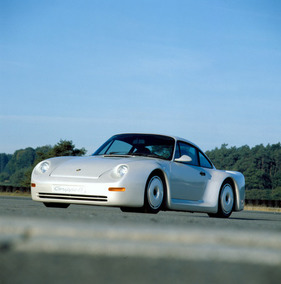
Porsche presents a special kind of high-performance vehicle at the Frankfurt Motor Show in 1983: the "Group B" study. Designed as a competition vehicle for endurance racing, the body of the prototype is characterized by soft lines and curves that are to be found in the later 911 generations. The production-ready version of the "Group B" study caused a worldwide sensation from 1985 under the name Porsche 959.
The "TAG-Turbo" engine, developed on behalf of the British racing team McLaren International and financed by Saudi Arabian businessman Mansour Ojjeh, celebrates its premiere in the summer of 1983 in the McLaren MP4 Formula 1 racing car. Designed under the direction of Hans Mezger as a 1.5-liter, six-cylinder V-engine with turbocharging, the lightweight and compact engine delivers up to 1000 hp. With a total of 25 Grand Prix victories and three world championship titles, the "TAG-Turbo made by Porsche" became the dominant power unit in Formula 1 between 1984 and 1986.

A special homologation series of 20 Porsche 911 SC RS vehicles is delivered to private customers with motorsport ambitions at the beginning of 1984.
Race victories even without works participation
As in the previous two years, the Type 956 is the dominant endurance racing car and once again secures the one-make world championship for Porsche. Although no works team competed at Le Mans in 1984, seven private Porsche Type 956s took first place. The victory of a Porsche 911 Carrera 4x4 in the Paris-Dakar Rally is just as surprising. The four-wheel drive prototype, painted in the colors of sponsor Rothmans, is driven by René Metge and Dominique Lemoyne.
With 220 hp and a drag coefficient of 0.33, the performance of the Porsche 944 Turbo presented in January 1985 is among the best in its class. It is considered to be the first car in the world to offer identical performance both with and without a catalytic converter.
The Porsche 962 brings the one-make world championship to Zuffenhausen for the fourth time in a row in 1985. In addition, Hans-Joachim Stuck secures the title of World Endurance Drivers' Champion together with Derek Bell during his first Porsche season. Private Porsche teams achieve major successes in Monza and Le Mans as well as in the American IMSA series and the German Sports Car Championship in 1985. In Formula 1, Alain Prost wins the world championship in a McLaren with a TAG turbo engine.
With the measuring center for aerodynamic research and testing, the Weissach Development Center has had one of the most efficient wind tunnels in international automotive engineering since June 1986. In Zuffenhausen, a state-of-the-art paint shop with environmentally friendly technology has also been ensuring optimum paint application since the spring.
In addition to the Sports Car World Championship for teams and drivers, Porsche wins the 1986 Sport Auto Super Cup, the IMSA and Interseries as well as the Formula 1 World Championship with the TAG turbo engine. The 24 Hours of Le Mans ends with Porsche's eleventh overall victory. The circuit version of the Porsche 959, the Type 961, achieves a class victory in the IMSA/GTX class. At the Paris-Dakar Rally, all three Porsche 959s that started reach the finish line and take first, second and sixth place.
Long-distance 911
The 911 model series is further rounded off in spring 1987 with the Porsche 911 Turbo Targa and 911 Turbo Cabriolet. Another new variant is the Porsche 911 Carrera Clubsport, which is around 100 kilograms lighter than the standard version of the 911 Carrera.
The announcement of the withdrawal from the endurance championship heralds a change in Porsche's motorsport commitment. For 1988, participation in the American CART series is decided and the development of a monoposto racing car begins. The Le Mans works entry of the Type 962 C is a particular success, setting a new brand record with Porsche's twelfth overall victory, and the press launch of the Porsche 944 S2 takes place in October 1988. Its 3-liter, four-valve engine is not only regarded as the world's largest and most powerful naturally aspirated four-cylinder engine, but also receives particular praise from journalists thanks to its harmonious power delivery.

To mark the 25th anniversary of the "nine-eleven", the all-wheel drive Porsche 911 Carrera 4 presented in November 1988 heralds a new generation of the successful model. Highlights of the sports car, known internally as the Type 964, include the new 3.6-litre engine and an aerodynamically optimized body with plastic front and rear sections and an automatically extending spoiler.
The end of production of the "G-series" 911 Carrera and 911 Turbo models in July 1989 marked the end of an era. The successor model was the Porsche 911 Carrera 2 (Type 964), equipped with a regulated catalytic converter and anti-lock braking system. Like the 911 Carrera 4 (Type 964), it is offered in Coupé, Targa and Cabriolet versions during the 1990 model year.
From November, Porsche offers a new gearshift system under the name "Tiptronic", in which the gears can be changed both fully automatically and manually.
Traditionally equipped with a wider body and large rear spoiler, the third generation of the turbocharged "911" is presented at the 60th Geneva Motor Show in 1990 with the 911 Turbo (Type 964).
The Porsche Carrera Cup celebrates its world premiere on April 1 in Zolder, Belgium, and replaces the Porsche 944 Turbo Cup racing series. Touring car specialist Olaf Manthey emerges as the winner of the inaugural race of the 40 identical Porsche 911 Carrera 2 Cup.
Final spurt for the transaxle sports cars
As the successor to the Porsche 944, the Porsche 968 has been offered as both a Coupé and a Cabriolet since the late summer of 1991. By the end of production in 1995, a total of 11,245 units of the four-cylinder Porsche 968 transaxle sports car had been built.

The Porsche 928 GTS is presented at the IAA as the technical highlight of the 928 model series, which has now been in production for 14 years. Extensive comfort features and the revised 5.4-liter eight-cylinder engine make the Porsche 928 GTS the ideal long-distance sports car.
In 1992, Porsche AG countered the decline in sales figures caused by the difficult global economic climate with an extensive program of measures. Under the leadership of Dr. Wendelin Wiedeking, Member of the Executive Board responsible for Production and Materials Management since October 1991, new organizational and production processes are introduced and hierarchical and process levels are fundamentally changed under the umbrella term "Lean Management". Against the background of the "Kaizen" philosophy introduced by a Japanese delegation of production experts, the Porsche Improvement Process (PVP) is created, which sustainably increases the company's performance and productivity with the involvement of all employees. As part of a streamlined work and process situation, rationalization measures such as short-time working and a reduction in the workforce by a total of 1850 employees become necessary.
CEO Arno Bohn leaves the company on September 30, 1992. His duties are taken over by Dr. Wendelin Wiedeking, who is appointed Spokesman of the Board of Management on October 1.
Another affordable Porsche in sight
At the 1993 Detroit Motor Show, Porsche CEO Dr. Wendelin Wiedeking and Porsche Style Director Harm Lagaay present the pioneering "Boxster" study, whose design is reminiscent of the legendary 550 Spyder racing car.

A new evolutionary stage of the Porsche 911 celebrates its world premiere at the Frankfurt Motor Show in September 1993. The Porsche 911 Carrera type 993 is characterized by a newly constructed aluminium chassis, a harmonious design and a 3.6-litre boxer engine that has been revised in many details.
The Tiptronic S automatic gearshift system with two paddle shifters on the steering wheel of the Porsche 911 Carrera provided a new Porsche driving experience from model year 1995 onwards.
From the 962 to the enduring Le Mans GT
The Porsche Type 962 celebrates an unexpected comeback at the 24 Hours of Le Mans. Modified for the GT1 class in the course of a change to the regulations, three examples of the Type 962 Dauer Le Mans GT were built in Weissach in cooperation with Jochen Dauer Racing in 1994. With a double victory in the GT1 class and a triple victory in the GT2 class, the 24 Hours of Le Mans ended with Porsche's 13th overall victory.

A new generation of the Porsche 911 Turbo (Type 993) is presented in Geneva in March 1995. The highlight of the all-wheel-drive super sports car is the biturbo engine equipped with the OBD II emissions control system, which is regarded as the world's lowest-emission production car engine. Another new feature is the hollow-spoke aluminum rims used for the first time in series production vehicles.
After the four-cylinder 968 series and the eight-cylinder 928 series are discontinued at the end of the 1995 model year, Porsche offers further interesting options for the classic sports car with the 911 Carrera 4S (Type 993) and 911 Targa (Type 993) presented in September. An innovative new feature of the "Targa" is the electrically retractable glass roof behind the rear window.
The 1,000,000th Porsche rolls off the assembly line in Zuffenhausen on July 15, 1996. The anniversary car, a Porsche 911 Carrera, is given to the Baden-Württemberg highway police.

The Porsche Boxster (Type 986) presented in mid-September sets new standards in sports car construction. The long-awaited mid-engined roadster has been enthusiastically received by the media, dealers, importers and customers alike. Even before its launch, more than 10,000 blind orders had been placed worldwide for the two-seater. Another new addition to the model range is the Porsche 911 Carrera S (Type 993) with its wide turbo body.
In the summer of 1997, Porsche AG enters into a joint venture with the Harley-Davidson Motor Company. A joint engine production facility in Milwaukee, USA, is agreed. This represents the provisional climax of the cooperation between Porsche and the motorcycle manufacturer, which has existed since 1969. The highlight of the cooperation is the "Revolution" engine type developed by Porsche and ready for series production, which has been used in the Harley-Davidson "V-Rod" since 2002.
911 with water cooling
One year after the successful market launch of the Porsche Boxster, the new 911 Carrera (Type 996) is presented at the Frankfurt Motor Show in September 1997 under the motto "Evolution 911". As a completely new development, the new sports car generation is powered for the first time by a water-cooled four-valve six-cylinder boxer engine. The design interprets the classic lines of the 911 in an innovative way and is characterized by a low drag coefficient of 0.30.

Professor Ferry Porsche dies at the age of 88 on March 27, 1998 in Zell am See. He is buried in the funeral chapel at the Schüttgut on March 30. The official funeral service takes place on April 3 at the Porsche plant in Zuffenhausen.
At the French endurance classic Le Mans, the Porsche 911 GT1 equipped with a carbon fiber chassis is able to hold its own against tough competition and bring a double victory and the 16th overall Porsche victory to Zuffenhausen.
The Porsche 911 GT3 (Type 996) is presented at the 1999 Geneva Motor Show as the successor to the Porsche 911 Carrera RS (Type 993). Designed as a sporty niche model with dry sump lubrication and a separate oil tank, the GT3 is also available as a club sport version for use on the racetrack. The Porsche 911 GT3 R immediately earns its first laurels when it achieves a class victory and 13th place overall at the 24 Hours of Le Mans.
The new highlight of the Zuffenhausen product offensive: the Porsche 911 Turbo (Type 996) presented at the Frankfurt Motor Show in 1999. As the first Porsche Turbo generation, the top-of-the-range model can also be purchased with a 5-speed Tiptronic S, putting an end to the turbo-less era for customers accustomed to automatic transmission. At the same time, Porsche is presenting a world first with the Porsche Ceramic Composite Brake "PCCB". The ceramic composite disc brake sets new standards in terms of response, fading stability, weight and service life.
The model update of the 986 Boxster series, which was carried out in August to coincide with the model year change, also brings the 252 hp Boxster S, which is powered by a 3.2-liter engine, in addition to the base model, which now has an increased displacement of 2.7 liters.
On February 7, 2000, Saxony's Minister President Kurt Biedenkopf, the Mayor of Leipzig Wolfgang Tiefensee and Porsche CEO Dr. Wendelin Wiedeking jointly break ground for the construction of the new Porsche plant in Leipzig. Under the "Made in Germany" seal of quality, series production of a five-seater "Sports Utility Vehicle" is planned for 2002.
The ten-cylinder sports car
The near-series Porsche "Carrera GT" study celebrates its world premiere at the Paris Motor Show on September 28, 2000 in the Louvre. Both the carbon fiber chassis and the ten-cylinder naturally aspirated engine of the high-performance sports car are based on thoroughbred racing technology.
The Porsche 911 GT2, presented at the Detroit Motor Show on January 8, 2001, represents a new performance peak in the sales program. With 462 hp and 620 Newton meters, the GT2 is the most powerful production sports car from Porsche to date. The super sports car is equipped with ceramic brake disks as standard.
The new 3.6-liter engine of the model-maintained Porsche 911 Carrera (Type 996) has been impressing since September 2001 with variable valve lift and an output of 320 hp. The sales program is also expanded to include the all-wheel drive 911 Carrera 4S and the 911 Targa.
Entry into the SUV segment
Guests at the official inauguration of "Porsche Leipzig GmbH" experience a surprise presentation of the Porsche Cayenne on August 20, 2002. Even before the official world premiere, German Chancellor Gerhard Schröder, who tightened the last screw on the first vehicle, and Porsche CEO Dr. Wendelin Wiedeking present the multi-purpose vehicle.

The sporty and all-terrain multi-purpose vehicle Porsche Cayenne is officially presented to the international public at the Paris Motor Show. The vehicle, designed in cooperation with Volkswagen under Porsche's development leadership, is initially available in the Cayenne S and Cayenne Turbo variants.

The Porsche Carrera GT celebrates its world premiere in Geneva on March 3, 2003. Its performance is as extraordinary as its design: the Carrera GT accelerates from zero to 200 km/h in just 9.9 seconds and reaches a top speed of 330 km/h. The Carrera GT is built in limited numbers. The high-performance sports car, produced in limited numbers, is built at the Porsche plant in Leipzig - the 612 hp naturally aspirated V10 engine is supplied by the Zuffenhausen engine plant.
With the construction of a new service center in Bietigheim, the three subsidiaries Porsche Deutschland, Porsche Financial Services and Porsche Consulting have been united under one roof since mid-2003.
In the upper market segment, Porsche expands its product range in 2004 to include the 911 Turbo S Coupé and 911 Turbo S Cabriolet. The new "S" variants are characterized by the increased performance potential of the engine and the PCCB ceramic brake system fitted as standard.
The market launch of the latest generation of the Porsche 911 will take place simultaneously in 85 German Porsche Centers on July 16, 2004. The models referred to internally as the "997" are initially available in the 911 Carrera and 911 Carrera S variants.
Cayman, the Boxster with coupé roof
One of the highlights of the Frankfurt IAA 2005 is the Porsche Cayman S, a sporty and ambitious mid-engined sports car positioned between the Boxster and the 911.

Porsche has been competing in the American Le Mans Series (ALMS) with the new RS Spyder sports prototype since the fall. At its first race in Laguna Seca, California, the RS Spyder achieved pole position, a lap record and class victory.

Porsche AG presents the new 911 Turbo at the Geneva Motor Show on February 28, 2006. The now sixth generation of the top model in the 911 series is the first production car with a gasoline engine to feature a turbocharger with variable turbine geometry (VTG). Alongside the 911 Turbo, the new 911 GT3 will also be presented to the world public in Geneva. Its 3.6 liter naturally aspirated engine develops an output of 415 hp, which corresponds to a specific liter output of 115.3 hp. The GT3 thus sets a new record in this displacement class for road-legal production sports cars with naturally aspirated engines.
At the third race of the American Le Mans Series (ALMS) season in Mid Ohio on May 21, 2006, the Porsche RS Spyders entered by the American Penske team achieve a one-two victory. This is the first time that a race car in the LMP2 class has achieved an overall victory in the ALMS. The Porsche RS Spyder ends its first full LMP2 season by winning the manufacturers', team and drivers' championships. The sports car prototypes, which are also available for private customer teams, are produced at the new motorsport center in Weissach, which opened in July.
Four years after the model launch, Porsche AG presents the second generation of its sporty off-road vehicle Cayenne at the beginning of December 2006. The new Cayenne, Cayenne S and Cayenne Turbo models feature more fuel-efficient and more powerful engines with direct fuel injection. The active chassis Porsche Active Suspension Management (PASM) can be extended by the new Porsche Dynamic Chassis Control (PDCC) roll stabilization system, used by Porsche for the first time.
On January 26, 2007, the Supervisory Board of Porsche AG elects Dr. Wolfgang Porsche as its new Chairman. He succeeds Prof. Dr. Helmut Sihler, who chaired the Supervisory Board for 14 years. Hans-Peter Porsche is a new member of the Supervisory Board. After 27 years on the Supervisory Board, Dr. Walther Zügel also steps down; his successor is Prof. Dr. Ulrich Lehner.
The Transsyberia Rally, which started on August 3, runs from Moscow to Mongolia, for which Porsche produces a small series of 25 Cayenne S Transsyberia. After 7,108 km, Rod Millen and Richard Kelsey reach the finish line in Ulan-Bator as winners.
In its second season in the ALMS, the Porsche RS Spyder is still the measure of all things. In 2007, the LMP2 racing car recorded no fewer than eight overall and eleven class victories.
The traditional 24-hour race at the Nürburgring ends on May 25, 2008 with a Porsche overall victory for the third time in a row.
The 911 lives on
In June 2008, the latest generation (997/II) of the 911 Carrera and Carrera S models, equipped for the first time with direct fuel injection (DFI) and optionally with the Porsche Doppelkupplungsgetriebe (PDK), is presented to trade journalists. This new transmission has seven forward gears and replaces the previous Tiptronic.

The new Porsche Museum is inaugurated on January 28, 2009 and opens to the public for the first time three days later.
And a limousine too
The new Porsche Panamera is unveiled on the 94th floor of the Shanghai World Financial Center on April 19, 2009. The Panamera will then be shown to the general public at Auto Shanghai, China's most important automobile exhibition.

Under the motto "Porsche Intelligent Performance", Porsche is presenting three hybrid world premieres at the 2010 Geneva Motor Show: The highlight is the 918 Spyder concept study, a high-performance mid-engined sports car with plug-in hybrid technology. With the Cayenne S Hybrid, Porsche presented the first series-produced hybrid in the company's history. The third innovation is the 911 GT3 R Hybrid, the first Porsche racing car with electric front-axle drive and flywheel storage.
From April 11 to 28, 2010, Porsche will be presenting the new Cayenne to around 600 German and international journalists in Leipzig. The second generation of the sporty off-roader impresses the trade press with its impressive performance and sporty character.
In July 2010, Matthias Müller is appointed Chairman of the Executive Board of Porsche AG with effect from October 1, 2010.

As part of a large-scale trial on electromobility, Porsche is testing three purely electrically powered Boxster E models in spring 2011. The aim is to gather experience in everyday operation and user behavior.
On September 13, 2011, Porsche presents a new generation of the 911 at the Frankfurt Motor Show (IAA). The model series, known internally as the 991, is characterized by a unique combination of performance and efficiency. The 7-speed manual gearbox is a world first.
A new generation of the Porsche Boxster is launched in February 2012. The 981 series presents itself with a completely new chassis, even greater efficiency and a unique design.
The Panamera Sport Turismo concept study provides a surprise at the Paris Motor Show. As a lifestyle vehicle study, the Panamera Sport Turismo powered by a plug-in hybrid drive is intended to represent a piece of the future.
40 years after the first 911 Turbo prototype, Porsche is presenting a new generation of the 911 Turbo and Turbo S at the Frankfurt Motor Show in September 103. A new all-wheel drive, active rear-axle steering, adaptive aerodynamics, full LED headlights and the six-cylinder biturbo boxer engine with up to 560 hp underpin the role of the new generation as a technology leader.
50 years of the 911
To mark the 50th anniversary of the 911, a special 911 model limited to 1963 units is presented at the IAA in Frankfurt in 2013.
The highlight of 2013 is the presentation of the production-ready 918 Spyder. Just a few days before the IAA opens, the high-performance hybrid sports car sets a new record of 6 minutes and 57 seconds on the Nürburgring Nordschleife.
With the 919 Hybrid, Porsche returns to the top category of the World Endurance Sports Car Championship in 2014. As the fastest research laboratory and most complex Porsche racing car of all time, the 919 Hybrid is set to take part in all eight rounds of the WEC.
From September, a revised generation of the Porsche Cayenne will impress with more comfort, more safety and more driving dynamics. The Cayenne S E-Hybrid is the world's first plug-in hybrid in the premium SUV segment. It consumes just 3.4 liters per 100 kilometers (NEDC) and can also drive up to 36 kilometers purely electrically.
With a double victory, Porsche clinches the 17th overall victory for the company at the 24 Hours of Le Mans 2015. Drivers Earl Bamber, Nico Hülkenberg and Nick Tandy were the first to see the chequered flag in the 919 Hybrid exactly 45 years to the day after Porsche's first overall victory at the Sarthe.
The Mission E concept study will celebrate its world premiere at the IAA in Frankfurt in fall 2015. The four-door model with four individual seats has a system output of more than 440 kW (600 hp) and a range of 500 kilometers. Thanks to a specially developed 800-volt charging unit, the lithium-ion batteries are available for 80 percent of the range after just 15 minutes of charging.
The Supervisory Board of Porsche AG appoints Dr. Oliver Blume as the new Chairman of the Executive Board of the sports car manufacturer with effect from October 1, 2015.
The 911 R celebrates its world premiere at the 2016 Geneva Motor Show. Like the 1967 model of the same name, the special edition model, limited to 991 units, with a 500 hp four-liter naturally aspirated boxer engine and a six-speed sports manual gearbox, focuses on consistent lightweight construction, maximum performance and an unfiltered driving experience.
With the 718 Boxster, Porsche is continuing the tradition of the four-cylinder boxer engines of the 718 mid-engined sports cars in 2016. They won numerous race victories in the 1950s and 1960s, including at the Targa Florio and Le Mans. The new turbocharged engine of the open-top two-seater is both more powerful and more efficient.
Porsche celebrates the world premiere of the new Panamera at the engine plant in Berlin. The second generation of the Gran Turismo combines the performance of a sports car with the comfort of a luxury saloon. The new biturbo engines are more powerful and up to 16 percent more economical thanks to the new eight-speed dual-clutch transmission.
On May 11, 2017, the one millionth Porsche 911 leaves the factory. The one-off commemorates Ferry Porsche's first service 911, which he took over on October 19, 1964. Elaborately refined by Porsche Exclusive, the anniversary coupé is the quintessence of more than half a century of the 911: sporty yet suitable for everyday use, powerful yet efficient, exclusive yet timeless. The sports car model is based on the 911 Carrera S with a performance-enhanced 450 hp boxer engine and seven-speed manual gearbox. It accelerates from 0 to 100 km/h in 4.1 seconds and reaches a top speed of 312 km/h.

The 919 Hybrid achieves a hat-trick at the 2017 24 Hours of Le Mans. On Saturday evening at 6.30 pm, the 24-hour race seemed lost for the number 2 Porsche driven by Earl Bamber, Timo Bernhard and Brendon Hartley: no more front-wheel drive, over an hour of repairs. But the 85th edition of the endurance classic at Le Mans takes such dramatic turns that an almost superhuman recovery from 56th place and a deficit of 18 laps is nevertheless rewarded with overall victory. Thousands of spectators watch one of the most exciting 24-hour races of all time at the Porsche Museum in Zuffenhausen.
At the International Motor Show in Frankfurt in September 2017, the new Cayenne is the centerpiece of the Porsche stand. However, the world premiere of the new generation already took place on August 29, 2017 with a specially composed symphony on the roof terrace of the Porsche Museum.
On June 8, 1948, the first sports car bearing the Porsche name received its general operating license. With innovative technology, timeless design and sporty suitability for everyday use, Porsche writes automotive history. As before. Porsche celebrates 70 years of sports cars in 2018.
