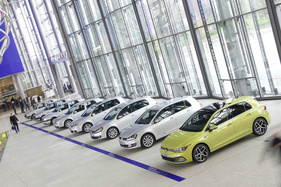
As early as January 3, 1974, readers of Automobil Revue can take a look at the upcoming VW Golf, still called the EA 337. It was unveiled a few months later.

It was an automotive revolution (at least for the manufacturer Volkwswagen) when the first VW Golf and thus the successor to the legendary Beetle was presented in 1974: with front-wheel drive (instead of a rear engine), with a variable overall concept thanks to a large tailgate and folding rear seat backrest. In addition, the straightforward design from the pen of Giorgetto Giugiaro contributed to the introduction of a new design language at VW, which was continued in its successors. The Golf quickly became a genuine "Volkswagen", with the first million sold as early as 1976. To date, 37 million units have been delivered. This makes the compact car the most successful European car, the best-selling VW of all time - and an icon.
No matter which generation - the secret of its success was and is the sum of its characteristics: Because the Golf was and is a perfect companion for everyday life, embodying versatility, functionality, reliability and quality. Over the decades, the portfolio has been expanded to include further variants: whether Golf GTI, Golf Cabriolet or Golf Variant and many more. Each new model generation brought advanced technologies, safety concepts and comfort features to the compact class. The VW Golf not only democratized technologies such as the regulated catalytic converter and the anti-lock braking system, but also airbags and cruise control, electronic assistance systems as well as mild and plug-in hybrid drives.
In the anniversary year 2024, Volkswagen will present the evolutionary stage of the eighth Golf generation, which will impress with its visual refinement, new assistance systems and drive systems as well as next-generation infotainment and software. The world premiere of the new Golf is just a few weeks away, with pre-sales scheduled for spring 2024.
The first generation (1974-1983)
Successor to the Beetle. The first Golf in series production was manufactured at the Volkswagen plant in Wolfsburg at the end of March 1974. The official market launch began in May. Previously, the Beetle and thus the rear engine and rear-wheel drive had characterized the Volkswagen brand for decades. But now, with the first Golf, a new era finally began: that of the front engine and front-wheel drive. This movement had been initiated a few weeks earlier by the Scirocco and the Passat, which had already been launched in 1973. However, the first VW with a front engine and front-wheel drive was the K70 presented in 1970 and taken over from NSU.

The fact is: with the Golf, the highest-volume class had now also been converted to the new technology. The Golf I designed by Giorgetto Giugiaro and Volkswagen, as the successor to the Beetle, of which more than 21.5 million were built, had to live up to the great expectation of continuing the success story of the world's most successful car to date. However, the modern and safe drive concept, the great variability with a tailgate and folding rear seat backrest and the design were so convincing that the millionth Golf could already be celebrated in October 1976. The first generation of the Golf - including all derivatives and the Jetta, which was identical in construction at the time - sold 6.9 million units worldwide.
The second generation (1983-1991)
First evolutionary stage. It was the second Golf with which the baby boomer generation, those born in the 1960s, learned to drive: if its predecessor had already become the favorite of all driving instructors and learner drivers, then the new Golf finally and indelibly drove its way into the minds of this generation, which was later even named after it in a novel by German author Florian Illies. And it was this Golf that particularly democratized progress - with technologies such as the regulated catalytic converter, the anti-lock braking system and the first all-wheel drive in the series.

However, part of the secret of the Golf's success is also the fact that the designers transferred the DNA of the first Golf to its successor, thus manifesting a Golf design culture for eternity. This DNA still makes every Golf unmistakable today. After 6.3 million units, the second generation of the Golf was discontinued in the summer of 1991.
The third generation (1991-1997)
Victory for safety. With the third Golf generation, Volkswagen ushered in a new era of safety from August 1991. On the one hand, the Golf III was the first model in the series to be available with front airbags from 1992; on the other hand, however, major advances in the area of body design led to a significant improvement in crash characteristics.

Numerous other milestones in the model series are associated with the Golf III: the first six-cylinder engine (VR6), cruise control, the first oxidation catalytic converter for diesel engines, the first direct injection diesel engine and the first side airbags. In 1997, the third generation was replaced after 4.8 million units had been produced.
The fourth generation (1997-2003)
Style icon. Today, design experts regard the Golf IV as a style icon and groundbreaking for the model series - certainly also because it built a bridge to the Golf I of 1974 with all its clarity and the C-pillar design that characterized the model series. With the Golf IV, Volkswagen set a completely new quality standard in the segment. At the same time, the democratization of safety continued with the debut of ESP. A short time later, ESP became standard in Germany. This was followed in 2001 by the Golf GTI, now long sought-after as a classic, on the 25th anniversary of the GTI with 132 kW / 180 PS, and in 2002 by the first Golf with petrol direct injection (FSI) and the debut of standard head airbags.

Also in 2002, Volkswagen presented the sportiest Golf to date: the 250 km/h R32, the original version of today's Golf R. In 2003, this Golf R32 was available with a dual-clutch gearbox (DSG) for the first time. In the same year, after 4.9 million units, the Golf IV made way for the Golf V on the production lines.
The fifth generation (2003-2008)
Class boundaries abolished. It was the fifth Golf whose comfort and dynamics left many a competitor in the upper mid-size class behind. The same applied to quality. One value that underpinned the stability of the laser-welded body was the 35 percent increase in torsional rigidity reported at the Golf V's debut in 2003.

For the first time, the Golf was now also available with optional side airbags in the rear - together with the six standard airbags (front, front side, head airbags), this meant that eight of the protective airbags were on board. The Golf V also scored points with its new four-link rear axle, a new 7-speed DSG, bi-xenon headlights, the debut of the first turbocharged direct-injection petrol engine in the Golf GTI and the world's first twincharger with turbocharging and supercharging. When the Golf VI was introduced in 2008, 3.4 million units of all versions of the Generation V had been produced.
Generations 6 to 8 (from 2008)
The sixth generation was built from 2008 to 2012, the seventh from 2012 to 2019 and since then Golf fans have been buying the eighth generation, which has come in for some criticism due to its user guidance.

The world premiere of a new Golf is due to take place at the end of January and, of course, numerous innovations are expected once again.
Keeping history alive
Volkswagen Classic is also accompanying the Golf in its anniversary year and is presenting historic Golf models from VW's own collection on numerous occasions.
From January 31 to February 4, 2024, Golf generations I to VII will enrich Volkswagen France's presentation at the Salon Rétromobile in Paris. Almost simultaneously, from February 2 to 4, 2024, VW will present a Golf I and the unique EA 276 concept car - the predecessor of the Golf from 1969, which was built in Wolfsburg - at the Bremen Classic Motorshow.