


In addition to the 125th anniversary of its founding, Škoda Auto 2020 also looks back on the market launch of several models that have played a special role in the car manufacturer's history. These vehicles include the 110 R, which added a dynamic sports coupé to Škoda's model range in the early 1970s.

In 1964, Škoda started production of the Škoda 1000 MB notchback saloon. With its self-supporting body, rear engine and rear-wheel drive, this model ushered in a new technical era for the Czech car manufacturer. Škoda invested extensively in modern production facilities for the new model series and soon concentrated fully on the production of this newcomer due to the sales success of the rear-engined saloon in export markets. Škoda therefore discontinued production of the Felicia convertible. However, the demand for a sporty model remained, particularly in the Western European markets. Škoda responded to this customer demand with a vehicle that would remain a niche product in terms of the planned unit numbers, but would give the brand the necessary image boost. Parallel to the development of the Škoda 100/110 L series - as the successor to the 1000 MB, it had a more modern body, front disc brakes and improved safety features - work therefore began on the Škoda 110 R two-door coupé version.
Production of the first prototypes and test drives in the former GDR
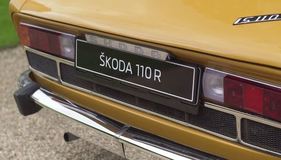
Development of the 110 R, known as 'Erko' in the Czech Republic, began in 1966. In March 1968, the first prototype with the internal designation Š 718 K rolled off the production line at the Škoda plant in Kvasiny. In addition to the elegantly sloping rear section, the coupé body differed from the notchback version in that it had a more steeply raked windshield and two wide doors with frameless windows. During test drives, which took place on highways in the GDR among other places, the coupé reached a top speed of 145 km/h. The second prototype was completed in March 1969 and already had a twin carburetor and an alternator instead of a dynamo.
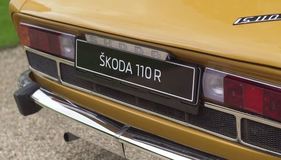
Škoda invited a number of journalists to the world premiere of the 110 R at the company's own vocational school in Mladá Boleslav. Following the press conference, the guests were then allowed to test drive the new sports coupé at the nearby Hoškovice airfield.
Presentation at international motor shows and start of production
The public was able to take a look at the 110 R for the first time on September 5, 1970 at the engineering fair in Brno, where Škoda exhibited three examples. The foundation for the success of the sports coupé on export markets was laid by the presentation of the vehicle at the motor shows in Paris, London and Turin, which opened in quick succession in October 1970. Demand for the 110 R rose sharply, but the ramp-up of production presented Škoda with problems due to the political conditions at the time. By the end of 1970, only 121 vehicles had been produced and it was not until the second quarter of 1971 that the first examples of the coupé were delivered to foreign customers. As a result, the Czech car manufacturer concentrated primarily on exports: of around 3,000 units built in 1971, only 442 vehicles were delivered to the car dealerships of the then Czechoslovak monopoly dealer Mototechna. The price for the 110 R was at least 78,000 crowns, which was equivalent to around 40 monthly salaries at the time.
Low weight and excellent traction for a dynamic driving experience
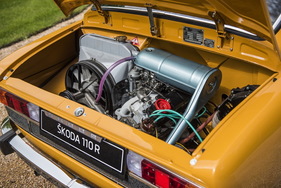
The 110 R measured 4,155 millimetres in length and 1,620 millimetres in width and, with a height of 1,340 millimetres, was 40 millimetres lower than the basic notchback model. The wheelbase was 2,400 millimeters. The in-line four-cylinder engine, equipped with an oil cooler, had a displacement of 1,107 cc with a compression ratio of 9.5:1 and twin carburetors and produced 38 kW (52 hp) at 4,650 rpm. In combination with the low kerb weight of 880 kilograms, this enabled a dynamic driving experience. The cylinder and crankcase as well as the bell housing of the direct-shift four-speed gearbox located in front of the rear axle were manufactured using die-cast aluminum according to the original Czech patent. On its 165 SR 14 radial tires, the 110 R reached a top speed of 145 km/h and needed 19 seconds to accelerate from zero to 100 km/h.

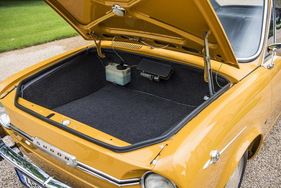
Deceleration was provided by a dual-circuit braking system, with disc brakes at the front and drum brakes at the rear. The brakes were manufactured by Škoda under license from the English brand Dunlop. As 57 percent of the vehicle's weight was on the driven rear wheels, the sports coupé had excellent traction. The average fuel consumption was 8.5 liters per 100 kilometers, the volume of the front-mounted fuel tank was 32 liters. Under the front hood was a storage space for 250 liters of luggage, the second luggage compartment behind the rear seats held 120 liters and was also accessible while driving.
Cockpit with extensive instrumentation and steering wheel with perforated spokes
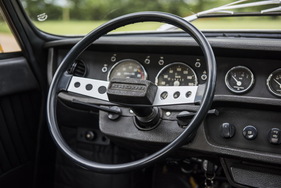
The early models were characterized by a dashboard with a wooden finish, which was soon replaced by a matt black version. There were five round instruments in the dashboard. Behind the steering wheel rim, the driver looked at the large rev counter, the red section of which started at 5,750 rpm, and the equally large speedometer next to it. Towards the middle of the vehicle were three smaller round instruments: the pressure gauge for the oil pressure, the temperature gauge for the coolant and, on the far right, the fuel gauge. The steering wheel had two perforated metal spokes that ran towards a rubberized impact element in the middle.
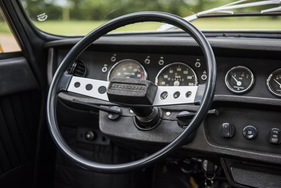
The extensive basic equipment of the 110 R included anatomically shaped front seats. When the backrests were folded forward, the much more cramped two seats in the rear could be reached. Over the course of the ten-year production period from 1970 to 1980, the Škoda 110 R received many minor revisions, which, in addition to a contemporary look, ensured the long-term competitiveness of the vehicle. From January 1973, four headlights adorned the front of the vehicle, as the two outer main headlights were supplemented by two smaller fog lights. The front seats were fitted with headrests, and the 14-inch wheels were replaced with smaller 165 SR 13 tires and plastic covers shortly before the end of the iconic coupé's production run.
High demand for the Škoda 110 R, even in demanding export markets
Škoda set an exciting new trend with the compact 110 R sports car and therefore also achieved considerable sales success with the vehicle on demanding export markets. In 1973, 93 percent of the approximately 6,000 coupés built were delivered outside of what was then Czechoslovakia. In the following year, production rose to around 7,500 units. From September 1972, Škoda also exported a right-hand drive version and just three years later, 2,371 coupés, or 36 percent of the total number of vehicles exported, went to customers in Great Britain. Some units of the 110 R were even exported to New Zealand, Kuwait and Nicaragua. In 1980, the last year of production, exports were limited to the Yugoslavian and Spanish markets.

Motorsport derivatives of the Škoda 110 R: the beginning of a successful era
The international demand for the 110 R was also boosted by the success of the Škoda Coupé's motorsport derivatives on circuits and rally courses, which began in the 1973 season with a modified works car. A little later, Škoda presented a 180 RS and two examples of the 200 RS. The prototypes inspired by the production coupé made their debut at the Barum Rally in June 1974. These road racing cars had OHC engines with a displacement of up to two liters and a five-speed gearbox from Porsche. In addition, a newly developed trailing arm rear axle was installed, which had a positive effect on the handling of the coupés.

The legendary Škoda 130 RS followed in the spring of 1975. In the late 1970s and early 1980s, it became one of the most successful racing and rally cars in the class up to 1,300 cc displacement. The body structure of the 110 R was slightly modified and given a robust roll cage. Škoda made the roof, hood and outer door skins from aluminum, while the fenders and hood were made from glass-fibre reinforced plastic. The lightweight construction measures reduced the weight of the 130 RS to just 720 kilograms. This meant that the 1.3-liter four-cylinder engine had a comparatively easy time of it. Its output gradually increased to up to 96 kW (130 hp), the engine with dry sump lubrication was fitted with an eight-channel cylinder head and two Weber twin carburetors. The circuit version reached a top speed of up to 220 km/h. The 130 RS, also known as the 'Porsche of the East', won the European Touring Car Championship one-make classification for Škoda in the 1981 season. The greatest success of the rally version was the double victory in its class at the 1977 Monte Carlo Rally.

