


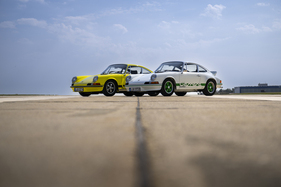


"Duck tail", "RS" or "2.7". The Porsche 911 Carrera RS 2.7 has many nicknames today. Its significance is unique: at the time, it was the fastest German production car and at the same time the first production model with front and rear spoilers - the latter gave it the nickname "Entenbürzel" (duck tail). Porsche thus established the trend for rear spoilers on production cars in 1972.
Around 50 years ago, Porsche began developing the 911 Carrera RS 2.7. "The 911 Carrera RS 2.7 was intended as a homologation vehicle. It was supposed to be a very light, fast sports car," recalls Peter Falk, Head of Testing for Production Vehicles at Porsche at the time. Even though the model variant was based on the 911, the result was a new basic vehicle for racing and rallying with many technical innovations. The most powerful model of the first generation of the 911 was the first 911 and the crowning glory of the Porsche range to be given the nickname "Carrera". Weight, aerodynamics, engine and chassis were intensively revised. Around 15 engineers developed the car from May 1972, joined by employees from production.
Surprised by the success
Porsche initially planned to produce 500 units in order to homologate the 911 Carrera RS 2.7 for Group 4, in which special GT vehicles competed. The vehicle received road approval and was aimed at customers who also wanted to take part in racing events. On October 5, 1972, the new model was presented at the Paris Motor Show at the Porte de Versailles, and by the end of November all 500 vehicles had been sold. Porsche was surprised by the success and was able to triple sales by July 1973.

A total of 1,580 vehicles were produced, meaning that the Porsche 911 Carrera RS 2.7 was homologated for Group 3 in addition to Group 4 from the thousandth vehicle. Porsche built 200 vehicles in the lightweight "Sport" version, the optional M471 equipment package. In the racing version, 55 units were built, 17 as the base vehicle and 1,308 vehicles in the touring version (M472).
The interior of the 911 Carrera RS 2.7 "Sport" (M471) was limited to the bare essentials depending on customer requirements and production date, including the absence of rear seats, carpets and a clock, coat hooks and armrests. Two lightweight seat shells replaced heavier sports seats at the customer's request. Even the Porsche emblem on the hood was initially glued on. Compared to the "Touring" equipment package (M472), the "Sport" weighs 960 kilograms empty, 115 kilograms less than the "Touring". Its price: 34,000 marks. The Sport package cost 700 German marks (M471), the Touring package 2,500 German marks (M472).
The 2.7-liter six-cylinder boxer engine with fuel injection in the 911 Carrera RS 2.7 delivers 210 hp at 6300 rpm and develops 255 Newton meters at 5,100 rpm. In the sports version, this is enough to accelerate from 0 to 100 km/h in 5.8 seconds. This makes the 911 Carrera RS 2.7 the first production car to break the six-second barrier set by the German trade magazine auto, motor und sport. The top speed is in excess of 245 km/h. (Touring 6.3 sec., 240 km/h). The RS 2.7 was a synthesis of weight, performance, aerodynamics and handling.

With rear spoiler for the first time
When it came to the bodywork, the focus was on weight reduction: with thin sheet metal, thin windows, plastic parts and no insulation, the total vehicle weight of the racing cars had to be reduced to less than 900 kilograms in order for the new model to be homologated. At the same time, the aerodynamics had to be improved: At high speeds, the aim is to minimize lift on the front and rear axles in order to achieve more neutral handling. Together with stylist Rolf Wiener, engineers Hermann Burst and Tilman Brodbeck developed a rear spoiler for the first time and tested it in the wind tunnel and on test tracks. The aim of the considerations was to maintain the formally closed character of the 911, to compensate for the disadvantage of the sloping rear end with suitable and stylistically acceptable measures and thus to improve the aerodynamics of the 911.

The new "duck tail" pushes the 911 Carrera RS 2.7 towards the road at high speed and supplies the rear engine with additional cooling air. The effect is achieved without increasing drag - on the contrary: the top speed increases by 4.5 km/h. "During tests, we found that we were able to increase the top speed with a higher spoiler because the drag was lower. So we kept extending the rear spoiler upwards by millimetres with sheet metal at the tear-off edge until we found the reversal point at which the air resistance increased again," explains Peter Falk. On August 5, 1972, the three Porsche employees filed a patent disclosure document No. 2238704 with the German Patent Office.

Different tire sizes for more traction
The engineers also worked on the chassis: Porsche had gained experience with wider rear wheels from racing, so the developers also tried this out on the 911 Carrera RS 2.7. "We wanted to improve traction and handling with wide tires on the rear axle because the weight is highest on the rear axle," recalls Peter Falk. For the first time, a Porsche production vehicle was fitted with different tire sizes on the front and rear axles. Fuchs forged wheels 6 J x 15 with 185/70 VR-15 tires were fitted at the front, and 7 J x 15 with 215/60 VR-15 tires at the rear. In order for these to fit, Porsche widened the body at the rear by 42 millimeters in the area of the wheel arches. "When this worked well in development, production and sales, all subsequent models were given this combination," says Peter Falk.
The first racing successes
After the changed regulations for the sports prototypes, which had prevented a continuation due to the new displacement limit of three liters, Porsche ended the very successful era. After the racing debut of a 911 Carrera RSR (racing sports race) with a significantly widened body at the Tour de Corse in November 1972, Porsche decided to extend the 911's racing success story in 1973. At the beginning of February 1973, an RSR driven by Peter Gregg and Hurley Haywood crossed the finish line at the 24 Hours of Daytona with a 22-lap lead, a brilliant start to the new season. Herbert Müller and Gijs van Lennep won the Targa Florio in May 1973. "The victory was important for us because it showed that the RSR with the larger rear wing was very fast on circuits and rally tracks," recalls Peter Falk. In the first season, the 911 Carrera RSR won three international and seven national championships - and thus established the 911's success for decades to come. At the International Race of Champions (IROC) in October 1973, Roger Penske from the USA entered twelve identical 911 Carrera RSR 3.0s in which drivers from different racing classes competed against each other.

With the 911 Carrera RS 2.7, Porsche not only developed a sports car for the racetrack, but also a car that customers could use in everyday life and in races. Contemporary advertising stated: "Its repertoire: On the road to the race and back home again. Monday to the office. Tuesday to Geneva. Back in the evening. Wednesday to the stores. City. Traffic jam. Creeping traffic, but no sooty plugs, no clutch on strike. Thursday country road, highway, serpentines, country lanes, roadworks, Friday only short distances and repeated cold starts. Saturday to Finland with vacation luggage. Carrera RS - full of inexhaustible reserves for sprints and marathons."

The Carrera name
For the first time, the 911 Carrera RS 2.7 featured the lettering "Carrera" between the wheel arches. The Spanish word means "race" in German, RS on the rear spoiler stands for racing. For Porsche, the "Carrera Panamericana" was the catalyst for the name. It was at this endurance race in 1953 that Porsche took its first class victory with the 550 Spyder. The sensation and initial spark for the new name suffix followed in 1954, when the 550 Spyder came third overall. In the following years, Porsche used the name suffix Carrera for the most powerful vehicles with the four-camshaft engine/Fuhrmann engine from 1954, such as the 356 A 1500 GS Carrera or the 356 B 2000 GS Carrera GT. On the Porsche 904 Carrera GTS from 1963, the Carrera lettering adorns the rear, and on the 906 Carrera 6 from 1965, the fender on the side behind the front wheel arch. According to a contemporary statement, the Carrera also saw itself as a "quality predicate for a technical delicacy that had proven itself on race tracks and rally courses". In short, the name was also suitable for the future top model of the 911. "We wanted to assign the already famous name 'Carrera' to a production model and thought about how we could best represent this," recalls Harm Lagaay, designer at Porsche at the time. They decided on the area between the wheel arches.
In addition to the Carrera lettering, Porsche offered other eye-catching design features: 29 paint colors, some in bright colors, were available to choose from, 27 were produced, including colors such as bright yellow, red or blood orange. Porsche also fulfilled individual color requests from customers. The rims matched the bodywork or the Carrera lettering on the sides, including white vehicles with red, blue or green lettering. The lettering is still very important today, as is the long-famous abbreviation RS. This is repeatedly quoted on particularly sporty 911 models - as it was almost 50 years ago.

From September 20, 2022, the Porsche Museum will be showing a special exhibition to mark the 50th anniversary of the 911 Carrera RS 2.7.
