


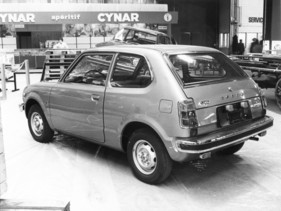


This year, Honda is celebrating the 50th anniversary of its iconic Civic. Developed as a "Car for the World", more than 27.5 million Civic models have been sold in 170 countries since its market launch in 1972. With the introduction of the 11th generation, the Civic is now entering its sixth decade. It continues to set new standards in its class and aims to exceed the expectations of customers around the world.

The enduring popularity of the Civic is testament to the pioneering work of Honda engineers over the past 50 years. Each generation of the Civic has brought with it evolved design, advanced technologies and new levels of performance - all while remaining true to its purpose: to be a spacious, efficient compact car without sacrificing driving pleasure.
1972-1979: A Civic for everyone
The first Civic was developed as a global car for all markets and impressed with its exceptional suitability for everyday use. It was one of the first Honda vehicles to be sold in Europe and achieved great success with its compact design, impressive fuel efficiency and user-friendliness.

Equipped with the revolutionary CVCC (Compound Vortex Controlled Combustion) engine, the Civic was the first vehicle to meet the world's strictest emissions regulations, the Clean Air Act of 1970, setting the standard for future emissions targets in the global automotive industry.

The first generation of the Civic was initially produced at the plant in Suzuka, Japan. The production volume reached 1 million units within the first four years. The first generation also included particularly sporty variants such as the "RS".
The 80s: The Civic comes of age
1979 saw the launch of the second generation of the Civic with an improved CVCC II engine.

The 1.3 liter engine built on the success of the original Civic and offered smoother power delivery and improved fuel efficiency. The model range was also expanded to include a sedan with a 1.5 liter engine, a five-door and an estate. A five-speed manual gearbox was also offered for the first time. The model was characterized by its new and striking trapezoidal design - the radiator grille and headlights were given a more angular look. However, this design was short-lived as the Civic grew in popularity and a new model was needed to meet the demand for larger cars.

The third generation of the Civic was launched in 1983 with a wider wheelbase and a more angular design. Notable is the introduction of Honda's "Man Maximum-Machine Minimum" principle, a human-centered design approach that ensures that technology and layout meet the needs of driver and passengers. Today, this principle continues to help define all Honda models to provide the space and usability that modern customers expect.
The Civic was available in three body styles: a three-door with a focus on sporty driving, a more practical four-door sedan and a five-door Civic Shuttle station wagon that offered exceptional space and usability. A sporty Civic Si variant with a 1.6 liter DOHC four-cylinder in-line engine was also offered.
1987-2000: New standards in quality and performance
In 1987, the fourth generation Civic introduced a new range of engine variants with the Honda VTEC (Variable Valve Timing and Lift Electronic Control) system.

Its variable valve timing revolutionized engine technology and provided more power at high revs and lower fuel consumption at low revs - for which the Civic won several awards.

The fifth generation of the Civic in 1991 brought a sleeker and more aerodynamic shape that made the car appear sportier, while retaining the everyday usability that had become synonymous with the car.

The sixth generation of the Civic was developed to exceed the standards of its class. In the 1990s, lower fuel consumption and other environmental measures became increasingly important. And so this generation received a newly developed VTEC engine. The Civic also featured an automatic, continuously variable Hondamatic Transmission (CVT) for the first time, offering seamless gear changes and the same efficiency as manual shifting.
Building on the exceptional dynamic handling characteristics of the Civic, Honda introduced the performance-oriented Type R version for the first time in 1997. With a focus on delivering the most powerful performance a Civic had ever offered, the Type R came to symbolize 25 years of success for the Honda brand in the competitive compact sports car segment.
2001-2021: The Millennium Civic
The seventh generation was launched in 2000. In 2001, the first Civic with hybrid technology was offered.

With an extremely low fuel consumption of around 3.4 l / 100 km, this Civic was the world's most economical production vehicle with a gasoline engine and five seats.

The eighth generation of the five-door model followed in 2005 with a futuristic design for the European market. The eye-catching front design and triangular accents - including the dual exhaust system - made it one of the most distinctive vehicles on the road. It was also the first generation of the Civic to feature Honda Magic Seats, where the rear seats can be folded up to create a larger and higher cargo area. Honda engineers made this possible by placing the fuel tank under the front seats - to this day a benchmark for more space and usability in the interior, which is still used in various Honda models.

The ninth generation Civic has been further refined to offer customers a balanced overall package with class-leading efficiency. Equipped with a revised 1.6 DTEC engine, Honda achieved a world record title in the Guinness Book of Records™ in the category "Lowest fuel consumption - all 24 contiguous EU countries (all cars)" - with an average fuel consumption of 2.82 liters per 100 km (100.31 mpg), the Honda Civic completed a 25-day drive through 24 contiguous EU countries covering a distance of over 13.498 km (8,387 miles).

The completely redesigned 10th generation was launched in 2015, with a choice of two VTEC TURBO engines and, for the first time, advanced Honda SENSING safety and driver assistance systems as standard. A stiffer chassis and more dynamic performance formed the perfect basis for the 2017 Civic Type R, which set a new benchmark for high-performance compact sports cars. The vehicle impressed with its direct handling, immediate response, top speed, stability and exceptional braking performance - all of which contributed to the Type R setting a new record lap time for front-wheel drive vehicles on the Nürburgring Nordschleife in Germany in April 2017.
2022: A new era of the Civic
Building on 50 years of tradition, the 11th generation Civic combines strong performance and efficiency with enhanced interior comfort, attractive design and overall user-friendliness. The latest generation marks an important milestone for Honda in Europe, as it is the latest model in the brand's range to receive an electrified powertrain. This fulfills Honda's "Electric Vision", which aims to equip all volume models on the European market with an electrified powertrain by 2022.

Equipped as standard with the most advanced version of the brand's multi-award-winning e:HEV full hybrid drive system, the Civic delivers outstanding dynamics and performance with impressive economy and efficiency.

"Since the first generation, which enjoyed great success in the market, the Honda Civic has become an icon for European customers," said Tom Gardner, Senior Vice President at Honda Motor Europe Ltd. "The 11th generation brings together the core attributes of practicality, usability and comfort that the very first generation Civic had. The Civic has been technically enhanced to offer new levels of performance, driving dynamics and driving pleasure with its powertrain, steering and suspension, which has always been at the heart of the Civic's appeal."
