

It set standards in terms of safety and sustainability, was the first Volvo model to become a multiple production millionaire - and with it, the Swedish premium car manufacturer entered the age of powerful and efficient turbocharged engines 40 years ago: in 1980, the legendary Volvo 240 demonstrated the full potential of the exhaust gas turbocharger, even in the first estate car with a turbocharged petrol engine. Volvo's design engineers drew on their expertise with turbo engines dating back to 1954, when the Volvo L395 Titan truck went into series production. Today, modular turbocharging forms the basis for all Volvo Drive-E engines to generate different power levels with the same displacement.

The beginning of the turbo age for the Swedes
"Volvo Turbo", these two words caused a sensation and made headlines 40 years ago. At the time, several manufacturers already had sporty passenger car models with turbo engines and turbocharged engines had also achieved early success in Formula 1. But the first Volvo model series with turbocharged petrol engines marked the beginning of a new era, especially as the Volvo 240 Turbo was not only introduced as an elegant saloon, but also shortly afterwards as the world's first estate car with a turbine in the exhaust gas flow reaching 110,000 rpm. This turbocharged, legendarily robust Volvo B21ET engine produced 114 kW (155 hp) from a displacement of 2.1 liters, making the Volvo 240 Turbo nominally just as powerful as the top-of-the-range six-cylinder Volvo 264 GLE.

At the same time, the four-cylinder turbo impressed with significantly lower consumption values than the V6, particularly in city traffic, and the Volvo 240 Turbo proved to be superior in terms of driving dynamics anyway. The large Volvo 240 estate was catapulted from a standstill to 100 km/h in just under nine seconds by the turbo power plant, which briefly put the charging giant in pole position among the world's fastest estates. In the USA, Volvo's advertising even compared the Swedes, dubbed "The Turbo By Volvo", with Italian super sports cars. What was important to Volvo was the sprinting ability of the Turbo models and not the Vmax, as emphasized in an advertising campaign that highlighted the great driving pleasure in a Volvo 240 Turbo while safely adhering to the 55 mp/h (88 km/h) limit in force in the USA at the time.
Reference model for safety research and innovative turbo technology
With around 2.7 million units sold in almost 20 years of production, the Volvo 240, launched in 1974, became a Swedish icon that cemented Volvo's image as a leading manufacturer of pioneering, safe premium models. Right from the start, the edgy Swede was characterized by its massive safety bumpers. In fact, the Volvo 240 set new standards in occupant protection, as confirmed by the US National Highway Traffic Safety Administration (NHTSA), which chose this Volvo as the reference model series for its safety research in 1976. The Volvo 240 also played a pioneering role in reducing harmful emissions in the fall of 1976, when Volvo delivered the world's first sedans and station wagons with regulated three-way catalytic converters and lambda sensors to California.

It actually took another three years before the Volvo 240 Turbo went into series production, as it was first subjected to a stress test in the day-to-day work of Swedish police authorities. The results were so convincing that the later series version of the Volvo 240 Turbo was used by police authorities in many countries. Pehr Gyllenhammar, then CEO and President of Volvo, also tested a fast Volvo 240 saloon with a turbo unit in 1979 - like all his vehicles in bright red paintwork - before approving the start of series production.
The mode of operation of the emphatically small turbocharger was revolutionary, as it already worked at 1,400 rpm, i.e. just above idling speed, without the late or too abrupt activation that was common with early turbos. The turbo in the Volvo B21ET engine reached its maximum at a low 2,600 rpm, at which point the wastegate valve opened at a pressure of 0.72 bar. The idea of downsizing engines to maximize efficiency was also accelerated by the Volvo 240 Turbo, as the top-of-the-range model did not use the 2.3-litre four-cylinder engine, but instead made do with a 2,127 cc unit. For various markets such as Finland or Italy, a 1.9-liter turbo four-cylinder of the type B19ET was even available for tax reasons. In North America, the Volvo 240 Turbo was also available from the end of 1983 with a larger intercooler and as an exclusively and sportily equipped two-door model.
Milestones in engine construction with racing expertise
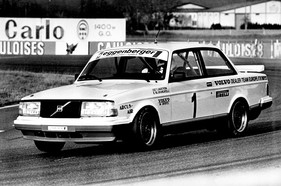
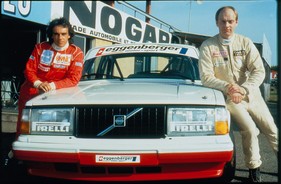
Motorsport can also drive technical developments and so the successful one-make cup series Volvo Turbo Cup was launched in Sweden as early as 1982, open to all Volvo 240s that were turbocharged with a turbo kit from Volvo R-Sport. In the same year, the FIA introduced new regulations that predestined the Volvo 240 Turbo for use in Group A touring cars. The Volvo 240 Turbo Evolution, which was specially developed in a production run of 500 units, had a larger turbocharger, a modified engine control system and water injection, a Volvo-patented invention. In the very first race of the new German Touring Car Championship (DTM) in 1984, the 243 kW (330 hp) racing car, which became famous as "The Flying Brick", won the overall victory. One year later, the Volvo 240 Turbo dominated the European racing series and not only secured the DTM title, but also the European Touring Car Championship (ETC).

New milestones in Volvo turbo engine development quickly followed. The Volvo 760 launched in 1982 debuted as the world's most dynamic six-cylinder turbo diesel, the Volvo 480 introduced three years later combined front-wheel drive with turbocharging, the Volvo 850 of the 1990s combined four-wheel drive with high-torque turbo power and the 1.6 liter GTDi engines introduced in 2010 in the Volvo S60 and Volvo V60 models presented themselves as groundbreaking direct-injection gasoline engines with turbocharging.
Future-oriented advantages through modular turbocharging in current Volvo models
In all current Volvo Drive E engines, modular turbocharging offers different power levels with the same displacement, as the compact design of the highly efficient Volvo engines allows the installation of one or more turbochargers. The top-of-the-range B6 AWD petrol engine also uses an electric supercharger. The B5 and B4 petrol engines use an exhaust manifold made of lightweight sheet steel with an integrated turbocharger with wastegate boost pressure control, whereby the sheet steel scores with significantly lower heat radiation thanks to additional insulation. This in turn enables high gas flow temperatures and therefore more efficient combustion. This fully integrated sheet steel turbo system is a globally unique innovation and has been patented by Volvo.
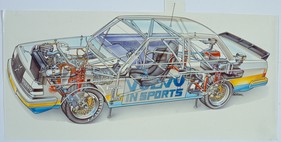
The innovative bi-turbocharger with variable turbine geometry (VTG) also ensures an optimized torque curve and improved response of the B5 petrol engine. In contrast, the B4 and B5 Drive-E diesel engines feature sequential twin-turbocharging, which guarantees a high power output across the entire engine speed range and low emission values at the same time.