


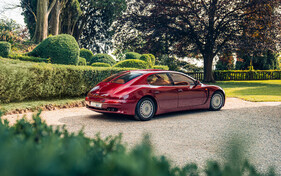


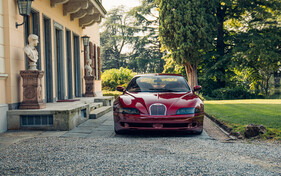

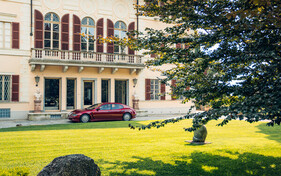
When the Bugatti EB112 was unveiled at the Geneva Motor Show in 1993, its design and technology were a sensation. It created a completely new, ultra-luxurious Grand Tourismo segment. Backed by the brand's tradition and equipped with the latest cutting-edge technologies, the EB112 completely redefined the idea of a saloon.

Giorgetto Giugiaro, who will turn 85 on August 7, 2023, cannot help but shower the EB112 with pure admiration: "The Bugatti EB112 has a number of nostalgic styling features that hark back to the famous models of the legendary French brand from the late 1930s, but presented in a car with innovative mechanics. The EB112 is in many ways a dream car and a forerunner of what we know today as high-performance fastback models. It perfectly combines design with technological and engineering features that were way ahead of its time."

Giugiaro's design was long celebrated as a groundbreaking achievement. Many critics praised the EB112 as the most beautiful sedan ever created and a thoroughbred Bugatti that seamlessly combined performance and luxury.

The flowing aesthetics of the EB112 proved to be a visionary idea. A true forerunner of Bugatti's current "form follows performance" philosophy, the EB112 combined a bold and elegant aesthetic form with a great technical effect that led to the development of a high-performance sedan with outstanding aerodynamic capabilities. In many ways, the EB112 is now considered the spiritual predecessor of the Veyron and Chiron.

The front of the EB112 exudes an elegant aesthetic that is now synonymous with Bugatti's famous design DNA. Its radiator grille, for example, laid the foundation for the radiator grille that adorned the Veyron ten years later. The longitudinal rib, which extends from the hood over the roof to the rear window, is a stylistic allusion to the Bugatti Type 57 SC Atlantic and was later subtly taken up again, first in the Veyron and then in the Chiron.
The beautiful and timeless, but also revolutionary, all-aluminum body of the EB112 concealed a carbon fiber monocoque derived from the similarly advanced EB110 supercar. This body and chassis technology was groundbreaking in the sports car segment in 1993 and a completely new development in the saloon segment.

The world premiere in Geneva was the highlight of the motor show. The EB112, which had been painstakingly developed over the previous months, drove onto the stand under its own power. The drivetrain was also groundbreaking: the 6.0-liter V12 engine with 60 valves (five per cylinder) was combined with a six-speed manual gearbox and sophisticated all-wheel drive.
The naturally aspirated V12 engine produced 460 hp at 6,300 rpm and its maximum torque of 590 Nm was already available from 3,000 rpm, which enabled a performance potential that was far above that of all contemporary high-performance saloons. A top speed of 300 km/h was possible, and the EB112 reached 100 km/h from a standstill in just 4.3 seconds.
The all-wheel drive of the EB112 was a further development of the proven, advanced technology of the EB110. In the EB112, 38% of the torque is distributed to the front axle and 62% to the rear axle to ensure high traction and performance in all conditions. This capability is further enhanced by the EB112's favorable weight distribution, as Bugatti engineers position the powerful V12 as far back as possible between the axles in a front center arrangement. A technical specification that not only supports the dynamic capabilities, but also increases crash safety.
"The Bugatti EB112 was a true pioneer, an avant-gardist and, after its unveiling, ensured that saloons as a whole changed radically. This vehicle created a completely new segment in 1993. Before that, there was no high-performance saloon that combined the characteristics of the EB112: visionary design, outstanding performance and luxury in abundance. The EB112 is an important milestone in Bugatti's rich automotive heritage," says Luigi Galli, Bugatti's specialist for history and certification.
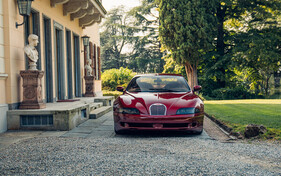
Bugatti's incomparable EB112 sedan from 1993 underscores the brand's ongoing commitment to pushing boundaries, advancing technology and setting entirely new standards in automotive engineering without neglecting the fundamentals that are the hallmark of Bugatti. Giorgetto Giugiaro, considered a true visionary with an absolute talent for design and aesthetics, also contributed to the rebirth of the brand in 1998, with the concept car of the two-door coupé, the Bugatti EB118, and its four-door counterpart, the Bugatti EB218.
As the brand enters a new era under the leadership of Mate Rimac, models like the iconic EB112 and visions like Giugiaro's will surely continue to inspire.
A comprehensive review of the Bugatti EB112 was published earlier.
