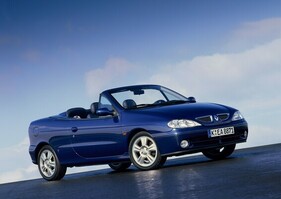
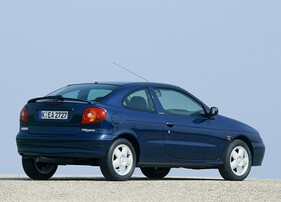


In the 1980s, Renault was under threat of being absorbed by a giant such as GM or Toyota. But President Raymond Lévy put an end to the American adventure and prescribed a cultural revolution towards quality for the company. The R19, recognized for its quality, created a solid foundation that would directly serve the new Mégane. "To be successful, we must of course capitalize on the R19's reputation for quality, but we must also offer the customer more services with more generous and attractive content," said Michel Faivre-Duboz, project manager at the time.
Cheaper but not worse
To achieve this, the brand had to learn to design and manufacture vehicles more cheaply. To this end, Renault approached Volvo. Experience was to be gathered and a group of employees was sent to the Dutch factory, which the Swedish manufacturer shared with the Japanese company Mitsubishi. But the really important insights were gained in Japan. Michel Faivre-Duboz set off with a team to the land of the rising sun and was forced to admit: "They had a cost price that was 30% lower than ours!" For a thorough analysis, Renault rented a Mitsubishi Colt, which was the equivalent of the Renault 19. The analysis showed that the decisive factor in competitiveness was not the equipment, but the cost reduction in purchasing and production, at that time additionally favored by an undervalued yen.
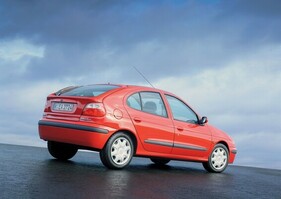
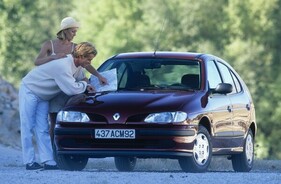
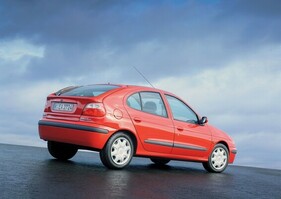
In this highly competitive environment, the idea was born to create a genuine Mégane family, including a compact van that was unique in this segment: "We had to say goodbye to the concept of 'one car for all' and switch to the concept of 'to each his own car'," recalls the project manager. And they had to do it on a tight budget. The decision was made to focus only on what the customer saw. The Mégane took over the entire front block from the R19 platform. In addition, it was equipped with the diesel engines of the F-segment and gasoline engines of the E-segment. One trick in particular was very effective: "The Mégane and Scénic had exactly the same dashboard. In the compact van, it was only raised and tilted by around 15 degrees. Nobody noticed it at the time!" The trick of using what was already there in a different way was used again in the development of the coupé by shortening the chassis while retaining the rear and front sections. Each car body was given its own designer. To ensure that the six models retained a family resemblance, the graphic theme of the ellipse was chosen, which gave the side of the six models a very strong unity. Each model was also given its own, very different proportions.
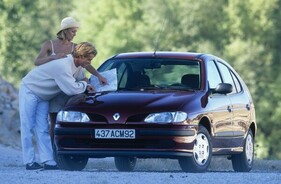
When they came onto the market in 1995, however, the saloon and coupé were slated in an article in Auto Plus magazine. "In particular, they questioned the stability of the saloon when braking and cornering," recalls Michel Faivre-Duboz. In response to this mini-crisis in the media, the four-link rear suspension was generalized. Previously, it had been reserved for the most powerful engines in the range. While the Coupé upgraded the entire range, the Minivan became the real sales hit of the model family from 1996 onwards. It was so successful that the production rate had to be quadrupled from 600 per day to 2,200 units.
Four generations, consistent success
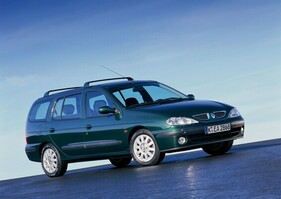
The Mégane was available as a four-door hatchback and three-door coupé right from the market launch. The notchback model followed in 1996, the Mégane Cabriolet in 1997 and the estate version in 1999. The Scénic compact van, launched in 1996, was initially even known as the Mégane Scénic.
In addition to the wealth of variants, Renault consistently focused on safety in the R19 successor. Driver and front passenger airbags were standard right from the start, and side airbags were added in 1998. The particularly stable body structure with defined deformation zones at the front and rear and the fitting of pyrotechnic belt tensioners and belt force limiters were also pioneering. This established the Mégane as the benchmark for occupant protection in the compact class. In 2002, the second model generation was the first vehicle in its segment to receive five stars in the Euro NCAP crash test at the time.
The Mégane II (2002-2008) was also the basis for the first Mégane R.S., which appeared in 2004. While the power output and top speed of the compact sports car were 165 kW/224 hp and 236 km/h respectively at that time, the figures rose to 221 kW/300 hp and 260 km/h by the current generation. Proof of the Mégane R.S.'s performance: each model generation set a new lap record for front-wheel drive production vehicles on the Nürburgring-Nordschleife.
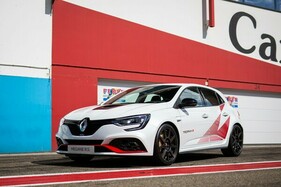
The fourth generation Mégane has been on the market since 2015. In addition to its expressive exterior, it impresses with a number of innovations that were previously reserved for higher vehicle classes. These include the Renault Multi-Sense system for personalizing the driving experience, 4Control dynamic all-wheel steering in the Mégane R.S. and a wide range of modern driver assistance systems.
First Renault compact model with E-Tech plug-in hybrid
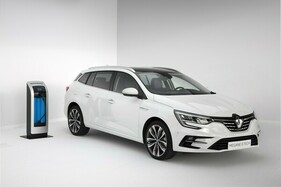
The Mégane's claim to be a technological driving force in the compact class has been underpinned by the E-Tech plug-in 160 hybrid drive since summer 2020. Initially available exclusively for the estate, the variant consists of a 1.6-liter petrol engine with particulate filter, two electric motors, an innovative multi-mode gearbox and a lithium-ion battery with a capacity of 9.8 kWh. Thanks to its high recuperation performance, the vehicle can cover up to 65 kilometers in city traffic in the WLTP test cycle on electric power alone. An electric range of 50 kilometers at speeds of up to 135 km/h is possible in a mix of city and country driving. The E-Tech plug-in hybrid drive will initially be available in the Mégane Grandtour and will later be introduced in the 5-door model.