


Happy 25th birthday: the H license plate celebrates its silver jubilee next year. Since the end of July 1997, it has recognized the status of vehicles as historical cultural assets. They can receive it 30 years after their first registration, provided they have a classic car certificate. In 2022, several Mercedes-Benz classics will be eligible for the coveted H license plate for the first time: The sporty and luxurious SEC coupés and the four-seater convertible of the 124 model series, as well as the G-Class and Unimog model series, are among the candidates for historic registration. They all premiered in 1992. In addition, there are other models and special editions presented 30 years ago.
Anyone who registers their classic car with the three-pointed star as a historic vehicle in 2022 will be in good company: according to the Federal Motor Transport Authority, 660,520 vehicles were registered in Germany on January 1, 2021, for which a classic car certificate confirms their status as a technical cultural asset - an increase of 11 percent compared to January 1, 2020.
These vehicles include 584,509 passenger cars, which accounts for 88.5 percent. In order to receive a classic car certificate, the vehicles must be in an authentic and technically good condition. By registering with a historic license plate, owners benefit from a tax reduction.
Luxurious sportiness with an individual appearance: SEC coupés from the 140 series
In January 1992, the SEC top-of-the-range coupés of the 140 series celebrated their premiere at the North American International Auto Show (NAIAS) in Detroit. These were the top models in the Mercedes-Benz passenger car range at the time. The C 140 was presented to the European public two months later at the Geneva Motor Show. The coupés are initially launched with the 500 SEC (V8 engine, 235 kW/320 hp) and 600 SEC (V12 engine, 290 kW/394 hp) models.

An innovation with far-reaching significance for the development of active driving safety was introduced three years later in the top model of the series, which was renamed the S 600 Coupé in June 1993 following the introduction of a new model designation: The Electronic Stability Program ESP® supports the driver by intervening in unstable driving situations through sensor-controlled, targeted braking intervention. Today, ESP® is a worldwide standard in automotive engineering.
The coupés are based on the S-Class of the 140 model series, but differ more clearly in style from the saloons than is the case with the predecessor 126 model series. The 1993 brochure describes the appearance of the sporty, luxurious, two-door touring car as follows: "By dispensing with anything superfluous and with clear, calm forms, the S-Class Coupé proves that dynamism can also be achieved without superimposed sportiness." By 1998, a total of 26,022 Coupés of the 140 model series were produced as SEC (1992 to 1993), S-Class Coupés (1993 to 1996) and CL-Class (1996 to 1998).
Open-top driving in the upper mid-size class: convertibles of the 124 model series
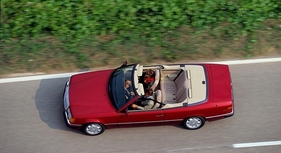
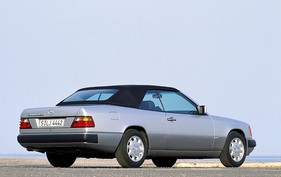
In June 1992, the Mercedes-Benz 300 CE-24 Cabriolet of the 124 model series made its market debut. The open-top four-seater with fabric top was presented at the International Motor Show (IAA) in Frankfurt am Main in September 1991. The Cabriolet is the fourth body variant of this generation of the upper mid-size class. Despite the close technical relationship to the Saloon (W 124), Estate (S 124) and Coupé (C 124), around 1,000 parts were completely redesigned for the Cabriolet (A 124). Many of these were used to reinforce the body to make the open-top four-seater as comfortable and safe as the other members of the model series family.

The open-top four-seater will initially be offered as the Mercedes-Benz 300 CE-24 Cabriolet with a 162 kW (220 hp) 3.0-liter inline six-cylinder engine. Following the reorganization of the model series and type designations and the simultaneous model update at Mercedes-Benz in summer 1993, there were four different types of the vehicle now known as the E-Class Cabriolet: E 200 Cabriolet (100 kW/136 hp), E 220 Cabriolet (110 kW/150 hp), E 320 Cabriolet (162 kW/220 hp) and the top-of-the-range model, the E 36 AMG Cabriolet (200 kW/272 hp).
For Mercedes-Benz brand history, the launch of the 124 model series Cabriolet is a significant return to the past. Previously, there had not been a four-seater convertible in the Stuttgart brand's model range for 20 years. The Mercedes-Benz 300 CE-24 Cabriolet continued a tradition last represented by the 280 SE Cabriolet and 280 SE 3.5 Cabriolet of the W 111 model series until 1971. By 1997, a total of 33,952 124 model series Cabriolets had been produced.
The off-road pros: Mercedes-Benz G-Model of the 461 model series
After 13 successful years since the premiere of the G-Model, Mercedes-Benz reorganized the model series family of the legendary off-road vehicle in 1992: the variants with a clear focus on professional applications as commercial vehicles were in future listed as the independent 461 model series. This model series designation had already existed before, but for versions of the G-model with 24-volt on-board electrics, which were primarily aimed at the military.

Customers from the municipal sector, rescue organizations, construction, forestry and many other sectors are now the main focus of the all-wheel-drive models in the 461 series (G-Class from 1993). The 290 GD (70 kW/95 hp) and 230 GE (90 kW/122 hp) models are available as station wagons (short and long), panel vans and pick-ups (long wheelbase) as well as chassis.
Unimog 408 and 418 series
30 years ago, the Mercedes-Benz Unimog received a double addition with the 408 and 418 model series. They made their debut at the IAA Commercial Vehicles in May 1992, replaced various models of the 417 model series and were the lightest Unimog model series in the sales program from the start of production. The newly developed cab, which is often ordered as a high-roof version with a visible channel hood, is striking. This is more inclined in front of the driver's seat than on the right-hand side and thus offers an even better view of front attachments.
The Unimogs of the 408 series are available with outputs between 65 kW (88 hp) and 85 kW (116 hp), those of the 418 series with 75 kW (102 hp) to 103 kW (140 hp). By 1998, a total of 1,223 418 series vehicles had been produced, and by 2001, 2,050 408 series Unimogs had rolled off the production line. The fact that the "universal motorized machine" had long since developed into an off-road icon in the 1990s is demonstrated by the "Funmog" study based on the Unimog U 90 of the 408 series as an all-terrain leisure vehicle.

V12 premiere for the SL of the 129 model series
In October, the 600 SL is the new top model of the SL sports cars in the 129 model series. The 290 kW (394 hp) roadster is the first Mercedes-Benz SL with a twelve-cylinder engine. The V12 engine ensures brilliant driving performance with very smooth running and turbine-like power delivery. The sports car accelerates from a standstill to 100 km/h in 6.1 seconds and the top speed is electronically limited at 250 km/h.
The top model in the SL family is characterized by a range of standard features: These include, for example, the adaptive damping system with level control on the front and rear axles, cruise control, an auto-dimming interior mirror, headlight cleaning system, automatic climate control, leather upholstery and heated seats. The exterior of the 600 SL, on the other hand, is discreet: Only the nameplate and two "V12" emblems behind the front wheel cut-outs distinguish it from its sister models. A total of 11,089 twelve-cylinder sports cars of the 129 series were built up to 2001.

Avantgarde rosso, azzurro and verde
In March 1992, three Avantgarde special models with special pearl color paintwork and striking interior design were launched in the successful W 201 compact class to appeal to young customers in particular: The Mercedes-Benz 190 E 1.8 Avantgarde rosso boasts metallic red paintwork and a colorful interior inspired by modern art. The 190 D 2.5 Avantgarde verde combines metallic green paintwork with the green and black dotted fabric pattern "Anton" in the interior. Finally, the 190 E 2.3 Avantgarde azzurro is painted metallic blue, the black leather seats are quilted in four different colors. It was presented in the 1992 brochure as "the powerhouse" of the special model series.
In addition to the bucket-shaped sports seats, the equipment included a Sportline suspension with 23 millimetres lowering, alloy wheels with wide tires, a sports steering wheel, black carbon fibre decor in the center console and numerous comfort features that were not a matter of course at the time. The special models were developed by an international team of female Mercedes-Benz designers. They are limited to a total of 4,600 vehicles and underline how the brand tapped into new groups of buyers with the 201 model series.

