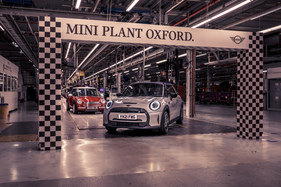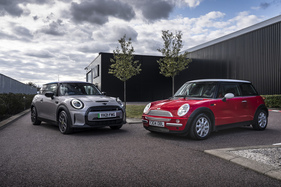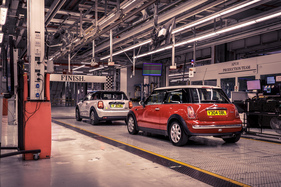
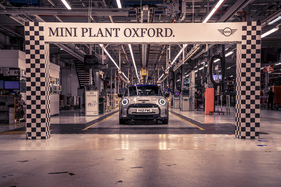
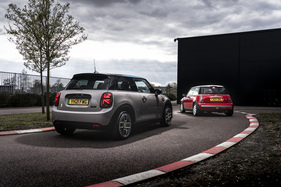
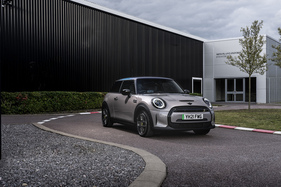
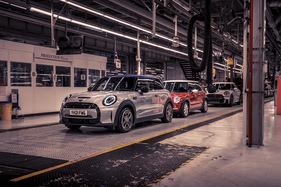
The Mini brand and the BMW Group's UK production plants in Oxford and Swindon are celebrating 20 years of producing the original small car for the 21st century.
The birth of an icon, relived
A success that has now lasted two decades: At the beginning of 2001, the production of Mini body parts started in Swindon. And a little later, on April 26, 2001, the first new Mini rolled off the production line in Oxford. Since then, Mini has built more than five million premium cars in the UK. The Oxford plant alone currently produces the Mini 3-door, the Mini 5-door and the Mini Clubman as well as the all-electric Mini Cooper SE - all on the same production line.
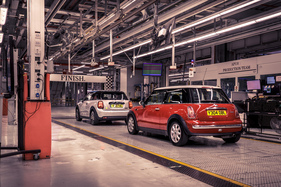
The Chairman of the Board of Management of the BMW Group, Oliver Zipse, was responsible for production at the Mini plant in Oxford from 2007 to 2008.
On the occasion of the 20th anniversary of the start of production, he says: "Congratulations to all employees at the Mini plants in Oxford and Swindon for achieving such a major milestone. I still have fond memories of my time in Oxford. It was a real pleasure to work in the home and heart of the Mini brand with such dedicated and passionate people, almost a quarter of whom have dedicated these full 20 years to building our cars - some even longer."
Currently, more than 4,500 highly skilled people are employed at the Mini plants in Oxford and Swindon, including 130 apprentices. Together, this strong team ensures that around 1,000 Mini cars are born on the island every day - one every 67 seconds.
Peter Weber, Head of the Oxford and Swindon plants since 2019, adds: "I am extremely proud of our teams in Oxford and Swindon and the incredible work they do. Their continued commitment and passion over the past 20 years has helped to establish Mini's legendary reputation around the world."
Manufacturing facility with a long history
The Oxford and Swindon plants already have a very long tradition as manufacturing facilities: Cars have been built there for 65 years (Swindon) and even 108 years (Oxford) respectively. For a long time this was done quietly, but in recent years the Oxford plant has become a magnet for tourists. In the meantime, the award-winning Mini factory tour there has delighted around 26,000 Mini fans.
The Oxford plant took an energetic step into the future in 2020 when the Mini Cooper SE, the brand's first all-electric model, rolled off the production line.
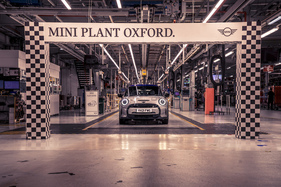
And that was just the beginning: By the early 2030s, Mini will be the first BMW Group brand whose entire range of models will be powered exclusively by electricity. The Oxford and Swindon plants have played a key role in making Mini production more sustainable over the past 20 years and are essential to the BMW Group's strategy to further reduce emissions.
The Mini brand and production in the UK:
- April 26, 2001: Start of Mini production at the Oxford plant.
- 2002: Just 13 months after the start of production, the 100,000th Mini leaves the Oxford plant.
- 2004: The BMW Group announces a £40 million investment in the Swindon plant. The Mini Convertible is unveiled.
- 2006: The Hams Hall plant produces a new generation of engines and supplies Oxford for Mini production, creating the British Mini production triangle of three plants. The Mini Cooper S with John Cooper Works GP Kit is unveiled.
- 2007: The Oxford Mini plant pioneers innovative paint technology. The Oxford plant is the first BMW Group production site to use IPP (Integrated Paint Process). This highly innovative system brings energy savings and emission reductions of well over ten percent in the painting of bodyshells.
- 2008: The new Mini Clubman is launched on the market.
- 2009: Start of the Mini E test, supported by the British government. Worldwide field test by the BMW Group to evaluate the technical and social aspects of living with a fully electric vehicle in everyday life.
- 2010: The brand's first all-wheel drive model, the Mini Countryman, is launched.
- 2011: Expansion of the model range to include the Mini Coupé.
- 2012: The Mini Roadster is launched on the market.
- 2013: Premiere for the Mini Paceman.
- 2014: The first Mini 5-door comes onto the market. One of the largest rooftop solar systems in the UK is installed at the Mini plant in Oxford. There are more than 11,500 solar panels on the roof of the body shop, covering 20,000 square meters (five soccer pitches). Together they generate enough electricity to power the equivalent of 850 homes (more than three megawatts). This will enable the Oxford plant to reduce its CO2 emissions by around 1500 tons per year.
- 2016: The latest generation of the Mini Convertible is announced.
- 2017: The second generation Mini Countryman is unveiled.
- 2019: The Mini plant in Oxford builds its 10 millionth Mini. Two new highlights in the model range are announced: the third Mini John Cooper Works GP and the brand's first all-electric production vehicle, the Mini Cooper SE.
- January 2020: Production of the Mini Cooper SE begins at the Oxford plant. The all-electric Mini is fully integrated into the production process. This makes it the first BMW Group plant where electric vehicles run on the same line as models with combustion engines, enabling flexible production in line with global demand.
- By the end of 2020: A total of 17,580 vehicles have been sold and delivered to customers around the world.
- October 2020: Mini announces future product plans and a new strategy with a focus on electric mobility, introduction of a new crossover model and production of models in China from 2023.
- March 2021: Mini confirms that 2025 will be the brand's last model with a combustion engine. From the early 2030s, the brand will drive exclusively electrically.
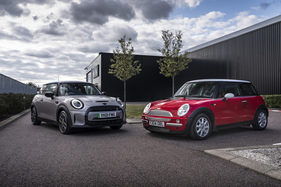
Video by Mini designer Frank Stephenson
Finally, there is an absolutely interesting video (in English only) by designer Frank Stephenson, these nine minutes are worth it! Frank Stephenson is one of the most successful car designers of modern times. His designs include the Ferrari 430 and the McLaren P1. In the video, he shows how he wanted to bring the then 40-year-old Mini into the modern era. His guiding principle: What would the Mini look like if it had been refreshed every few years?