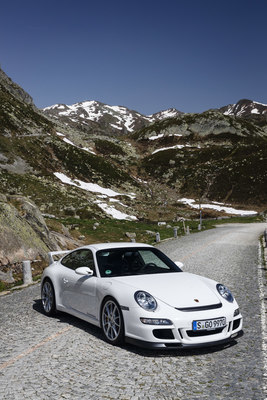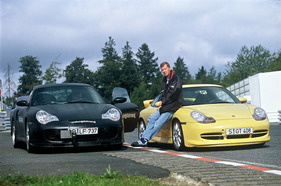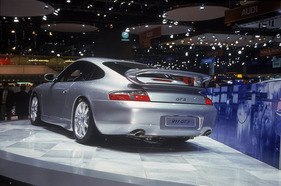
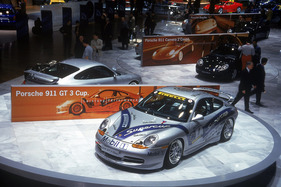
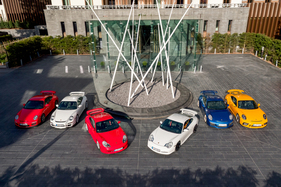
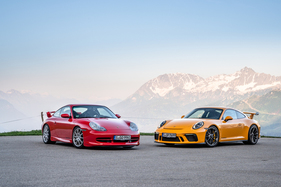
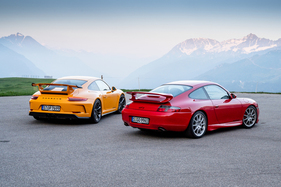
The unveiling of the first Porsche 911 GT3 at the Geneva Motor Show in March 1999 marked the beginning of a new era for discerning sports car drivers. The GT3 bore the signature of Porsche's racing department like no other Porsche 911.
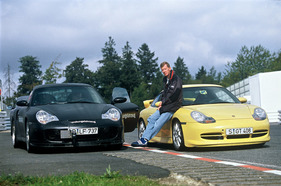
Developed by two-time rally world champion Walter Röhrl, racing engineer Roland Kussmaul and the Porsche motorsport specialists from Weissach, the Porsche 911 GT3 brought racetrack-ready agility to the road. Since then, the road-legal top athlete has become even faster, more precise and more dynamic with each generation - and with its naturally aspirated engine, manual gearbox and rear-wheel drive, it remains the favorite Porsche 911 of all purists to this day.
Many racing successes
The racing versions of the Porsche 911 GT3 have written motorsport history. In addition to countless class victories, the GT3 has claimed numerous overall victories in major endurance races, including the 24 Hours of Spa, the 24 Hours of Daytona and the 24 Hours of Nürburgring, which it has won seven times since 2000.

It is part of the Porsche 911 GT3's recipe for success that experience and innovations from motorsport are always incorporated into the development of the next road-going version. No wonder that around 80 percent of all 911 GT3s produced are regularly driven on the racetrack.
Successor to the 911 Carrera RS 2.7: The first GT3 debuted in 1999
With its highly developed racing technology, the Porsche 911 GT3 continued the tradition that began in the 1970s with the legendary Porsche 911 Carrera RS 2.7 shortly before the start of the new millennium. For the first time, however, the model was not given the designation "RS" for racing, but the name GT3 - a reference to the GT class in which the motorsport versions of the model were to race.
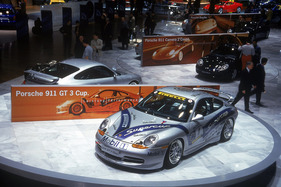
The water-cooled 3.6-liter six-cylinder boxer engine of the new sports car produced 265 kW (360 hp). So it was hardly surprising that the Porsche 911 GT3 earned its first laurels even before its premiere in Geneva: With Walter Röhrl at the wheel, it had lapped the 20.8-kilometer Nordschleife of the Nürburgring in less than eight minutes - setting a new benchmark for road sports cars.
From racing to the road
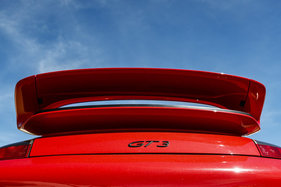
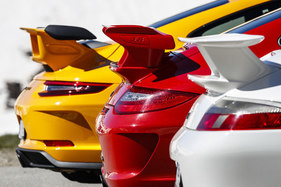
However, such exceptional performances were not only made possible by the race-proven boxer engine, but also thanks to a finely tuned overall package: the suspension was lowered by around 30 millimetres and the brakes were reinforced. The six-speed manual gearbox came from the Porsche 911 GT2. Gear ratios, axle geometry, anti-roll bars and springs could be adjusted depending on the track characteristics. Lightweight construction came before comfort. The 911 GT3's fixed rear wing was a distinctive feature of its racing origins.

Anyone who wanted to could also order their 911 GT3 in the Clubsport version, including with a bolted roll cage.
From May 1999, the first examples of the Porsche 911 GT3 left the production line in Weissach. As a homologation basis for motorsport, the new model also formed the basis for the successful 911 GT3 Cup and the 911 GT3 R and GT3 RSR racing versions above it, which were to achieve great success in one-make and GT sport in the years to come.
New generations in rapid succession
Following the great success of the first 911 GT3, Porsche presented a new evolutionary stage of the road-going sports car with racing genes every three to four years.
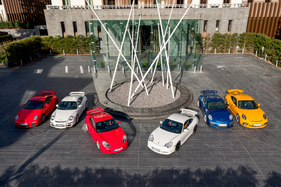
In 2003, the output of the boxer engine climbed to 280 kW (381 hp) with the use of the VarioCam continuously variable camshaft adjustment. On request, the GT3 could now also be ordered with the particularly powerful Porsche Ceramic Composite Brake (PCCB).
Three years later, the next leap in performance to 305 kW (415 hp) followed. For the first time, the Porsche 911 GT3 now had active suspension with the sporty Porsche Active Suspension Management (PASM).
In 2009, the engineers increased the displacement of the six-cylinder boxer engine to 3.8 liters and the output to 320 kW (435 hp). The completely redesigned rear wing and a fully clad underbody increased downforce to such an extent that the downforce more than doubled compared to its predecessor.
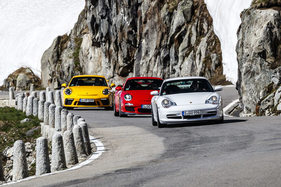
To mark the 50th anniversary of the Porsche 911, the fifth generation of the 911 GT3 celebrated its world premiere at the 2013 Geneva Motor Show. The engine and transmission, body and chassis were completely new. The powertrain consisted of a 3.8-liter naturally aspirated engine with 350 kW (475 hp), combined with a Porsche Doppelkupplungsgetriebe (PDK) for the first time. Another first was active rear-axle steering. At its debut, the new 911 GT3 lapped the Nordschleife of the Nürburgring in just 7:25 minutes - more than half a minute faster than the first 911 GT3 on its record-breaking run in 1999.
The 911 GT3 reached its latest stage of development in 2017, with the six-cylinder boxer engine at the heart of the development work, with a displacement of four liters and an output of 368 kW (500 hp). Porsche also has two treats in store for purists: firstly, a manual six-speed gearbox is available as an alternative to the PDK. And secondly, the 911 GT3 is available with a discreet touring package, in which, among other things, the fixed rear wing is replaced by an automatically extending spoiler - pure understatement.
And so the circle closes: the name "Touring package" is a reference to the civilian version of the legendary Porsche 911 Carrera RS 2.7 from the 1970s.