



Opel has been building automobiles since 1899. It all started with the 4 hp patented motor car "System Lutzmann" - according to the company brochure at the time, "Always the best of the best". In 2019, Opel celebrates 120 years of automobile manufacturing - and 120 years packed with innovations. The brand from Rüsselsheim has a tradition of cleverly putting technical achievements on the right track and making them affordable for series production.

Lively engines and safe chassis with plenty of grip have always played a prominent role - such as the 1.3 liter with "Opel synchronous suspension", the Diplomat B with De-Dion rear axle, the rally Kadett GT/E or the extra dynamic Calibra Turbo with all-wheel drive.
Opel Motorwagen represents "the highest achievements in engine construction to date"
The Opel Insignia in general and the Insignia "Ultimate 120 Years" in particular show that it is part of the brand essence to always offer customers more than they expect in the respective vehicle class. The foundation for this was laid at the end of the 19th century with the Opel patented motor car "System Lutzmann". This already offered two technological trump cards: firstly, the pneumatic tires, which had already been invented by Robert William Thomson in 1845, but had not yet found widespread use in automobile construction. Secondly, the small coach was powered by a 4 hp single-cylinder engine with buzzer ignition and speed-dependent surface carburetor.
In January 1901, Opel raved about this unit, saying that the cars built in Rüsselsheim "represent the highest level of engine construction achieved to date in terms of simplicity of mechanism and solidity of construction".
"Dizzying speed" thanks to two-cylinder engine with 12 hp
"Always the best of the best" is another Opel motto. And because the Rüsselsheim-based company, like all automobile and engine manufacturers, was confronted with the demand for more power right from the start, they went one better in 1902: The company's first two-cylinder engine, developed under the guidance of brothers Fritz and Wilhelm, who had a technical university education, mobilized 12 hp.

Thanks to the two bottom-mounted camshafts with spur gear drive for controlling the opposing intake and exhaust valves and the fan behind the characteristic honeycomb radiator, which was unusual at the time, the Opel MotorwagenThe Opel motor car with tonneau body achieved the "dizzying speed" of up to 45 km/h - more of a theoretical value, as the roads were only paved and adequately surfaced in cities, if at all. The mechanical oil pump undoubtedly makes the progress noticeable. This means that the hand pump with sight glass, which otherwise had to be operated by the driver every 10 to 15 kilometers, has finally had its day.
Opel synchronous suspension ends the carriage era
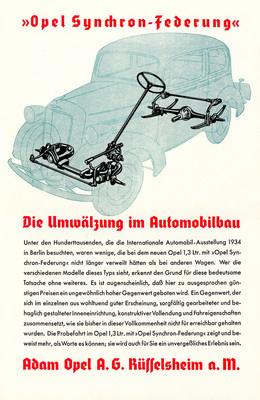
A milestone in Rüsselsheim's technological development ensures that not every infrastructural inadequacy reaches the motorists in its entirety: the "Opel synchronous suspension" presented at the Berlin Motor Show in 1934 is the counter-design to the axle-less suspended front wheels that were still widespread at the time. Horizontal coil springs and double-acting hydraulic shock absorbers in the spring housing (Dubonnet spring knee) prevent pitching vibrations.

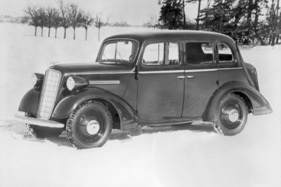
Together with the semi-elliptical leaf springs and hydraulic dampers on the rear axle, they allow the car to float over potholes. Many competitors with designs dating back to the carriage age suddenly look very old against the 24 hp Opel 1.3-liter model, which features a box frame with diagonal bracing and cross members, four-speed transmission and hydraulic brakes.
Inline six-cylinder engine transports a premium feel to the mid-size class
The example of the Rekord A "6" shows how Opel is driving forward the "democratization" of high-quality technologies. The heart of the top-of-the-range version launched in 1964 produces an impressive 185 Newton meters of torque from 2.6 liters of displacement. Power lies in tranquillity - thanks to the superior in-line six-cylinder engine, the mid-range saloon and coupé have a premium feel to them.

This is based on the old-school design principle with side camshaft, pushrods, rocker arms and overhead valves. Hydraulic tappets make the valve train maintenance-free. The short-stroke engine significantly upgraded the Rekord A towards the end of its career and, thanks to its convincing character, also suited the new Kapitän and Admiral luxury class models.
As if Opel had built the best road imaginable into the Diplomat
The Rüsselsheim-based company continues to make no secret of its penchant for advanced drive and chassis solutions. For example, the sales brochure for the Opel Diplomat B, launched in 1969, states: "We built it from the inside out." Meaning? "The technology sets the tone." That's fair to say - especially in view of the De Dion rear axle, which was highly praised by experts.

This sophisticated design combines the advantages of the toe and camber-resistant double-jointed rigid axle with independent wheel suspension aimed at low unsprung masses. The differential on the subframe, the drive shafts with homokinetic joints and length compensation, trailing arms and wishbones for precise wheel guidance, stabilizer bar, coil springs and telescopic shock absorbers complete the picture. All together, it looks "as if we had installed the best road imaginable".
105 hp catapult for the "rocket from Rüsselsheim"
105 hp in a compact car in 1975 is also quite something. With the Kadett GT/E, Opel releases a "basic model for competitions". What rally and circuit pilots consider their racing machine, the sporty "average consumer" considers their sprint-strong everyday vehicle with excellent driving characteristics. The powerful 1.9-liter injection engine, which is also used in the new Manta GT/E, catapults the "rocket from Rüsselsheim" with an unladen weight of just 900 kilograms from a standstill to 100 km/h in 10.2 seconds. 184 km/h is possible at top speed and even 190 km/h with the two-liter engine.

To ensure the best grip and high cornering speeds, the Rüsselsheim engineers also left nothing to chance on the suspension side: thanks to stiffer coil springs and special Bilstein shock absorbers, the chassis is able to cope with the high engine output and offers plenty of safety reserves.
High-tech in-line six-cylinder engine combines smooth running with top speed
At the end of the 1970s, Opel introduces the Senator as the successor to the legendary KAD series (Kapitän, Admiral, Diplomat). The new Opel flagship impressed both technically and in terms of quality and also performed excellently in direct comparison with saloons from Stuttgart and Munich. One vehicle class below, the Opel Omega replaces the Rekord E in 1986 and earns the "Car of the Year 1987" award the very next year. For both models - Senator and Omega - Opel developed a completely new six-cylinder in-line engine, which was one of the best engines of its time in terms of performance, smoothness and power delivery. With these engines, the edge of a coin can be placed on the valve cover at idle without being tipped over by engine vibrations.

A particular challenge for the Opel engineers was the fact that the new engine in the top-of-the-range Senator 3.0i 24V model was to provide superior, unagitated propulsion, while at the same time driving the Omega 3000 24V as the sportiest version of the mid-size sedan to the top without compromise. A balancing act that the designers mastered with flying colors. The new three-liter six-cylinder engine has an output of 150 kW/204 hp. Four-valve technology and the innovative dual-ram intake system ensure superior power delivery and plenty of driving pleasure even at low engine speeds, while the maximum torque is 270 Newton meters. The engine impresses with excellent acceleration and high elasticity in all engine speed ranges: The Omega 3000 24V sprints from 0 to 100 km/h in 7.6 seconds with a five-speed manual gearbox, while the heavier Senator 3.0i 24V needs two tenths more.
DSA safety suspension with multi-link rear axle offers high reserves
To ensure that the increased engine power is transferred safely and evenly to the road, the Opel designers have equipped the sporty Opel Omega 3000 and Omega 3000 24V as well as all Senator models with a newly developed multi-link rear suspension system. The system, which is based on the DSA safety suspension, guarantees high safety reserves in all speed ranges and driving situations. The engineers achieved this through an additional guide element.
Without this additional diagonal control arm, a harder suspension set-up would have been necessary, which would have led to a considerable loss of comfort, particularly in the Senator models - a fact that customers would probably not have approved of. Thanks to many years of computer-simulated development work, the engineers were able to improve steering precision and cornering behavior. This is particularly evident during fast cornering and load changes, but also during sudden lane changes or evasive maneuvers. Here, particularly with high-performance engines, large torque differences act on the drive wheels, which leads to self-steering reactions of the vehicle. The new DSA multilink rear axle reduces this to a minimum. The Opel engineers have thus achieved the feat of safely transferring the significantly increased performance of the new six-cylinder engines to the road without compromising on comfort or vehicle set-up.
Opel Calibra sets standards with progressive design and all-wheel drive
Opel enters the last decade of the last century with a progressive design: The Calibra presented at the IAA in 1989 not only wins numerous international design awards, the four-seater sports coupé also impresses technically across the board. The Calibra boasts the lowest aerodynamic drag of any production car; its drag coefficient of 0.26 earns it the title of "Aerodynamics World Champion".

From the end of 1990, the all-wheel drive system already familiar from the Opel Vectra was available for the Coupé. The system promised high traction, excellent braking stability and safe handling in all situations. A viscous coupling ensures the necessary speed compensation between the front and rear axles when cornering. It also automatically distributes the drive torque between the two axles depending on the slip on the front wheels. The rear axle thus takes over between 15 and 60 percent of the drive, in extreme cases even up to 100 percent. Opel engineers have achieved a further increase in driving safety with the hydraulic multi-plate separating clutch. By interrupting the drive power to the rear axle at lightning speed when braking, the system ensures outstanding braking stability in all driving situations, also thanks to the use of the standard ABS system.
Due to its sporty, wedge-shaped design, the Calibra virtually demanded a top version with plenty of power - which Opel delivered from 1992. The Rüsselsheim-based company replaced the 16-valve engine with a newly designed turbo engine. The unit was based on the proven four-valve engine, to which the engineers only had to make a few modifications. However, these resulted in a significant increase in power from 150 to 204 hp with almost the same fuel consumption and, in conjunction with the all-wheel drive, made the Calibra Turbo a real competitor to the Porsche 968, which was almost twice as expensive at the time. One of the special technical features of Opel's new turbo engine was the integration of the turbocharger and exhaust manifold into one component. This integral system works with particularly low thermal losses and a significantly higher efficiency of the supercharger. The newly developed turbo engine marks the beginning of a new era: turbocharged engines are finding their way into more and more models and vehicle classes.
FlexRide chassis with three individual modes for precisely portioned driving pleasure
From 2008, the Opel magic word for even more driving fun and safety is "FlexRide". Initially reserved for the new Opel flagship Insignia, the mechatronic chassis with adaptive shock absorber control will find its way into the new Astra generation just one year later. The special feature: FlexRide allows the driver to adjust the driving dynamics according to their own preferences by selecting Standard, Sport and Tour modes - a real rarity in the compact class segment.
Thanks to the DMC control unit (Driving Mode Control), the suspension adjusts itself in a flash according to steering maneuvers, acceleration behaviour, road conditions and the desired mode. In Tour mode, for example, the dampers react more softly and the steering is also smoother. This makes long journeys less tiring and more relaxed. In Sport mode, FlexRide offers a dynamic driving experience with optimum feedback: The damping becomes harder, the steering reacts more directly and the electronic accelerator pedal responds more progressively. To reflect the sportier look of the car, the illumination of the instruments changes from white to red.
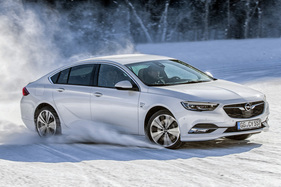
If you want to see how the different Opel models perform in the snow, you will certainly enjoy the video from Opel.
