When you hear the name Lancia, you might think: Does the brand still exist? Where are vehicles with this name still sold? At the same time, cars from this traditional company appear in the mind's eye: they are particularly progressive cars or those with outstanding styling. And last but not least, one thinks of the many sporting successes of the car brand, which was (co-)founded by Vincenzo Lancia in 1906. It is therefore fitting to commemorate its anniversary with a special exhibition. The latest "pop-up" exhibition at Autoworld Brussels is divided into two segments: "Design and Innovation" and "Successes in Rallying". The collection, ambitiously put together by curator Leo Van Hoorick, uses around a dozen exemplary exhibits to show the great achievements that the Lancia brand has been capable of in the 120 years of its existence. Let's take a look around...
Cars in the exhibition
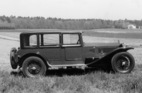
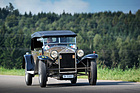
The oldest Lancia is a Lambda from the second series from 1924. Over 100 years ago, this was the first vehicle with a self-supporting body and it had independent front suspension.

It was followed in time by an Astura Roadster from 1935, a sports car on a "short" chassis with a V8 engine, again with independent front suspension and elegant bodywork by Pinin Farina.

The small Aprilia compact sedan with a compact V4 engine and independent suspension dates back to 1947 and the second series. Its body follows the streamlined shape, and getting in is particularly easy thanks to the absence of the B-pillars. It is amazing how effectively the interior space is used with a wheelbase of 2.75 meters.

Two exhibits are from 1952: the PF 200 prototype, which was presented at the 1952 Turin Motor Show and designed by Pinin Farina, is certainly not something you see every day. It is the first of five or six examples. The round radiator grille, inspired by the new jets of the time, and the six small-diameter exhaust pipes arranged in two groups of three are striking.

Related to this is the Lancia Aurelia B 20, which - like the prototype - is also equipped with an innovative V6 engine. This vehicle probably founded the 2 + 2 genre in the GT. Its no-frills, purist body design has a timeless look and is somewhat reminiscent of the famous Cisitatia 202, which was designed by Mario Felice Boano.

If a small digression is permitted: Just a few meters away is a Ferrari 250 GT from Autoworld's permanent collection, which was built at the coachbuilding company briefly run by Boano.
The Lancia Florida study, based on the Aurelia, is undoubtedly impressive. This is a large, four-door saloon from 1956 designed by Pinin Farina, which served as a model for the later Lancia Flaminia. With wide-opening doors that open in opposite directions and no B-pillar, this design study invites you to take a look inside the luxurious interior.

Now we come to the Lancia Flaminia Zagato Sport from 1963. The Flaminia coupé was interpreted by various designers at the time. The Zagato version shown here naturally also has the typical "double bubble" roof.

With a big leap in time, we come to the last exhibit in this exhibition segment: the Lancia Thema 8.32 from 1987. At first glance, this rather inconspicuous vehicle embodies pure understatement, because under its hood is a transversely mounted V8 engine from Ferrari, with the "8" standing for the number of cylinders and the "32" for the number of valves.

Motorsport
The motorsport section of the exhibition begins with the 1955 Lancia D 50 racing car. The Formula 1 racing car was developed by former Alfa Romeo chief engineer Vittorio Jano and was once driven by Alberto Ascari. The aluminum fuel tanks mounted on the sides between the wheels are striking. The engine was designed as a load-bearing part and the transmission shaft was offset, which meant that the cockpit could be low. After Ascari's fatal accident, Lancia sold the entire racing department to Ferrari. The Type D 50 was revised and used as the Ferrari D 50 by Juan Manuel Fangio, who won his fourth world championship with it.

Rally sport
Somewhat hidden in the "Bagnole" museum bistro is a Lancia Fulvia Coupé 1.6 HF Fanalone, where "fanalone" refers to the car's large auxiliary headlights. Lancia started a long series of victories with these cars, the victory at the 1972 Monte Carlo Rally being a prime example. However, a "customer version" of the Fulvia is shown at Autoworld.

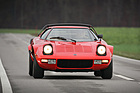
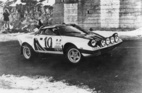
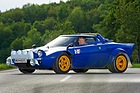
Let's stay with the rally cars. The Lancia Stratos HF, which was victorious in numerous competitions in the 1970s, is legendary. In 1974, 1975 and 1976, Lancia won the Constructors' World Championship with it. An exact replica of the 1974 Lancia Stratos HF Group 4 "Alitalia", in which the recently deceased Sandro Munari and his co-driver Piero Sodano won the 1977 San Remo Rally, is on display in Brussels.

At his side is a ten years younger Lancia Rally 037 Evolution II. Walter Röhrl won the 1983 Monte Carlo Rally with this rear-wheel drive model. In the same year, Lancia secured the Constructors' World Championship, something that has only ever been achieved with all-wheel drive cars. The replica of the car in which Markku Alén and his co-driver Ilkka Kivimäki won the Tour de Corse in 1984 is on display at Autoworld.

Let's end our look at the special exhibition with the Lancia Delta HF Integrale 16 V Group A "Martini" from 1990. This compact four-wheel drive car dominated the rally scene for a long time, with Lancia winning the Constructors' World Championship six years in a row.

Let's draw a conclusion: this small but worthwhile exhibition pays tribute to a very old automobile company whose achievements should not be forgotten. After completing this report, the author's gaze falls on his model car showcase. To be more precise: the Lancia Stratos Zero from 1970. Mamma mia, what a futuristic wedge!

Further information
Further information on the exhibition "Lancia 120 Years - Innovation through Italian Design", which is on display until April 19, 2026, can be found on the museum's website.