Wintertime is also museum time, so the various classic car museums in our latitudes should have a fruitful time again. Accordingly, these places of automotive history are also equipping themselves with special exhibitions and attractions.
In Zwickau, the August Horch Museum is located in the former production halls of the Audi company. Over the next few months, it will be showing a special Röhr exhibition alongside the permanent exhibits (until April 1, 2013). For this reason alone, but not only for this reason, a trip to Zwickau is worthwhile.
Röhr - safety itself!
Röhr built around 4,000 vehicles up to 1935; today, only around 30 of them are said to still exist, most of them in a pitiful condition. The cars were considered to be extremely progressive in the 1930s, with two of the most famous German automotive engineers, Ferdinant Porsche and Hans Ledwinka, among others, working on them. As many as six of the surviving vehicles, i.e. 20% of the remaining stock, can be viewed in the special exhibition, which was put together in collaboration with Werner Schollenberg.

The cars and the informative texts provide an exciting insight into the history of this pioneering automobile factory, which was located in Ober-Ramstadt.
In the footsteps of the German inventor August Horch
August Horch not only gave the museum in Zwickau its name, he also strongly influenced the German automotive industry and founded two brands, Horch and Audi, which are still important today. Born in 1868, the trained mechanical engineer founded the Horch brand in 1899 and presented the first German car with a four-cylinder engine in 1903. From the very beginning, he was convinced that his cars had to prove themselves in motorsport and he was able to celebrate great successes.
In 1909, following disputes, August Horch left the company he had founded and soon set up a second one, which he again called Horch (August Horch Automoiblwerke GmbH), but had to change its name after a legal dispute with the other "Horch" and came up with the Latin "Audi", which again translated means "hear" or "horch".
The first Audi was delivered as early as 1910 and these vehicles were also characterized by the most advanced technology.
Horch and Audi - winged globe against the "one"
A selection of vehicles from the two competing brands Horch and Audi can be seen in the museum in Zwickau, most of which excelled with technical innovations. Despite all their engineering prowess, however, both factories ultimately suffered from an unfortunate economic environment and sales difficulties.

The formation of Auto Union
In 1932, the "Auto Union" was founded, under whose umbrella the four brands DKW, Wanderer, Horch and Audi were brought together and which was subsidized by the state. The permanent exhibition at the Zwickau museum features many DKW vehicles, but also shows Wanderer and, of course, Audi and Horch exhibits.

The Trabi - from the beginning to the end
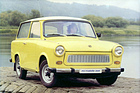
A significant part of the exhibition space is dedicated to Trabant vehicles. Visitors can not only observe the individual stages of development, but also explore the construction of these cars, which were planked with plastic parts out of necessity. A number of prototypes are also on display. Few people know, for example, that Wankel engines were also developed for the Trabant and tested quite successfully. Like so many others, this project was discontinued due to high fuel consumption and unconvincing environmental friendliness.

However, the car makers in Zwickau suffered most from the lack of financial resources, which meant that even good ideas and beautiful prototypes could not be transferred to series production. Or as the knowledgeable museum guide said in broad Saxon: "We had the turnips (by which he meant the heads), but not the money".
Until the end of the year - 100 years of driving licenses
Another special exhibition is currently dedicated to the German driving license, which is now 100 years old and has taken on new forms time and again.
Atmospherically designed
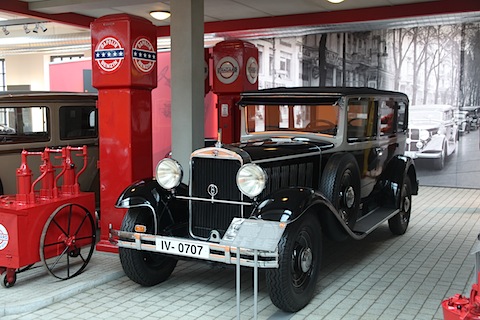
The interior of the August Horch Museum, which was created with significant funding from Audi and the city of Zwickau, impresses with its varied and tasteful design and atmospheric details. For example, an entire street was recreated on the first floor, including cobblestones, sidewalk, shop windows and utensils. Not only perfectly restored vehicles are on display, but also ruins and vehicles with signs of wear and tear.

Informative
You can learn a lot in Zwickau. The exhibits are labeled with informative explanatory panels, and you can also have the exhibits explained to you acoustically. Of course, a guided tour of the exhibition is even more interactive and entertaining, as the museum's experts know a lot of things that are not on the explanatory panels.
In addition to the cars, you can also visit a workshop with functioning machines that are put into operation several times a day. There is even a running Horch eight-cylinder engine ready for a test run.
And if you want to see more about life in those days, you can walk through the offices where August Horch came and went, and there is even an old telephone and a "photocopier". On special request, the manufacturer's villa can also be included in the visit.
Entertaining
The tour through the museum is entertaining, not least thanks to the collected and exhibited visual material, but also thanks to the clever inclusion of sound and images. The Auto-Union racing simulator will soon be put into operation. Anyone who is tired, hungry or thirsty can get refreshments in the museum coffee shop.
Not overloaded
The August Horch Museum, which opened in 2004, is well laid out and the exhibition is not huge, covering around 3,000 square meters. Around 1.5 to 3 hours will normally be enough to get a comprehensive impression. This leaves plenty of time for a stroll through the center of Zwickau.
A visit to the museum doesn't break the bank either, at Euro 5.50 - there are also discounts for groups, children, students and others - it can be described as inexpensive.
Further information about exhibitions and events, as well as opening times, can be found on the museum website .