The Schlumpf Museum, or as it is officially called "Citè de l'Automobile - National Museum - Collection Schlumpf", is one of the largest automobile museums in the world and is particularly famous for its huge Bugatti collection.

The history of the creation of the Schlumpf Museum in Mulhouse is neither straightforward nor easy to understand. For those readers who have not been able to follow it, it is briefly summarized here:
The two brothers Hans and Fritz Schlumpf founded SAIL (Sociéte Anonyme pro l`Industrie Lainière) in 1935, bought their first shares in the Malmerspach worsted spinning mill and took over a majority stake in several companies in 1940, such as Ersten in 1956 and then Roubaix. In 1957, they also acquired the HKD (Heilmann, Koechlin & Desaulles) textile factory, a traditional wool spinning mill in Mulhouse.
Start of the collection
Between 1961 and 1963, Fritz Schlumpf secretly bought a large number of classic automobiles. In order to make these purchases unnoticed, he used numerous "front men" in France, Switzerland, England, Italy, Germany and the United States. Some of these contacts proved to be particularly fruitful: 13 of them provided him with around half of his collection, i.e. more than 200 cars. Among them was M. Rafaelli, Renault dealer and owner of several Bugattis, whom Fritz Schlumpf made his sales advisor. This cooperation lasted for several years.

The wealthy industrialist was constantly buying European cars of the heyday, but he rejected American cars.
In May 1965, the first article was published in the magazine "L'Alsace", revealing the extent of the hitherto secret collection. Fritz Schlumpf granted only a select few access to the factory warehouses where the collection was housed.
Preparations for presentation
In 1966, work began on the presentation of the collection. Fritz Schlumpf's aim was now to make his unique collection, which he had amassed in just a few years, accessible to the public.
He had part of the textile factory's warehouses converted into the "Musée Schlumpf". This extensive work took several years. All the partition walls that had separated the different production areas in the large hall were torn down. This new exhibition hall was 17,000 m2 in size and was in turn divided into 23 rectangular rooms with space for 10 to 20 cars to be displayed.
These sections were bordered by wide tiled avenues and bore names such as "Avenue Carl Schlumpf", "Avenue Jeanne Schlumpf" and "Rue Royale" ....usw.
At the same time, the restoration work on the classic cars progressed rapidly. An extensive team was at work: mechanics, saddlers, tinsmiths, painters and their assistants, almost 20 people in total.

In this way, Fritz Schlumpf spent around 12 million francs over 10 years on the purchase and presentation of his collection.
Crisis and expropriation
On June 28, 1976, the textile industry slipped into a major crisis and the workers went on strike. The trade unions denounced the "lack of understanding" and the "evasion of the law" by the two industrialists. The Schlumpf brothers tried to sell their factories for a symbolic franc. However, when no offers were received, they resigned from their company posts and fled to the "Trois Rois" hotel in Basel. They never returned to France. At the end of 1976, the 20 workers remaining in the HKC factory were dismissed and the factory doors were sealed. A long legal battle then began between the Schlumpf brothers and their creditors.
On March 7, 1977, the warehouses were occupied by the trade unions. The "Musée Schlumpf" was renamed the "Museum of the Workers". Under the supervision of the CFDT trade union, admission to the museum was free. Donations were collected at the exit of the museum to cover the costs of keeping the museum open and continuing the action. "I earned 1400 francs a month, see where the rest went!" read one of the numerous information boards placed on the radiator grille of a racing car. That was the beginning of the so-called Schlumpf affair.
Nationalization
In 1978, at the suggestion of Jean Panhard, the collection was classified as a "Monument Historique" by the French Council of State, which meant that none of the collector's items were allowed to leave French soil.
In 1979, the Colmar Court of Appeal confirmed the extension of the liquidation to the Schlumpf brothers' personal assets, including the automobile collection that had been restored at the factory's expense. A few hours after this ruling, the CFDT union returned the keys to the factory.
In October 1980, the Court of Cassation authorized the sale of the collection. The following year, the "Association Propriétaire de Musée National de L`Automobile" bought it back. At the time, this association consisted of the city of Mulhouse, the Haut-Rhin department, the Alsace region, the Mulhouse Chamber of Commerce and Industry, the Automobile Club de France, the Société Panhard and the Comité du Salon de L`Automobile.
Under the chairmanship of the President of the General Council of the Département of Haut-Rhin, 44 million francs were raised to purchase the collection. This lump sum was contested by the Schlumpf brothers and 20 years later they were vindicated, receiving an additional 25 million francs.
The Musée Nationale de L`Automobile was opened on July 10, 1982.
Reopening
In 1989, a ruling by the Paris Court of Appeal forced the Musée national de l`Automobile to add "Collection Schlumpf" to its name and all documents referring to parts of the collection.
In 1999, the company Culturspaces was entrusted with the operation of the museum. After extensive work, the new administrator opened the partially renovated and modernized largest automobile museum in the world on 25 March 2000.

Extension to include an archive
Another important highlight was added this year. The descendants of the Schlumpf brothers began selling off some of the real estate. During the clearing work, they came across Fritz Schlumpf's automobile archive. He had not only meticulously collected the cars, but also the associated papers. Documents, photos and correspondence with the factories or restoration companies were cherished and cared for by him. There are also original plans for Alfa Romeo and Bugatti, as well as overalls and helmets worn by drivers and even posters of some events.
As the dispute between the Schlumpf family and the museum had never subsided over the years, the Schlumpf heirs wanted to cede this archive to anyone but the museum. Although this archive belongs to the museum like a child belongs to its parents, it was auctioned off in 20 different lots at Christies.
Just one hour before the auction began, the museum received the OK from the Ministry to purchase the entire archive and a corresponding loan was approved. A heated bidding scenario, with two bidders in the room, two on the phone and others on the Internet, took its course.
It came to a happy ending for the museum. In November 2015, the president of the museum and chairman of the owners' association, Mr. Trimailles, and his chief curator, Mr. Keller, were able to give a group of interested parties a sneak peek at the documents.

In future, one or two archive documents will be exhibited on an ongoing basis and presented to museum visitors for inspection.

Extensive documentation
It is fascinating to realize how intensively Fritz Schlumpf had dealt with all his cars. Given the very large number of vehicles purchased, one imagines a wild and random collection. However, this impression is deceptive, as the numerous photos and correspondence prove.
The corresponding documents for each vehicle were neatly filed in folders. Even back then, some of the vehicles acquired were so-called barn finds, which Schlumpf was certainly able to acquire at a reasonable price at the time. However, these poorly preserved cars naturally required a thorough restoration, as this letter clearly shows. Fritz Schlumpf wrote to the leather manufacturer Lynn in Stuttgart on August 3, 1964: "Dear Sirs, thank you for your kind offer of August 31. I find your pigskin much too hard and would like the soft English version. Are you able to provide me with the same. Yours sincerely ..." (Letter copied verbatim without correction).

For the restoration of the Alfa-Romeo owned by Swiss racing driver Peter Dätwyler, the factory asked for the original plans without further ado. Schlumpf actually received them, as can be seen in the photo.
Obsessed with Bugatti
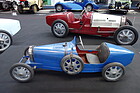
Fritz Schlumpf was completely obsessed with the Bugatti brand. He didn't just buy one vehicle per model, he hoarded all available examples and didn't care what condition the cars were in. This resulted in an impressive number of models. It was rumored that Schlumpf owned 30 Bugatti Type 35 cars alone! There were seven of the Atalanta and no less than 15 of the Type 57!
The first Type 41 built by Bugatti in 1931 and then sold could not be included in Fritz Schlumpf's collection as an original, so it was quickly rebuilt using the original plans and various original parts. The reconstruction began in 1975 and ended 15 years later.

Not only does the museum itself embody an exciting history, but each of the exhibits could and can also tell a very personal story.
Further information about the museum can be found on its website.