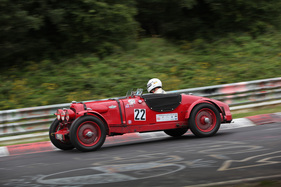
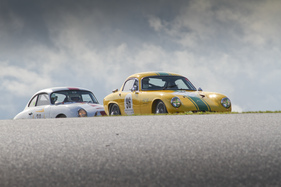
The AvD Oldtimer Grand Prix (AvD OGP) is a bit like an old acquaintance. You know its strengths and weaknesses, are immune to big surprises and are nevertheless, or perhaps precisely because of this, always happy to see it.

Fans of historic motorsport flocked to the Eifel for the 42nd time. The program differed only marginally from previous years, but to speak of a lack of highlights would certainly be wrong. After all, this year's Oldtimer Grand Prix also had a few highlights to offer.
Eifel weather for the marathon
For the first few kilometers, the participants of the AvD Historic Marathon and the Nürburgring Trophy (for youngtimers) could still look forward to a dry track, but soon it started to drizzle and then really pour, so that veritable streams crossed the Nordschleife. Many a driver had to painfully realize that under these circumstances, the bodywork can quickly become deformed. In fact, more and more cars were showing signs of damage.

Only Walter Röhrl seemed to suit the wet and slippery conditions, despite not having the best tires. "It was incredibly difficult to drive; you can't even imagine it - the car suddenly went sideways at 160 or 170 km/h - with 40 years of rally experience it was manageable, otherwise probably not; but ultimately it's also fun when you can see that the reflexes are still all there," said an exhausted Röhrl after his stint in the 1965 Porsche 911, which he shared with Armin Zumtobel and which the two of them placed an excellent third overall.

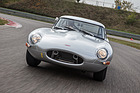
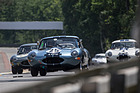
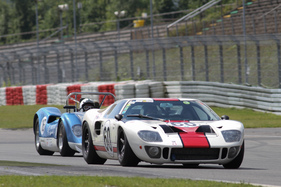
Ahead of them were vehicles with almost twice the engine capacity or even more. The winners were Frank Stippler and Marcus von Oeynhausen in the 1962 Jaguar E-Type, who narrowly held off the Ford GT40 of Michael Gans and Jason Wright. "It really rained on us," said Gans, who drove brilliantly, "it got so wet inside that the electrics were under water."

The Porsche 904/6 of Fatemi/Kaufmann was unable to finish the race in the top positions, ending up in 9th place for a car that Kaufmann believes has the potential for overall victory. After all, the same car won the prototypes in the 1964 1000 km race on the Nordschleife under Joakim Bonnier and Richie Ginther.
The Aston Martin DP214 was also unable to finish on the podium, with a crash and significant sheet metal deformation forcing it to retire from the race.

The rain had become so heavy after around 2.5 hours that the race was interrupted and could only be reopened over half an hour later for a final 40-minute sprint.
The Nürburgring Trophy for the younger cars was won by Stefan Oberdörster and Andreas Gulden in the Porsche 911 S 2.4 from 1970. It was not least the weather that allowed the narrow and less powerful early 911-ers to prevail against the powerful RS and RSR models.

The Skoda 130 RS, also known as the "Porsche of the East", provided a special splash of color. Although the beautifully prepared coupé did not finish in the top places, the car did not suffer any damage.
The gentlemen go full throttle
What is normally reserved for the two-seater sports cars with their night race, the Gran Turismo vehicles up to 1965 of the Gentlemen Drivers were able to enjoy in 2014: driving into the evening sun and dusk.

The Saturday race actually started late, but this did not prevent the drivers, who were full of energy, from giving their all and sometimes even a little more. There were one or two spins in the Yokohama-S, which led to tricky situations, such as when a Ginetta G4 in the wrong direction in the middle of the road failed to start and had to be pushed on again. Lightweight construction also has disadvantages when the on-board energy is not even enough to start the engine.

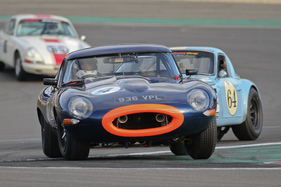
The battle between Martin O'Connell in the Jaguar E-Type and Sean McInerney in the TVR Griffith raged for several laps. In the end, however, the Jaguar driver came out on top. In third place was Andrew Haddon in the AC Cobra, followed by the Dane Pedersen in the Ginetta G4R, which was inferior in terms of displacement. Urs Müller, another lightweight car, a Lotus Elan, took eighth place among the powerful sports cars with 3.8 liters and more.

Exotic cars such as the Bizzarrini 5300 GT, the Alfa Romeo TZ2 or the Ferrari 250 SWB did not make the cut for the top places in the trophy distribution.

Two-seater in the night
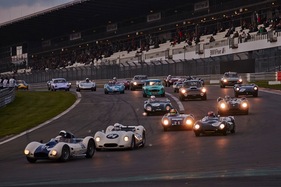
The sun had already disappeared over the horizon when the 47 two-seater racing cars and GT sports cars up to 1960/61 started their journey to the night race.

Julian Majzub took the lead at the start in the Sadler Mk III, but by the end of the race he had to settle for second place behind Mark Lewis in the Lister Chevrolet Knobbly. Sam McLeod completed the English podium with a convincing third place in the clearly inferior Lotus 11. Jürg Hübner was able to drive the Tojeiro Jaguar to fourth place and thus defend Germany's honor, as the ranking continued in English. Jürg and Ronny Tobler took 7th place in the Lola Mk1.

More important than the order, however, was the Le Mans atmosphere that the dancing headlights conjured up on the asphalt.

In the second race in daylight, Majzub was able to return the favor and win. Second place went to Philip Walker/Miels Griffiths in a Lotus 15, third place to Barry and Tony Wood in the Lister-Jaguar Knobbly.
Position battles among the juniors
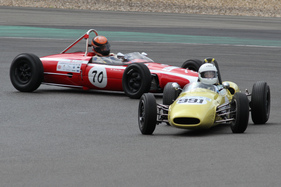
The Formula Junior drivers once again created a great atmosphere around the races on the Grand Prix circuit, which were watched by around 50,000 spectators. In the first race, Jonathan Hughes came out on top in the Brabham BT6, followed by Swiss drivers Philip Buhofer and Christian Traber.

In the second race, however, Stuart Roach, who finished fourth in the first race, won in the rain in the Alexis Mk IV ahead of Pier Enrico Tonetti and Jonathan Hughes, both in the Brabham BT6.
Contested Porsche dominance
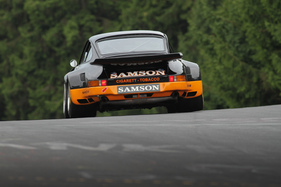
In perhaps the most colorful field, the Porsche 934/5 from 1976 could not be denied victory in either race. The touring and racing cars of the German Racing Championship from 1972 to 1981 have been among the favorites of OGP visitors for years, as they offer a wide variety of vehicles, many acoustic attractions and hearty drivers gripping the steering wheel.

However, the Porsche driver's lead over the runner-up was not large and Peter Mücke's attractive Zakspeed Ford Capri was only beaten by four and three seconds respectively at the end of the 30-minute race.

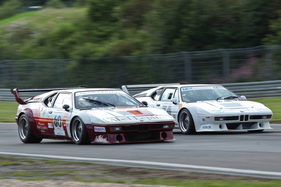
In 3rd place in both races was a BMW M1, driven by Achim Heinrich in the first race and Michael Kammermann in the second.

The exotic De Tomaso Pantera, driven by Michael Erlich and Martin Jürgens, and the Chevrolet Corvette, which performed particularly well in the second race under Artur Haas, were among the field of BMW M1s and Porsche sports cars.
Duels and excitement
In the first race of the historic Formula One for cars from the seventies with three-liter engines (FIA Masters Historic Formula One Championship), everything looked set for a victory for Simon Flash in the Ensign N180, but things turned out differently and Steve Hartley in the Arrows A4 was the lucky winner, while Flash crossed the finish line in second place with a bent spoiler. Silvio Kalb finished third in the Arrows A4.

In the second race, Michaels Lyons in the Hesketh 308E finished on top of the podium followed by Silvio Kalb and Steve Hartley.

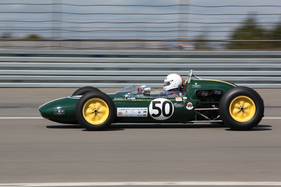
In the Formula 1 and Grand Prix cars up to 1965, which were powered by 1.5-liter engines, the podium looked almost the same twice. While Miles Griffiths took victory in both races in his Cooper T51, William Nuthall and Peter Horsman swapped places. Max Blees from Germany narrowly missed out on the podium in both races in his Brabham T7A. Switzerland's Peter Studer was able to hold on to 6th and 5th place overall in the two races, also taking two class wins.

The race was stopped in the first race when Cooper driver Nick Eden had a violent rollover in the historic Grand Prix cars up to 1960. The driver suffered serious injuries and was transported to hospital by helicopter, where his condition has since stabilized.

Accordingly, the racers finally started again after a 30-minute interruption. The first four places in both races went to Philip Walker (Lotus 16), Julian Bronson (Scarab Offenhauser), Tony Wood (Maserati TecMec) and Tony Smith (Ferrari 246 Dino).

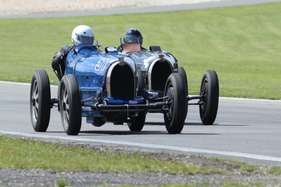
The salt in the soup of the first race, however, was the performance of the two Bugatti T51 drivers Stephen Shoosmith and Timothy Dutton, whose fast French cars were well within striking distance of the much younger Maserati 250F and Cooper Bristol.

An intra-team duel left spectators holding their breath in the first race for the BMW Group Classic prize, which was reserved exclusively for vehicles of the white and blue brand. For several laps, Michael Kammermann tried to outbrake his boss Christian Traber, both of whom were driving BMW M1 Procar models. But Traber held firm and did not allow Kammermann to pass. In the end, Kammermann's spirited driving style was slowed down considerably by a bump, so that he ultimately had to settle for second place behind Traber.

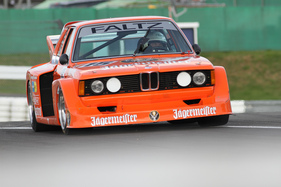
However, he was able to win the second race with a provisionally repaired race car. The fire-breathing M1s were unbeatable in 2014, but at least Dieter Tögel in the BMW 3.5 CSL and Jürg Dürig in the BMW 635 CSI were able to keep half the field behind them.

The two races in the FIA Masters Historic Sports Car Championship for sports cars from the late sixties and seventies ended with victories for Martin O'Connell in a Chevron B19, followed by Jason Wright in a Lola T70 Mk III B and Tim Cousins in a Chevron B23.

In the race for the AvD Touring Car Trophy, Graham Wilson won in a Lotus Elan, followed by Jean Clement in a Giula Sprint GTA and Tommy Bronsson in a Lotus Cortina. Eighth place went to Roland Portmann/Dieter Lehner, who saved the honor of the German manufacturers with their BMW. Incidentally, Uwe Koenzen drove an interesting DB HBR5, but he couldn't quite keep up with the rest of the field in terms of performance.
Uniform pre-war romance

The pre-war fraction contested two regularity runs on the Grand Prix circuit at the OGP and enjoyed some free laps on the Nordschleife. Among the participants, who competed in various Bentleys, Mercedes Benz SSKs and all kinds of exotic vehicles, was Ulrich Sauer, who many Nürburgring spectators have known since the first Oldtimer Grand Prix, as he competed in his BMW 328 back then. And continues to do so year after year.

They know each other by now and the OGP is just like an old acquaintance ....