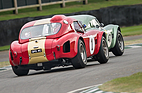
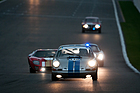
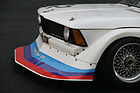
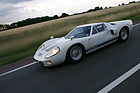
It is legendary, the Tour de France Auto, which was held as a road race from 1899 to 1986. It took place 50 times and in the 1960s it also became a racing event for sports prototypes such as the Ford GT40, the Ferrari 512 S, the Porsche Carrera 6 or the Matra MS650, where they could gain international renown. The dates of the 13th Tour de France Auto in 1964 prove that it was better to be well rested at the start.

Back then, Lucien Bianchi won with George Berger in a Ferrari 250 GTO, which had already won the previous year, after covering 6000 km in nine days. Of the 117 cars that started in Lille, just 36 made it to the finish line. Ford launched a major attack at the time, but the Ford Mustang was simply not fast enough to pose a threat to the GTO. Nevertheless, the American manufacturer was able to win the touring car category.
On historical tracks
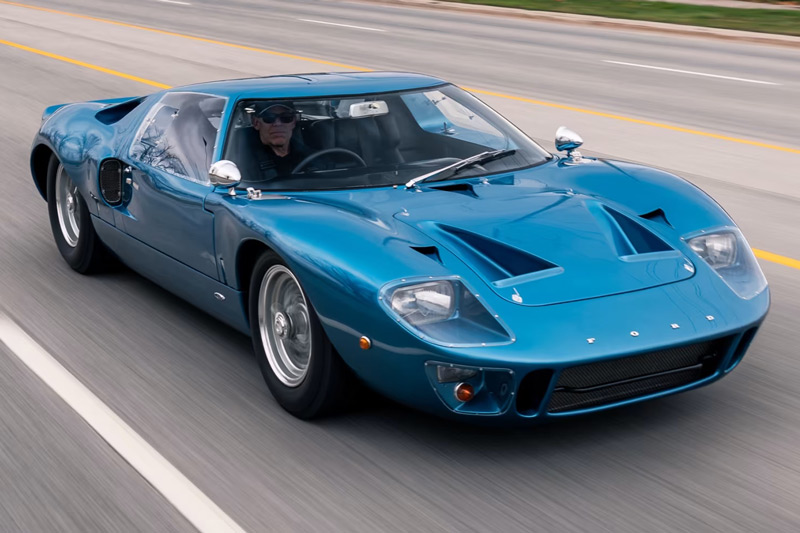
53 years later, fortunes changed and a Ford GT40 took overall victory in the 26th Tour Auto, the historic successor to the Tour de France Auto.

However, he only had to cover 2500 km, but he had to deal with around 250 opposing teams.
However, while in 1964 there were a total of eight circuits, including Monza and Pau, as well as eight hill climbs to compete for the best times, in 2017 there were far fewer opportunities to compete on the race track and in timed special stages.
A challenging undertaking
Nevertheless, the participation was challenging. Despite much better weather conditions than expected, the long route and keeping up with normal traffic posed considerable challenges. It was not uncommon to be on the road for 15 hours, and accidents sometimes caused considerable delays for the organization. Some participants tried to make up time on normal roads by not driving in accordance with the regulations, which neither the organization nor the police were happy about.

Even if 50 km were covered on the highway almost every day, the 400 to 600 kilometers per day were a real challenge for the crews. Unfortunately, some of the competitors ran out of road and there were a few accidents.
Attractive field of vehicles
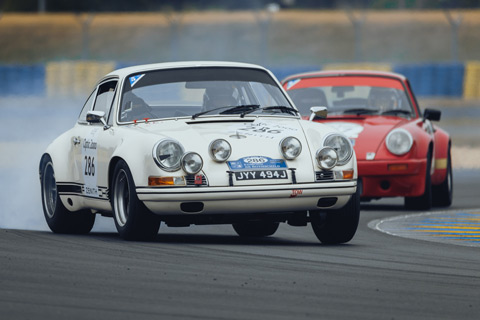
Once again, the organization around Patrik Peter (Peter Auto) had put together a very attractive field of vehicles. The condition for the start is that the same or a similar car must have taken part in the Tour de France Automobile, which was organized until 1986. It is obvious that many Porsche 911s, some Lancia Stratos and various Ferrari 308s or 275 GTBs came together under these conditions.

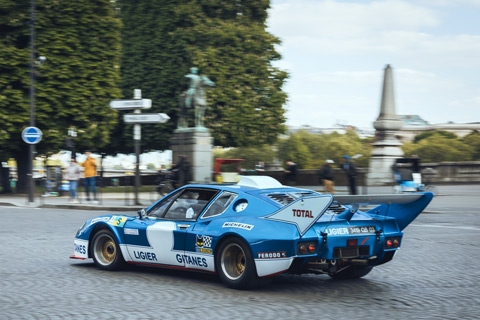
But there were also many typical French exotics to admire, such as a horde of Jidé, a group of German Bonnets, a few Panhard, many Alpine-Renault and vehicles from CG, Ligier or Hotchkiss.

The spectrum offered by the approximately 250 participating vehicles was truly extraordinarily diverse. It was no wonder that thousands of spectators lined the streets when the race cars passed through. Even if the Ferrari 250 GT0, as it won in 1964, was missing.

The crews of the vehicles, which did not have hundreds of horsepower to fall back on, were certainly also to be admired. 2500 km in a Fiat 600 D is certainly an experience all of its own.

Incidentally, anyone expecting only exotic cars of the Ferrari or Porsche variety was soon proved wrong, as the participating cars also included Peugeot 504s, Saab 96s, Opel GTs, Volvo 142s and BMW 2002s.
A magnificent start
Traditionally, the modern Tour Auto in Paris begins at the Grand Palais. Where new cars were once presented on the occasion of the Mondiale de l'Automobile, the Paris Motor Show, the competition vehicles, which compete in racing or regularity mode in a ratio of three to one-fifth, are now shown in their best light.

After the car inspection, there were then five one-day stages to complete, which took the participants to the north and south-west of France, among other places.
Through Brittany for the first time
For the first time, the route took the competitors to Brittany, with new landscapes as well as new architecture to discover. Of course, a visit to a race track was already on the agenda on the first day - the Bugatti circuit in Le Mans.

The speedometer finally showed 454 km more on arrival in Saint Malo, where the mechanics were able to take care of the well-being of the vehicles still in the race.
Transfer stages, special stages and circuits
The next four days followed a similar pattern. The transfer stages were followed by special stages on closed-off sections of road or circuits. In some cases, the drivers not only had to contend with the road, but also with hail and snow.

Meanwhile, Andrew Smith and James Cottingham in the Ford GT40 consistently extended their lead in the VHC class.
On the longest special stage of Saint Céré, which covered 13.9 km, the drivers and their machines were able to show what they are made of. The ride on Albi-Le-Séquestre, the second oldest French circuit, which had already been used by the Tour de France Auto, was hardly less demanding.

Many winners
Smith and Cottingham were also in contention for victory on the final stage from Toulouse to Biarritz. They had achieved 11 of the 15 partial victories, four on the circuits and seven on special stages. Only a Shelby Cobra 289 could have posed a threat to the Ford GT40, but it was not to be.

In the end, Swiss drivers Raphael Favaro and Lucien Charles Nicolet finished second in their Jaguar E-Type, one minute ahead of third-placed Olivier Ellerbrock and Olivier Louisoder in another Ford GT40.
Winners of the G1 and G2 periods were Viard/Haquette in a Ford Escort Mk1 RS 2000, while the H1, H2 and I periods were won by John/Sibel in a Ligier 2 DFV.

Tomas Hinrichsen and Solange Mayo in a Maserati 200 SI came out on top among the evenly matched teams.
Competently organized
The organization of the very large rally entourage with almost 250 participants and a further 180 service and organization vehicles is no easy task, but the Peter Auto crew mastered it with great aplomb.

The fact that the landscapes through which they drove were not quite as impressive as in other years probably bothered the photographers more than the participants, who were able to enjoy the nights in castles and hotels. They were allowed to do so, after all, they had shelled out an almost five-figure sum for their participation, and that didn't include a suitable car, an accompanying team and costs for gasoline and repairs or round-trip transportation.
A wide range of impressions are provided in the photo gallery accompanying this article; it's worth looking through the more than 300 photos!