
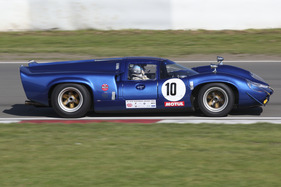

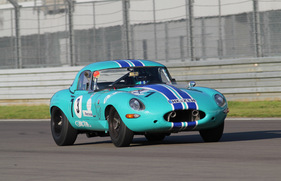
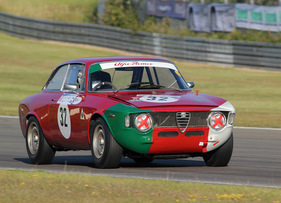
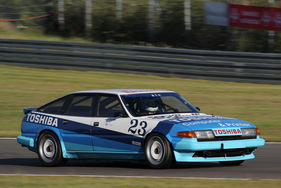
Impressive! Which classic car event can celebrate its 40th anniversary? In fact, fans of historic racing gathered at the Nürburgring for the first time in 1973. This has developed into one of the leading European events, which can be mentioned in the same breath as Goodwood, Le Mans Classic and Monaco Historique. And the 40th edition showed that the good reputation is justified.
It all began 40 years ago
It was a different world when the first classic car Grand Prix was launched in 1973. Although the French and, of course, the British (and, incidentally, the Americans back in the 1950s) had already paved the way a little, historic racing was still in its infancy at the time. And in Germany at that time, there were hardly any vehicles that were suitable for racing. So the enterprising, race-enthusiastic organizers recruited their fields in nearby countries. A total of 63 cars and 40 motorcyclists took part, no comparison with the 600 racing teams that were at the start on the second weekend in August 2012.
From Holland to the Nürburgring without lights
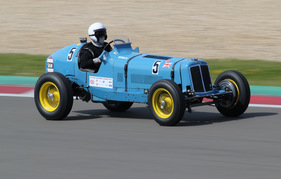
Generally speaking, classic car racing in the early seventies was quite archaic, but also very pragmatic. Most participants traveled by axle, and even a pre-war ERA or Delahaye monoposto was driven over long distances on the highway, with or without lights. The racing cars were not concours-restored treasures worth millions, but barely salvaged scrap iron, hardly worth more than their weight in steel. There was a lot of tinkering in the paddock (and on the way there).
The mouse in technical scrutineering
Many of the assembled vehicles still bore the dust of long storage on their paintwork in the seventies. Straw is even said to have been found in the engine compartment of an old racing car during scrutineering. When the foreign objects were removed, a mouse was robbed of its hiding place and fled the scene, which, according to stories, drove half the technical staff to their chairs.
Youngtimers and used separators
What gathered at the start in 1973 and the following years were comparatively young racing cars. Some of the racing classics competing today were not even built in 1973, and a Porsche Carrera 2.7 RS had just been sold as a new car. The field then consisted of DB Panhard, Maserati 150S or early Porsche 356s, none of which were even youngtimers at the time.
The drivers were both mechanics and pit crew in one; there were no articulated lorries, hospitality tents or marketing presences of large vehicle manufacturers. In terms of safety, they used what their fathers had already used in their old vehicles, some started without helmets and fireproof suits were recommended at best. And before we forget, there was of course no safety-optimized Grand Prix circuit back then, nor was there a rollercoaster ...
Incidentally, in the early years, the race was not held on the entire Nordschleife, but only on the"concrete loop around the pits" (south and north hairpin bends, as well as the finishing straight and back straight), which resulted in a track length of 2.292 km. The title of the event was"Nürburgring Show".
A lot has changed since then, and the classic car world has also become more commercial. And a few thousand spectators have become over 50,000!
Continuity instead of upheaval
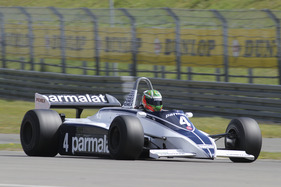
Anyone studying the race program of the 40th AvD OGP was able to discover a lot of familiar and tried-and-tested events. Most of the series have been part of the event for many years and well-known highlights of recent years were scheduled again in 2012, such as the revival of the 1972-1981 German Racing Championship, the historic Formula 1 cars, the two-seater sportscars and GT cars up to 1961 or the Formula Junior for the Lurani Trophy.
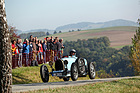
Only the pre-war racing cars are increasingly marginalized, as the participants of the "Roaring Twenties and Golden Thirties" were only able to show their vehicles on Friday and Sunday evening. It's a shame, because it's precisely these veterans of mobility that are very popular with the spectators.
Sun and no rain in sight
The classic car event at the Nürburgring includes the Eifel weather, i.e. rain and fog. Obviously, Peter didn't want any of that in 2012 and so it was actually dry for three days at the anniversary event, with sunshine and occasional patches of cloud and pleasant temperatures.
Just like 40 years ago in the MG Mistral
Not that the car had already competed in 1973, but it would have been possible. After all, the 1956 MG Mistral was already 17 years old 40 years ago. And it also looked like a racing car, with its Microplas plastic body of the "Mistral" type, which not only made the MG A lighter, but also moved it visually in the direction of the Jaguar C-Type. Microplas Limited was an English company that specialized in plastic bodies for mass-produced chassis and sold attachments for the Ford Ten as well as other chassis.
The dark MG Mistral competed in the group of "two-seater racing cars and GTs up to 1960/1961". The car belongs to Thomas Matzelberger, one of the three Gaisbergrennen musketeers. And he swears by history and tradition. The car has not been disfigured with a roll bar or seat belts, the bodywork shows a lot of patina and the technology corresponds to what was possible at the end of the 1950s. A truly historic racing car with club racing history from England, where every scratch is a witness to history.
Le Mans start
After technical scrutineering, a practice run was scheduled for Friday. The highlight, however, was the night race on Saturday. Shortly before nightfall, the cars were lined up on the home straight for the Le Mans start. Thomas Matzelberger and his fellow drivers got ready on the opposite side of the road, then it was time to get going. A sprint across the road, start the engine and drive off.
However, whereas 30 or more years ago the riders would then race their laps, in 2012 the field was stopped again shortly after the start as usual so that the riders could fasten their seatbelts. Matzelberger would have been one of the few who would have been able to continue, but he was plagued by other worries, as one of the pistons showed signs of decomposition, which significantly worsened the compression of the affected cylinder. However, everything went well and the race was completed on schedule, just like the second shorter race on Sunday. And Matzelberger was certainly fast on the road.
When anniversaries meet - 40 years of M GmbH racing
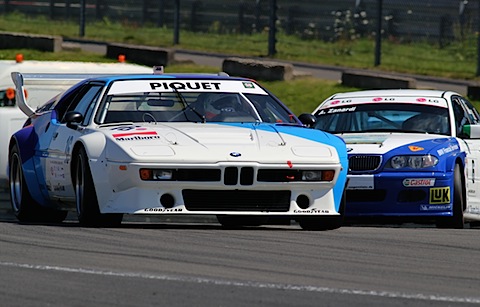
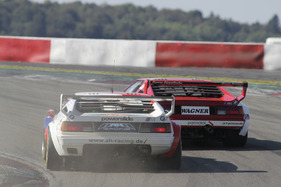
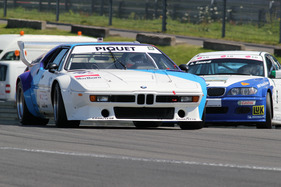
Not only the AvD Oldtimer Grand Prix celebrated a milestone birthday, BMW Motorsport GmbH also turned forty. And what better way to celebrate than with a specially organized race? The entire range of M vehicles from M1 to 320 Group 5 to the various M3 types, an E46 GTR, a Z4 GT3, as well as various CSL coupés and other BMW vehicles were on the starting grid and there was a lot of "toasting" regardless of the year of the vehicles. Famous BMW legends such as Marc Surer, Johnny Cecotto, Dieter Quester and Prince Leopold of Bavaria were also at the wheel.
The classification showed a wild mix of vehicles and vintages, with the modern E46 GTR at the front, followed by Christian Traber's M1 Procar, followed by Johny Cecotto in the BMW 320i E36 and Dieter Quester in the Z4 GT3. Marc Surer lined up in fifth place in the 320 Group 5, followed by other M1 cars.
Excitement in the Formula Junior
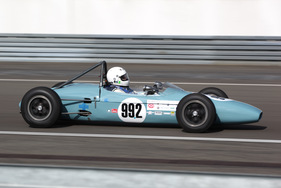
Once again, the races in the FIA Lurani Trophy were all about hundredths of a second. Once again, there was more racing on offer here than some modern racing series are capable of. In Race 1, Piero Tonetti won in his Brabham BT6, 1.111 seconds ahead of Christoph Burckhardt in a Lotus 22, followed by Buhofer in a Lola Mk V A, Traber in a Lotus 22 and Walford in a Lotus 22.
The second race was even closer. Tonetti managed to keep the upper hand, but just 373 thousandths separated him from Michael Hibbard in a Lotus 27, followed by Burckhardt, Walford and Traber. The bodywork damage to Burckhardt's Lotus was impressive proof of just how close and tough it is in the juniors.
Reunion with the Zakspeed Capri
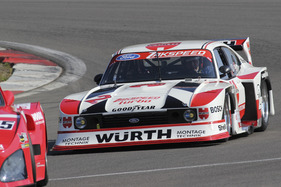
A highlight of the event was once again the two races for the revival of the German Racing Championship. Vehicles from 1972 to 1981 were on the grid, with the Ford Capri Turbo, with which Zakspeed once stirred up the small division of the DRM, certainly a highlight. In 1981, 600 hp was teased out of the 1.45 liter displacement and the well-prepared vehicle still looks impressive today.
Double triumph for Stippler in the marathon
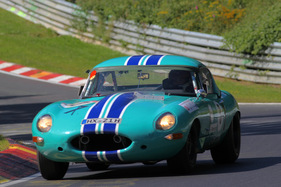
On Friday, the Nordschleife was the venue for the AvD Historic Marathon, as has become a tradition. Three fields were staggered over the 22 kilometers and Frank Stippler took part twice, once in the Alfa Romeo GTA (start stint) and then in the Jaguar E-Type (final stint). The fact that he won in both cars is probably something unique. While he, together with Marcus Graf von Oeynhausen-Sierstorpff in the E-Type, relegated Walter Röhrl and Dr. Armin Zumtobel in the Porsche 911 to second place and Allen Tice/Chris Cololey in the Marcos GTS to third place, he also handed the Alfa GTA over to his team colleague Alexander Furiani in first place after his "start stint".
Stefan Oberdörster/Andreas Gulden in a Porsche 911 S prevailed in the third field for younger vehicles built up to 1971. The fact that the race was no cakewalk is also evidenced by Walter Röhrl's statement: "I really had to give it my all and practically drove 110 percent throughout.
The racing action delighted the expert spectators lined up along the Nordschleife and once again everyone agreed that a natural racetrack like the Nordschleife simply offers a unique ambience for classic car racing, something that modern retort circuits simply cannot compete with. Hopefully this race track will stay with us!
Silhouettes and symphonies of sound
An event like the AvD OGP is a feast for the eyes and ears. Within a very short space of time, you can view the work of sports and racing car designers from several decades, compare silhouettes and shapes. And acoustically, the intake and exhaust noises are a delight anyway. Instead of describing this in length and breadth, however, the reader is better off leafing through the photo galleries and listening to the two sound samples.
Results in detail
The AvD offers a comprehensive collection of results online . Individual results are therefore not repeated here.
The surroundings are more than just a supplement
Once again this year, dozens of marque clubs honored the AvD OGP with their presence. Hordes of Alpine, Triumph, MG, Volvo, TVR, De Tomaso, Ford Capri and Opel Manta cars could be admired in various parking lots. And in the "infield", Ferrari and Porsche drivers showed off their beautiful sports cars.
A vintage party was held on Saturday, with concerts, fashion shows and autograph sessions rounding off the program. Those who were not only interested in engines could also be entertained in other ways or bid for a sports/racing car for next year at Coys(separate report with detailed results).