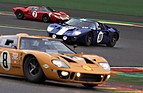
One day after Ford announced that they would be returning to Le Mans, they were once again in the spotlight. Two GT40s, which had already raced at La Sarthe in the 1960s, had claimed a double victory at the Le Mans Legend, one of the opening races for the subsequent 24-hour race.

Blue ovals on the podium
Bernard Thuner, who has already competed in the 24 Hours of Le Mans three times, dominated at the wheel of Claude Nahum's GT40. The latter had retired after a dicey spin in qualifying on Thursday. The 1994 Swiss touring car champion only briefly lost the lead during the pit stops, while Andrew Smith and James Cottingham ensured that two Fords finished on the podium.

There could have been even more blue ovals represented on the podium had Diogo Ferrao and Martin Stretton not had technical problems towards the end of the race.
New regulations open up new possibilities
The GT40s were a new and welcome addition to the biennial support race after the regulations were extended to allow the more modern Ford models to take part. Iconic machines from 1949 to 1968 are now allowed to take part.
Poor starts here and there
Thuner shot off from pole position in his Ford, which had taken part in the 1968 24-hour race in the hands of Mike Salmon and Eric Lidell, while Ferrao watched the whole thing.

There was a lot going on further back; Smith slipped back many places after it had twisted him at Indianapolis. Richard Meins in his GT40 also got off to a bad start, while Sylvain Stepak's Alpina A220 got off to the best start.
Barrie Williams in the Mini Marcos GT also had an unfortunate start when he steered his bright yellow car into the Indianapolis gravel track. By the time he finally found his way out of the gravel, he had already slipped back to last place.
The GT40s pull away from everyone
Over the next few laps, the GT40s pulled away from everyone. At the same time, Smith in his ex-Scuderia Bear GT40, which had retired from the 1966 24-hour race after a collision, was able to make up for his mistake and took second place at the second Mulsanne chicane on the penultimate lap. His comment: 'Driving that thing down the Muslanne straight was just phenomenal!
While Smith caught up, the Alpine slipped further back, with Stepak and Jean Luc Blanchemain dropping back to seventh place. This beautiful machine is a fascinating piece of motorsport history in more ways than one - it pioneered slick, treadless tires, among other things, when it raced with Michelin at Le Mans in 1968.

Late in the race, the safety car had to be deployed as there was a lot of oil on the track, which is of course always very dangerous. When the lead car finally pulled into the pits, the 61 cars that had started were able to cross the finish line and the first to finish was Thuner in his Ford GT40.
Watching the GT40s and noticing their tremendous speed, one immediately wondered whether they stood a chance in the modern 24-hour race. The best lap times provide the answer: Thuner's best lap was 4:32 minutes - exactly 31 seconds slower than the slowest car in the real race (Porsche 991 in the amateur GT class).
Cheeky overtaking maneuvers
Towards the very end, things got exciting once again. Ludovic Caron in his Shelby Cobra made a cheeky move on the last corner and stole second place, but the race stewards saw his overtaking maneuver as an illegal action and later relegated him to third place, which put the second GT 40 in second place and helped Ford to a one-two victory.

There were other GT40s in the top six; mine finished fifth and Philip Walker and Miles Griffith's car took sixth place. An AC Cobra in the hands of David Hart finished the race in fourth place after starting ninth.
The winners
There were also dominant victories in all other classes, with most of the winners holding on to the lead throughout the race.
In Class 1 for vehicles from 1949 to 1954 with an engine capacity greater than 2000 cc, John Young won in a Jaguar C-type. In Class 2 for machines with the same engine but slightly newer, Clive Joy and Jarrah Venables in a light blue D-type, which has seen all facets of motorsport, were able to prevail against their competitors.
In Class 3 for cars from 1955 to 1959 with an engine capacity of less than 2000 cc, victory went to Dion Kremer in a Lotus 17 prototype, while in Class 5 for cars from 1960 to 1965 with the same engine sizes, victory went to Afshin Faterni in his Porsche 904/6. This vehicle was one of two prototypes that Porsche had fitted with an 8-cylinder engine especially for the 1964 24 Hours of Le Mans.
Many returnees
A total of 14 of all the vehicles that started this year have already competed in a 24-hour race at Le Mans. Vehicles that have raced on the legendary French circuit in more recent times were also present. This included another GT40 from 1966, which Marc Doncieux had driven to eleventh place in the Le Mans Legend.
The dear sun...
On Saturday, clear sunshine ensured very high temperatures in Le Mans, which may have pleased many of the spectators, but the heat was a problem for many cars, including many Le Mans veterans. Even the 1964 Alfa Romeo TZ1 of Holly Mason-Franchitti and Charles Knill-Jones did not take part in the first round as it suffered from the temperatures.
Some of the drivers were also veterans of one of the biggest motorsports races there is. Among them was former British touring car champion Steve Soper, who returned to Le Mans after a full 15 years at the wheel of a Jaguar E-type semi-lightweight. He finished the race in tenth place.
Successful start
The enormous variety of motorsport legends on the starting grid of the Le Mans Legend was an impressive and beautiful prelude to the subsequent Le Mans 24-hour race, which then provided just as much fun and excitement.