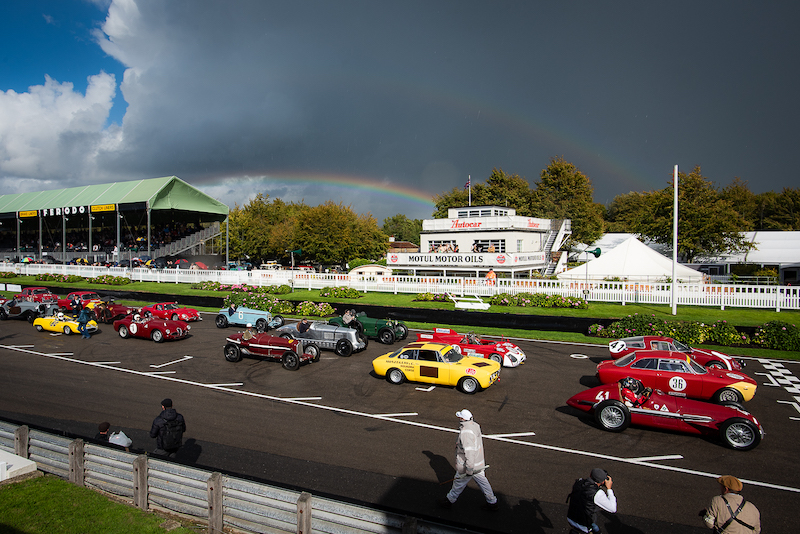
Traditionally on the second weekend in September, Charles Gordon-Lennox, 11th Duke of Richmond, goes from landowner to theater director. This is because the 3.8-kilometer Goodwood Circuit is located on his 5,000-hectare estate in the southwest of England. Opened in 1948 and largely preserved in its original condition, the circuit has been meticulously spruced up, decorated and prepared as a perfect theater stage since 1993.
The play that will be performed over the next three days is called Goodwood Revival. With it, the Duke of Richmond has invented the working time machine and travels with his visitors back to the fifties and sixties of the last century. It is the time when the Goodwood Circuit experienced its golden era. England and historic motor racing are celebrated here every year.
The past comes alive
This year, the revival from 16 to 18 September overlapped with the funeral celebrations for the death of Queen Elizabeth II. However, the organizers of the event managed the balancing act between a great motorsport event and a dignified remembrance of the Queen. All the flags at Goodwood were flown at half-mast. Every day, a band played the English national anthem and the Duke of Richmond gave a moving speech in honor of the late Queen, who paid many visits to Goodwood, where horse racing was and still is held.

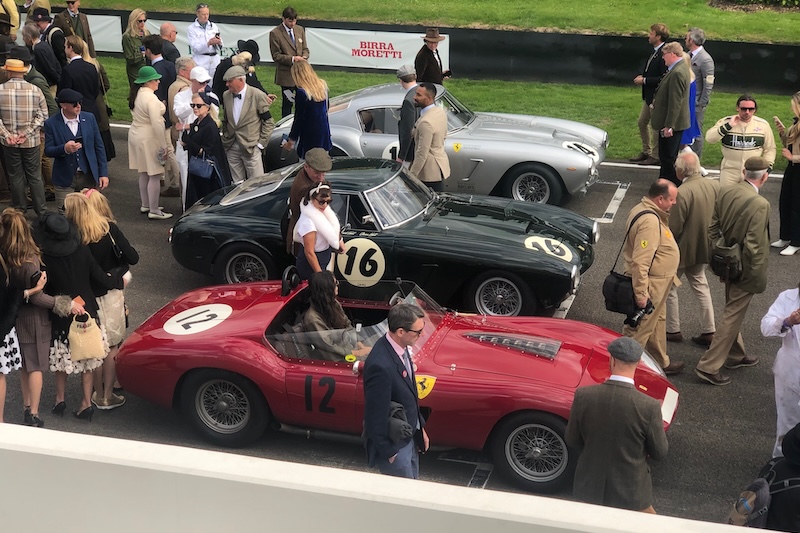
Traditionally, all visitors to the grandiose play called the Goodwood Revival become extras who contribute significantly to the success of the event. As a precaution, the Duke has hired 300 actors in historical outfits to mingle with the illustrious audience. But that would not have been necessary. Most of the visitors appear in the fashion of bygone times and become part of the whole spectacle. Whether in the flower child style of the late sixties, in a tweed jacket combined with knickerbockers or in a historical pilot's uniform - everything is allowed here, no, even encouraged.
If you can't think of anything, buy the "Dress and Style Guide" for inspiration, which is available for both men and women. But don't worry, there's no carnival here. Everything feels authentic and true to style. The visitors fit in like a black and white photo come to life with the old wooden grandstands, the classically preserved pit area and not forgetting what you're actually here for: the old cars.

The Goodwood time machine works like clockwork. When you buy a ticket, you are effectively buying a ticket back to a supposedly better time, which was probably never as good as Goodwood is today. You can switch off, block out the bad news of recent months and forget about it. The race track itself is just one part of the big stage on which the revival is staged. There is also a nostalgic fairground with a roller skating rink, chain carousel and Ferris wheel. A little further on, classic films from the good old days are shown in an old drive-in movie theater. And Bonhams organizes an auction where you can stock up on racing cars for the next revival.

On the way, it's only natural to come across a Pan Am flight captain carrying a charming stewardess by the hand. Another lady pushes an old wicker baby carriage in front of her. Naturally, she is dressed in a wide skirt and an elegant hat. The offspring are also wrapped up in nostalgia. Six men, easily recognizable as British Royal Air Force officers, stroll around the exhibition grounds and take a look at what is on offer. And there is plenty on offer at the numerous market stalls. If you're still looking for the right outfit for him or her, you're sure to find it here.
Knee grinding and full contact
As soon as the racing engines roar, most people head back to the paddocks. However, only those who strictly adhere to the dress code have access to this area. Gentlemen are requested to wear a suit and tie, while ladies are requested to dress "smart and elegant" as stated on the admission tickets and signs.

The motor racers of the "Barry Sheene Memorial Trophy" push their Norton, MV Agusta, BSA and Matchless to the starting line. The racing prototypes and Can-Am cars await their turn at the Whitsun Trophy. Famous racing cars can be found everywhere you look: Maserati, Ferrari, ERA, Bugatti, Porsche, Aston Martin, AC, Talbot-Lago, Lola, Cooper and so on - neatly sorted according to the individual racing categories, they are prepared here for the races by their mechanics in (formerly) white overalls.

But it wasn't just the cars that were first-class, so were the registered drivers. Former Formula 1 drivers Jenson Button and Martin Brundle were joined by Jochen Mass, André Lotterer, Jackie Stewart, Emanuele Pirro, Dario Franchitti, Scott Dixon, Tom Kristensen and Derek Bell. They all enjoy coming to Goodwood and entering the time capsule in which so many of their successes are commemorated. There is relaxed conversation and lots of laughter. You drive here without pressure or the thought of a championship - but not without ambition. Of course, the professionals know the value of the car. But when the owner gives the order to drive for victory, the air is on fire.

Of course, the willingness to take risks increases sharply as the value of the vehicle decreases. While drivers of a Ford GT40 thought twice about entering a gap, the drivers of the "Lavant Cup" let it rip without restraint. The pack of 30 hot-rodded MGBs even had to be sent out onto the track a second time after a pile-up on the first lap caused the race to be stopped. But even after the restart, there were plenty of sparks flying. After 30 minutes, Nick Maton, well known to the Goodwood audience from his stints as an interviewer on the grid, emerged victorious from the survivors, followed by Malcolm Gammons and crowd favorite Ed Foster.

The other classes are also battling it out to the delight of the spectators. The 3.8-kilometer circuit has a few gentle hills and almost as many gentle bends. The smaller the car, the higher the proportion of full throttle. The slowest, but no less spectacular section of the track is the Woodcote chicane just before the home straight. It is a real bottleneck, which is usually driven through with centimeters between each other and with a slight drift over all four wheels. If the chicane wall is touched or an overconfident driver hits the grass on the side, a murmur goes through the rows of grandstands, followed by applause and cheers.

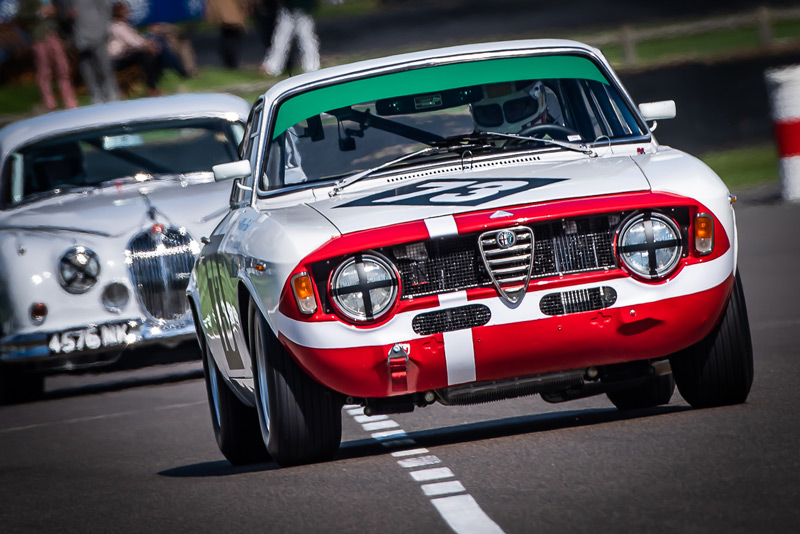
Among the favorites each year are the RAC Tourist Trophy with the thundering Shelby/AC Cobra, E-Types and the not-to-be-underestimated TVR Griffith. The St. Mary's Trophy is also a crowd favorite. It is contested in two parts and with around 60-year-old touring cars of the type Ford-Lotus Cortina, Alfa Romeo Giulia Sprint GTA or Ford Fairlane. In one race, the professionals are at the wheel, in the second, the owners and amateur racers. The spectacle was breathtaking again this year, even though the car with the most displacement was able to prevail with a comfortable lead over the two heats. The wheel-to-wheel battles will live long in the memory.
In addition to the 15 different races for cars, a race for classic racing motorcycles also took place during the weekend with the "Berry Sheene Memorial Trophy". And their drivers usually outdo their car colleagues in terms of drama as they race around the course side by side with one knee dragging on the track.

Muscle power to victory
The race for the Settrington Cup is one of the highlights of this weekend, which is almost entirely made up of highlights. The shortest race of the weekend is also the one with the largest starting field - and by far the cutest. The boys' caps are usually two sizes too big and half over their eyes. Nevertheless, the competition is watched with suspicion. The girls pay more attention to the correct fit of their classic overalls and their smiles. After all, the man from TV could be interviewing them right away.

Drivers between the ages of four and ten are eligible. They drive pedal cars modeled on the Austin A 40. These vehicles have a large fan base in England, as they are an important part of English post-war history. In 1949, a special factory, the Austin Junior Car Factory, was set up in Bargoed, South Wales, which was financed with state funds and was intended to provide employment for disabled miners with lung diseases. The pedal cars were made from scrap metal from the Austin Motor Car Factory and were built and painted in the same way as the original vehicles themselves. By 1971, around 31,000 examples of the "Austin J 40" had been produced.

The pedal cars are neatly lined up in their own small paddock. Next to them are the excited drivers, who still have to attend the drivers' briefing before their race. The race is started in Le Mans style. This means that the young drivers sprint across the track and jump into their vehicles. Then it's time to pedal hard and get everything out of the little speedsters. After about 50 meters comes the first chicane. It is then about 100 meters to the finish. Esme Graham finally won a fierce battle in the leading group - and the spectators in the grandstands clapped as if a Formula 1 race had just ended.
Not just full throttle
On a scale of 1:1, demo runs on all three days of the event also paid homage to what is probably the most popular British passenger car of the pre-war era, which will celebrate its 100th birthday in 2022: the Austin 7. Rarely have so many different variants of the "Seven" been gathered together in one place. Around 130 cars strolled around the circuit like a string of pearls.

Things got a little faster at the next "Special Parade" to mark the 75th anniversary of Ferrari's founding. 50 different models from the 1949 to 1966 model years offered a special kind of feast for the eyes and ears. At the steering wheels of the 250 GTO, 250 GT SWB, 250 LM and Co. were great and now somewhat ageing racing drivers such as Jackie Stewart and Derek Bell.

Graham Hill, the only racing driver to have won the so-called "Triple Crown" with victories in Monaco, Le Mans and Indianapolis, was also celebrated. A large number of his former vehicles, including several Jaguars, Lotus, BRM, Ford Escort, Ferrari 250 GTO, Maserati Birdcage and his own F1 designs, were driven around the circuit by racing drivers from his time and later. Of course, son Damon Hill also sat in one of the cars and wore a helmet like his father once did.

After three days, the curtain came down on this year's Goodwood Revival on Sunday evening. The Duke of Richmond would have had to come on stage quite a few times afterwards and bow to the imaginary, long-lasting applause of the well over 100,000 visitors. It was another grandiose performance of an event that only exists so perfectly in England.

Next year, the Goodwood Revival will celebrate its 25th birthday, and most spectators are probably already counting the days until then.