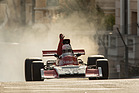
It's not yet 8 o'clock in the morning, the partygoers have only just fallen into a coma, but are about to be woken up again. With rhythmic blasts of gas, racing drivers from all over the world are flushing carburetors, getting their cars' lungs and hearts up to temperature. Nothing unusual for a racetrack, except that this racetrack is quite unusual. Monaco. The paddock is located on the quayside of the harbor, and the pulse of horsepower echoes off the walls of the Principality's stately homes and residential silos. It's time for the Monaco GP.
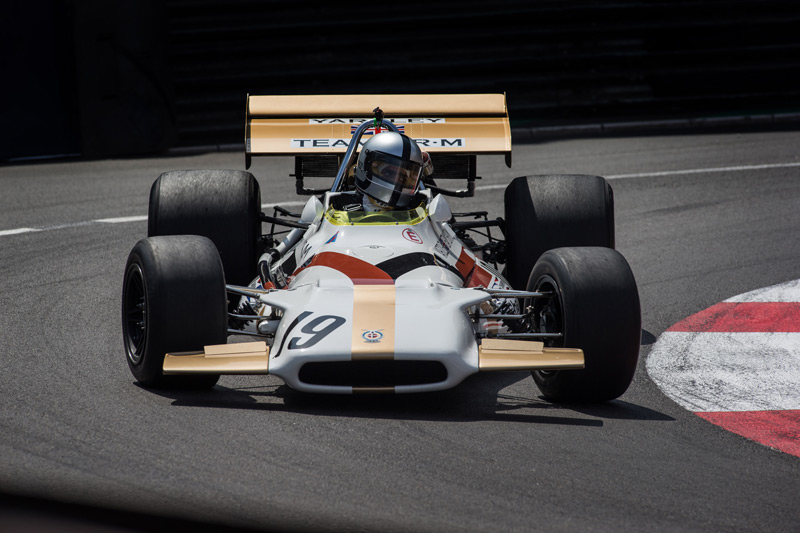
Every two years, two weeks before the Formula 1 race, racing legends from the past come together - not the drivers, of course, but the machines. The GP Historique de Monaco, launched in 1997, is without doubt one of the most prestigious historic racing events in the world.
The race-like ride on the 3.3 km short circuit between Mirabeau and Rascasse is highly coveted. Accordingly, the lucky ones are not on a "start list", but on the "liste des acceptés".
More than just a race
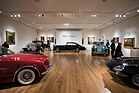
Because the atmosphere is so exquisite, the GP Historique lends itself to equally exquisite supporting programs. These take place in bars or on yachts. Or in the Grimaldi Forum, where an RM auction was held. Not all of the vehicles found a buyer, but the highest bids were not from bad parents. Two bidders for a 1957 Ferrari 625 TRC Spider, for example, drove themselves up to the round sum of 4.5 million euros.
Demonstration of the Auto Union Type C
Audi also benefited from the legend of the location. An Auto Union had already made an appearance at the GP Historique at the first event. This year, Jacky Ickx took the wheel of the Type C supercharged monster. The Belgian drove the 520 hp car with care, as he did not want the priceless one-off to end up in the crash barriers. However, as light-footed as the racing car is (825 kg), it cannot be circled through the chicanes.
Simple mode
Practice and qualifying sessions were held on Friday and Saturday, with the races starting on Sunday. Each race lasted 10 laps or a maximum of 30 minutes, with the exception of Formula 1, which lasted 15 laps or 45 minutes.
Races in various classes
The races themselves were contested by around 200 participants in seven classes. The range was wide. In Series A, pre-war cars from 1926 - three years before the first Monaco GP ever took place - competed, while the latest products were 2-liter Formula 3 cars up to 1984.
In view of such vintages, the term veteran race is only partially appropriate, and the driving style at the GP Historique was also not very tranquil. New Zealander Roger Wills, who competed in three classes in Monaco, took pole position in his March 701, but tried to improve his position further and got caught by a slower competitor on the last fast lap. An unsuccessful evasive maneuver ended in the crash barrier, and a start on Sunday was out of the question.
Material problems in the pre-war series
Even the drivers of the oldest racing cars were by no means gentle on their materials. Swiss driver Roland Portmann, in Georg Kaufmann's Maserati 4CL, finished second in the first qualifying session and third in the final practice, but was unable to start the race. A gearbox failure towards the end of qualifying proved to be a major problem.
The classics pro was correspondingly disappointed: "Two years ago, I retired from the race in Monaco in second place, but now I would have been sure of a podium finish based on my practice times. Now I'll probably have to try again in two years, it's time to show these Brits."
Portmann is referring to two Brits who had a hot race in English cars on Sunday, well ahead of the competition. Julian Bronson stayed in front for the entire race, but Paddin Dowling was always breathing down his neck. Bronson with an Era Type D benefited from half a liter more displacement, Dowling behind him on the older Era Type B with a spectacular driving style, always wonderfully crosswise. But it didn't help, Bronson defended like an Italian national football team under coach Bearzot.
Behind him, Michael Gans took third place on the podium. He rode another Era B to third place. "I battled with Ian Landy until he shifted in front of Ste Dévote, after which I managed the podium." Gans celebrated his success in Monaco with a fierce champagne battle with winner Bronson.
Jürg König was in a different league, albeit in the same series. As always, his 1926 Bugatti 37 A could not keep up with the ten years younger Era in terms of performance. König was happily battling with another Bugatti at the back of the field until the brake cable lever broke at the front left. Without suitable brakes, he was unable to fight, but managed to get his car through the ten laps.
End in the rain
Another Swiss driver did well in Monaco: Hans Peter, otherwise competing in the Historic F2 European Championship, first had to get to know the track in a 1978 Tyrrell 008. What's more, he stopped in the second quali after just three hours with a faulty electrical system. Peter's team, Phimmo Racing, was housed in the pits of Peter Sauber's Swiss Formula 1 team. They were ready for the race again. Just before the start, it began to rain. With a mixture of caution and boldness, Hans Peter worked his way up to 14th place (out of 29 entrants) in the 1978 Tyrrell 008. As with many of the participants, Peter's satisfaction and hunger for more were more or less in balance. In any case, he will attack again in two years' time, says the racer.
Benefiting from the current Formula 1
The historic GP is organized by the Automobile Club de Monaco (ACM). The entire machinery, including the fire department, emergency services, checks at every corner, grandstands and countless kilometers of crash barriers and barriers, is in operation to welcome the Formula 1 circus. In Monaco, the city center is rebuilt for a few weeks at a time.
Anyone who sees this gigantic effort today, with its extensive collateral damage, wonders how anyone could have had the idea of organizing such a race around the corners of a narrow city. The answer is legend: The Monegasques had to, if they wanted to join the world sports association, today's FIA. The condition for membership was a race held entirely on their own territory - the Monte-Carlo Rally, which had been held in Monaco's hinterland since 1911, was not enough for the elite association.
The race results
Series A - Voiturettes and Grand Prix racing cars before 195
1. 36 BRONSON Julian GBR - ERA D 1938
2. 32 DOWLING Paddins IRL - ERA B 1936
3. 20 GANS Michael CHE - ERA B 1935
Series B - Grand Prix racing cars and Formula 2 cars before 1961
1. 60 WILLS Roger GBR - Cooper T51 (Climax) 1959
2. 30 PEARSON Gary GBR - BRM P25 1958
3. 34 BAXTER Barrie GBR - BRM P48 1960
Series C - Sports cars and prototypes before 1953
1. 66 BUNCOMBE Alex GBR - Jaguar C Type 1952
2. 28 URE John GBR - Frazer Nash Le Mans Replica Mk2 1952
3. 68 MONTEVERDE Carlos GBR - Jaguar C Type 1952
Series D- Rear-wheel drive Formula 1 cars before 1966
1. 9 MIDDLEHURST Andy GBR - Lotus 25 (Climax) 1962
2. 19 HOOLE Sidney GBR - Cooper T66 (Climax) 1963
3. 14 DRAYSON Paul GBR - Lotus 24 (Climax) 1962
Series E - Three-liter Formula 1 cars before 1973
1. 8 DUNCAN Dayton USA - Brabahm BT33 1970
2. 27 FITZGERALD Michael USA - March 711 1971
3. 21 SMITH Andrew GBR - March 701 1970
Series F - Three-liter Formula 1 cars from 1973-1978
1. 31 LYONS Michael GBR - Hesketh 308E 1977
2. 8 VERDON-ROE Bobby GBR - McLaren M26 1977
3. 26 PANE Mauro ITA - Lola T370 1974
Series G - Formula 3 until 1985
1. 10 BARKER Ben GBR - Lola T670 (Toyota) 1978
2. 47 MARZOTTO Matteo ITA - Ralt RT3 (VW) 1984
3. 25 BARILLA Paolo ITA - Martini Mk34 (Alfa-Romeo) 1981