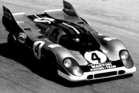
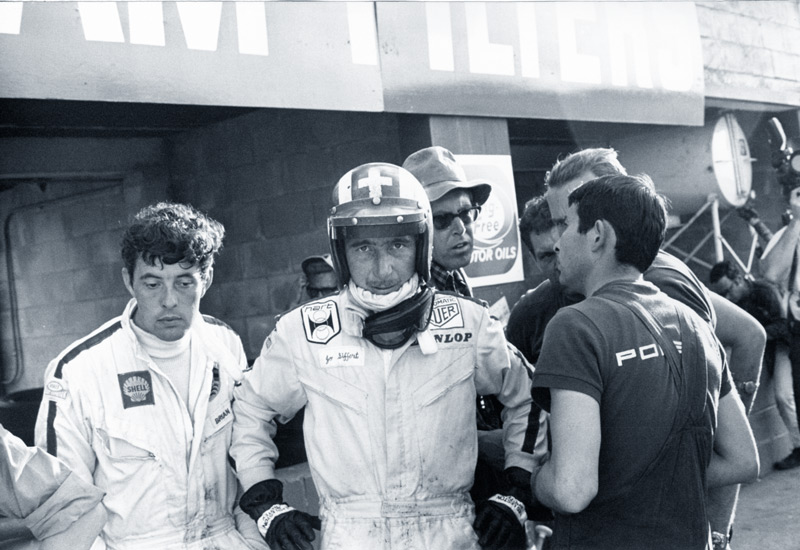
April 1970, the time when the Porsche 917 horsepower monster learns to run. The 12-cylinder monster with its 600 hp from 5 liters of displacement is the pride and joy of Ferdinand Piech, the big, strong man behind all Porsche racing activities at the time. The 917 was Piech's child, his supercar, with which he wanted to beat everyone and everything. However, the factory drivers' enthusiasm for the monster was initially limited, with even intrepid types such as Jo Siffert, Rolf Stommelen and Udo Schütz declaring the white giant simply undriveable. The gentlemen works drivers would much rather climb into the agile, compact and unproblematic Porsche 908, an open-top sports car with which you can easily and effortlessly drive in circles around the competition.
But the 917 project was Porsche's top priority and was driven forward mercilessly. The fact that Jo Siffert and Kurt Ahrens won the inaugural 1000 km race on the new Österreichring in Zeltweg in the summer of 1969 with the stubborn car was already considered a sensation. And it was the first major victory for the 917, which was destined to finally bring Porsche its first overall victory at the 24 Hours of Le Mans. Piech therefore drives his engineers to optimize the car's handling, constantly arranges new test drives and repeatedly and energetically appeals to the ambition of his young Porsche technicians. One of them was Helmut Flegl, 27 years old at the time, a graduate engineer, chassis specialist and project manager for everything to do with the 917. "For me and my team," recalls the now 67-year-old, "the biggest challenge at the time was to reconcile the potential of this car with the needs of the drivers.
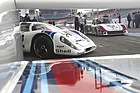
The 1970 season got off to a good start, with two 917s finishing one-two at the 24 Hours of Daytona. Nevertheless, testing, testing and more testing is carried out in the spring, primarily for the eagerly awaited Le Mans victory. The venues alternate between the Porsche test center in Weissach, the Nürburgring, Hockenheim and the VW proving grounds in Ehra-Lessien, around 20 km from Wolfsburg. Ehra in particular, with its two 10-kilometer-long straights, is ideally suited for a Le Mans high-speed simulation. With a new long-tail version, the aim is to achieve top speeds of around 350 km/h and more. All tests are carried out in the strictest secrecy, external journalists and photographers have to come up with the best tricks to catch a glimpse of the action.
On April 7, 1970, Kurt Ahrens is summoned from nearby Braunschweig to the hermetically sealed Ehra site. The Porsche works driver, one of the best ever in Formula 2, is to test a further modified 917 long-tail version with a view to the upcoming Le Mans qualifying session. A team of technicians led by Helmut Flegl and Peter Falk supervises the driving program. It is cold April weather, with rain and snow showers alternating with a few rays of sunshine. Ahrens, now 68 years old and a retired racing driver, describes what happens next from his own memory:
'Actually, for the high-speed test, a technician was supposed to sit next to me on a specially installed seat to record the data on a notepad. I categorically refused, fortunately. After a few laps, I approach a slight, long bend on slicks at a good 320 km/h, which is normally full. But because it's shimmering so strangely, I ease off the gas to about 250 km/h to be on the safe side. Then I see the surprise: a small shower has flooded the road. Now everything happens incredibly quickly - the steering no longer reacts, aquaplaning in its purest form. The car flies across the track and is torn in two when it hits the crash barrier opposite. The front part gets stuck under the guardrail, the rear sails brutally fast with me as a passenger. I felt like I was hanging in a parachute. I convulsively try to hold on to the straps of my safety harness. After an endless 200 meters, the rear of the car hits a crash barrier at an angle. I immediately try to free myself, but it's quite difficult because my legs are trapped under the steel rail. I carefully and patiently wriggle out and sit down on the crash barrier to catch my breath. Only now do I really realize what has happened here and how lucky I have been. Part of it is that you hardly feel any pain at first. But then it started: I suddenly felt dizzy, couldn't stand up straight and could hardly breathe.

Peter Falk took me straight to the hospital in Wolfsburg. The first thing they wanted was information about my health insurance and other paperwork, which took an endless amount of time. When there was no end to the palaver and nothing else was happening, we got fed up and simply left the hospital. At my own request, Mr. Falk took me straight to my family doctor in Braunschweig. The doctor immediately examined me thoroughly and diagnosed a bruised liver as well as bruises and contusions on both lower legs. Just 18 days after the accident, of which only the scars below the kneecaps remind me today, I was back in the 917 cockpit at the 1000 km race in Monza. Without any feeling of fear, I was able to drive just as fast as before the big crash. Ehra-Lessien was by far my worst racing accident ever. It is absolutely clear to me that I had a huge portion of luck and jumped off the brink of death. And I don't even want to imagine how it would have turned out for the co-driver, who Porsche wanted to place next to me for the data recording.

Kauhsen: "Impact at 350 km/h"
Exactly ten days later, the almost identical sequence of events of the Ahrens accident was repeated in the same place - this time with Porsche test driver Willi Kauhsen from Aachen in the cockpit. Once again, the focus was on long-tail tests, new aerodynamic modifications and gaining experience for Le Mans. This time the weather is more stable, sometimes sunny, sometimes cloudy, but dry - for the time being. Kauhsen, a frequently booked Weissach tester, hardened and fearless, knows exactly how to do the job. He climbs confidently into the Porsche and begins his high-speed chase on treadless slicks. Soon he is recording speeds of 320 km/h and more. In between, short stops for data synchronization and brief meetings with the technicians. The next turn, the next stage, now the long-tail 917 is already thundering along the long straight at 8,600 rpm, which is a good 350 km/h according to Kauhsen. But suddenly the smooth, rich hum of the 12-cylinder engine stops, and instead ugly, harsh noises penetrate from afar to the command post. And then there is that eerie silence that you know means nothing good.
The Porsche men find a 917 smashed up, especially at the rear, and a thankfully uninjured but slightly shocked pilot. Like his colleague Ahrens ten days earlier, Kauhsen had also been the victim of a localized rainstorm with treacherous aquaplaning. The entrepreneur from Aachen, now 69, remembers the scary moments very well:
"It was immediately clear to me that this was going to be a huge accident at that speed. The first impact on the right against the crash barrier was at around 350 km/h, fortunately at such a favorable angle that I deliberately tried to lean the car against the metal rail for as long as possible to reduce speed. As a result, the stripped parts were spread over more than 1500 meters of the road. When there was no longer a crash barrier, the car first shot up an embankment and took a massive signboard with it on the descent back to the runway. Then the horror flight came to an end, with the steel tubes of the sign structure still stuck in the torn-open rear end."

Kauhsen is at least lucky that the car doesn't break in two, as happened to his colleague Ahrens. He returns to the base with the engineers and the shock is soon gone. He has already experienced many a nasty test accident and only a few days earlier he had survived a nasty road accident with the 911 Porsche - so an experience like this no longer throws him off course. He even asks for another drive in the "Dicken Berta", a test vehicle with the type designation 917/20. "I wanted to drive fast again straight away so that no feelings of fear remained. Regaining your own safety, the immediate confirmation that your reflexes are still working as before and that you have a good feeling even beyond 300 km/h, is immensely important after such a mega crash." Incidentally, Porsche engineer Norbert Singer considers it conceivable, at least in the Kauhsen case, that the "interrupted woodland along the long straight could also have played a role due to the wind blowing in from the side".

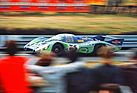
Two months later, Kauhsen started the 24 Hours of Le Mans for Porsche together with Frenchman Gerard Larrousse and took second place with the long-tail 917, painted in bright green and purple as the "Hippie". After almost 20 years of participation, Porsche actually achieved the long-awaited overall success on this June weekend in 1970. However, it was not the long-tail 917, which had been tested ad nauseam for top speed, that won, but the short version with Hans Herrmann/Dick Attwood. The Austria team Rudi Lins/Helmut Marko in the open 908 rounded off the magnificent triple victory.
The end of the 1975 season marked the end of the Porsche 917's great era, as the car was now considered unbeatable and was therefore deliberately banned from almost all national and international regulations by the sporting authorities. The only remaining areas of use were the CanAm racing series in the USA and the European Interseries. While a customer initially had to fork out around 150,000 marks to buy a 917 K with a naturally aspirated engine, the most powerful 917 Turbo Spyder later cost around half a million marks.
All in all, around 50 different types of 917 were built in Weissach. In addition to the 12-cylinder naturally aspirated versions 917 K, 917 LH and the one-off 917/20, the product range also included the open 917/10 and 917/30 Spyders with their gigantic 1000 hp turbo engines. In Mark Donohue's CanAm-917/30, up to 1,400 hp could even be mobilized for a short time if necessary.
This story comes from the second volume of the successful book series "Hallo Fahrerlager" by Rainer Braun. Further information can be found on the series' website www.hallo-fahrerlager.de .