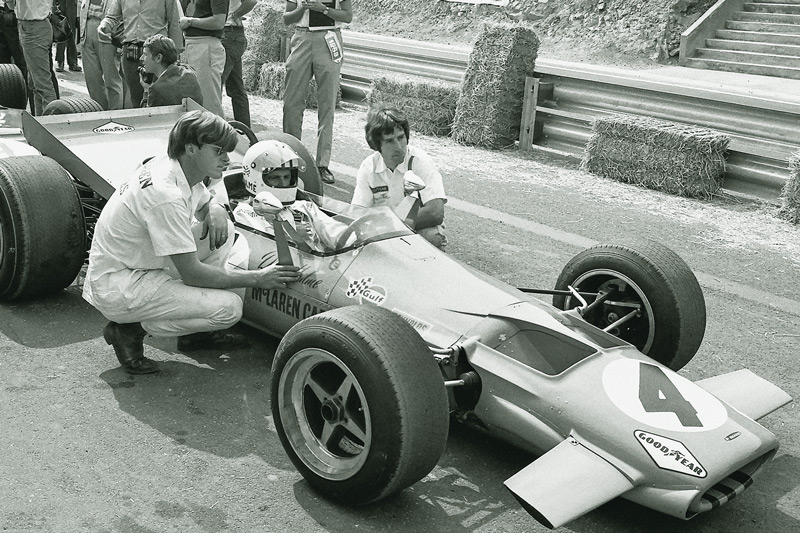
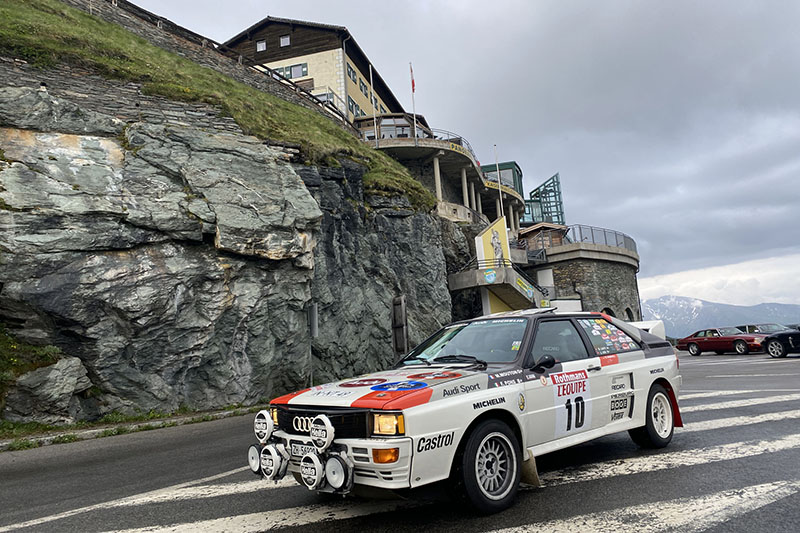
The "Bosch Hockenheim Historic - Jim Clark Revival" is not necessarily one of those historic racing events that you should definitely not miss. However, it does have a certain significance in honor of Jim Clark, who was killed in an accident at the Badisches Motodrom on April 7, 1968 in a Formula 2 race that was rather unimportant for him. If "Jimmy" were still alive, he would have been 80 years old on March 4. Virtually nowhere else can you see such a colorful mix of racing cars in action, ranging from post-war racing cars to current GT3 sports cars.

Bad luck with the weather
Unfortunately, the organizer - Hockenheim-Ring GmbH in cooperation with the private Huter Marketing Group - had bad luck with the weather. On all three days, it rained heavily in the morning and the conditions only improved from midday onwards. On both race days, the sun even peeked through the clouds at times, creating almost ideal conditions for some of the fields. This also attracted more spectators to the stands, while the usual crowds gathered in the pits, which were open to all.

"After we saw a slight boom last year with 22,000 spectators, the changeable weather naturally makes our efforts to further develop this event more difficult. Because when it rains in the morning, many people prefer to stay at home," regretted Kerstin Nieradt from Hockenheim-Ring GmbH. However, the future of the "Bosch Hockenheim Historic" should not be in danger because it should retain its permanent place in the calendar.
The challenge cup is back
Those who wanted to warm up in between could marvel at the unique Jim Clark exhibition by Jürg Mallepell and his helpful wife in the Mercedes pavilion in the middle of the paddock (and no longer on the cold pit roof). The Zurich resident was particularly proud this year that the challenge cup donated by Clark's father on the occasion of the 1st Jim Clark Memorial Race for Formula 2 in 1969 came into his collection in a roundabout way. Jean-Pierre Jarier, the winner in 1973 (and first in 1969), had simply not returned it...

Mallepell, who has been a permanent fixture at the Jim Clark Revival for ten years, has taken up the cudgels for the new organizers, taking the wind out of the sails of critics who are crying out for a purely historical event: "They don't want to copy anything, they want to go their own way. This way, they give young people the chance to see the old."
Used Formula 1 as a crowd puller
Due to the changeable weather, there were unfortunately only a few sporting highlights to be seen, whereby we are excluding the racing series with predominantly more modern cars such as the STT Cup and Lotus Cup Europe (which at least fits in well with Jim Clark's past in terms of the brand) from the coverage. They all have their undisputed place in the motorsport landscape.
The only exception is the BOSS GP (Big Open Single Seaters). Together with the other cars from GP2, Renault World Series, Superleague Formula and Formula 3000, the powerful and loud monoposti from Formula 1 up to 2006 with their shrill, high-revving naturally aspirated engines are a crowd-puller. This is because the normally frequented grandstand sections have never been so well filled at any other race.

Without this attractive combination of history and modernity, there would probably have been far fewer spectators. And on Sunday afternoon, they even got to see a great duel between the previous day's winner Klaas Zwart in the 2005 Jaguar R5 and Ingo Gerstl in the one year younger Toro Rosso STR1 - both with Cosworth V10 engines - which the Austrian won. Their lap times were less than ten seconds faster than those of the GP drivers at the time, despite the significantly worse track conditions. Hats off to the fit private drivers - Klaas Zwart could even be the grandfather of today's Toro Rosso driver Max Verstappen!
Weibel offers a masterpiece
The most historically authentic field was the FIA Lurani Trophy for Formula Junior, although here too there was a decline in the number of participants. "It's a question of money, and there aren't enough young drivers," says long-time Junior driver and team boss Bruno Schaffner. His protégé Bruno Weibel produced one of the best sporting performances last weekend. On Saturday, the European champion broke down with differential damage on the ex-Siffert Lotus 20, which, according to Schaffner Racing, was due to incorrect thermal treatment of the supplier's parts. After an original replacement could be found, the team worked late into the night.

Weibel made it worthwhile on Sunday with a magnificent drive on a damp track, where he drove from seventh on the grid to second place overall among the cars with disc brakes. The Zurich driver overtook the Italian Piero Tonetti in the Brabham BT6 in the last corner, only Manfredo Rossi di Montelera, who had already won the previous day, was already too far behind in his Lotus 22.

"In the wet, my disadvantage with drum brakes is just not that big, plus I gave it my all and looked for grip everywhere to catch up with Tonetti," said a beaming Weibel after his first-time advance into the top 3 of the overall standings. However, only the points by class count for the Lurani Trophy classification, in which Weibel had to settle for third place behind Ivo Goeckmann (Jolus FJ) and John Delane (Lotus 18) after adding up the two unfinished races.
50 years of CanAm
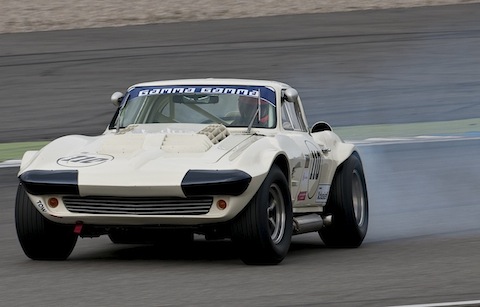
Always a visual and acoustic treat at the "Bosch Hockenheim Historic" is the field of historic sports cars, which has also shrunk. In 1966, the Canadian American Challenge Cup, CanAm for short, was launched in North America, and its equally popular offshoot in Europe was the Interseries.

After Silvio Kalb organized the SuperSports Cup for many years, Peter Schleifer took over this task in 2010. To mark the 50th anniversary of the CanAm, the German is organizing a cup this year. "I don't want to let these cars die," Schleifer laments, referring primarily to the big bangers with their V8 engines of up to 8.8 liters displacement. He himself drives a rare and ultra-flat Lola T310. As in Formula Junior, Schleifer also senses a generational change. "We haven't yet managed to get the youngsters excited about it. That's a shame, because many spectators only come because of these cars."
Some of the attractive sports cars only drove as a demonstration before the actual race, in which just under a dozen people took part. They had to start on a drying track on both days, which made conditions even more difficult for those without rain tires.

Even a full professional like Marco Werner in a Porsche 936 had no real chance against the Lola T292 DFV of Michele Liguori from Italy in these conditions, especially as the three-time Le Mans winner didn't risk anything with this unique car. The flounder from Ulrich Schumacher's collection was once driven by Stefan Bellof and Rolf Stommelen in the final years of the German Racing Championship, before it became the DTM with Group A touring cars.

The only real battle was between the two Swiss drivers Toni Seiler in the 1966 Lola T70 MkII Spyder and Felix Haas in the Lola T294-BMW. In the first race, Haas kept the upper hand in the fastest two-liter car; in the second, Seiler, who was struggling with deteriorating rain tires, was able to keep him behind him until the finish. If Seiler had not left the rear wing for the Spyder at home, there would have been more downforce on the rear axle and the power of the Chevy V8 would have been easier to transfer to the road. Ioannis Inglessis brought the most brutal and typical vehicle of the CanAm era to the start. But with slicks on his Porsche 917/30, the Greek drove like on raw eggs in the wet in the early stages, only setting the fastest race lap at the end.
Full steam ahead into the gravel trap
The Dutch Youngtimer Trophy has been offering a smorgasbord of different touring cars and GTs at this event for several years. The spectrum ranges from the tiny racing Trabbi, which chases the field on the opening lap, to Roger Bolliger's beefy Pontiac Firebird TransAm.

Despite 700 hp and 900 Nm from the V8 engine, the champion from the Histo Cup Austria was no match for Daniel Schrey in the Porsche 935 Turbo. After he spun into the gravel in the first race after a braking maneuver before the Sachs curve, he was unable to snatch a clear second place on Sunday.

Hubert Färber in the equally loud Shelby GT 350R and the speedy Alexandra Irmgartz in the Porsche 964 RSR took the podium places alongside Schrey in the first race, while Jan Bot jr. (NL) in the Linder BMW M3 from the former DTM relegated the Shelby to third place in the second race.
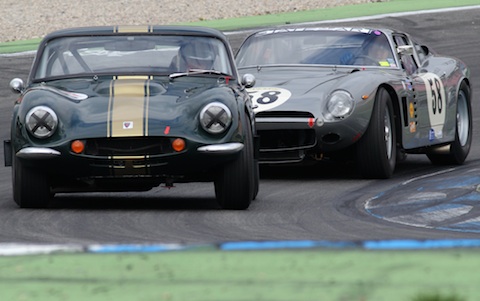
In both rainy races of the Triumph Competition and British GT, the TR6 with Florian Lübbert and Philippe Vermast at the wheel triumphed - nomen es omen. Paul Conway (Morgan Plus8) and Paul Lejeune (Triumph TR4) took second and third place respectively.
Attractive demonstration runs
Attractive racing was on offer not only when fractions of a second were at stake, but also in the demonstration runs, in which interesting vehicles were on the track.

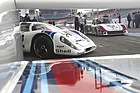
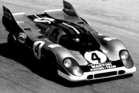
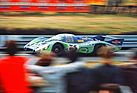
When else can you see and hear a Porsche 917 or a Talbot-Lago Monoposto with their powerful soundscape in the Motodrom, if not at the Bosch Hockenheim Historic?

All results and further reports can be found on the event website .