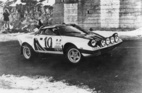
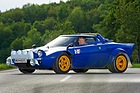
Anyone who didn't get chicken skin on the Bernina Pass on September 22 and 23, 2018, probably didn't have any petrol in their blood. When the screaming Lancia Stratos roared up the mountain, it sounded like the Col de Turini at the Montecarlo Rally.

On Sunday in particular, the V6 engines could be heard for a long time before the vehicles made their way towards the top of the pass (2330 meters above sea level), not least because of the lack of visibility due to fog. Anyone who described this background noise as noisy was certainly not a Lancia fan.
Already for the fourth time
In 2015, the organizers of Bernina Gran Turismo hosted a hill climb for historic racing cars for the first time, and the weather was modest. In 2016, the weather was hardly any better, but in 2017 the sun shone for the first time for a longer period of time, even if it was not completely wet.

In 2018, Bernina Gran Turismo took place for the fourth time, over 60 vehicles lined up at the start and the weather played along for once, with the exception of unruly clouds of fog.
The fast competition drivers
After a supporting program that lasted several days, the timed races were on the agenda on Saturday and Sunday. And like Arosa, the mountain race from La Rösa at 1880 meters up to the top of the Bernina pass at 2330 meters offers a real racing atmosphere, as the fastest riders compete for the best times.

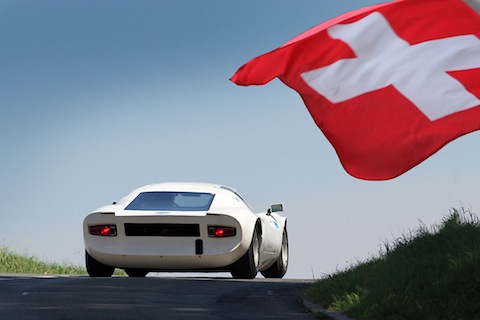
Daniele Perfetti was the fastest in a 1975 Lancia Stratos HF Group 4, with no one beating his best time of 3:28.65. Chris Ward in a Ford GT40 was a little faster last year, but even a time of 3:30 still corresponded to an average speed of around 100 km/h. And this despite the hairpin bends and a total of 50 bends on the 5.9 km route.

Michael Stoschek came second in a Porsche Carrera RS 3.0 from 1973, Reto Gansser third in a Porsche 911 ST from 1970, taking into account the two best times.

A surprise was certainly Daniel Uebelhard in the standard UrQuattro, who finished fourth with times of around 3:50.

The second-best time of the weekend, however, was set by Ewan Cameron in the 1969 Harrier Formula 5000. With a time of 3:29.36, he was only just under Perfetti's best time. However, he was only able to complete one timed run (on Sunday).
Martin Halusa's times in the only pre-war car to take part in the Competiton class were also impressive.

With times of under 4 minutes and 10 seconds, the driver showed why the Bugatti 35C (built in 1927) was the car to beat in many competitions at the time.
Lancia Festival
The fact that a Lancia won the competition was a fitting tribute to the fact that this brand, so neglected by FCA, was represented at the Bernina with a wide range of products that made spectators' mouths water.

Five Lancia Stratos were at the start, two Lancia Fulvia, two Lancia Delta (including an S4) and a Lancia 037 Rally - there was almost no better way to celebrate the once leading manufacturer in rally sport.

After all, the cars from Turin made up around a sixth of the vehicles.

Most of them were in the "Regularity" class, but this did not detract from the attractiveness of the vehicles.
Rarities on the mountain
But it wasn't just the Lancia rally and sports cars that made a trip to the Bernina Pass worthwhile for the public, but also many other exclusive rarities that you don't get to see every day.

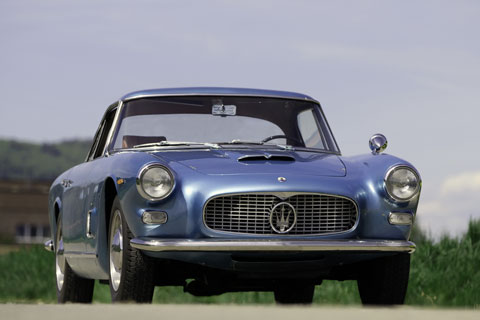
The Lister Jaguar Costin two-seater from 1959, the Aston Martin DB2/4 Bertone from 1953, the Frazer Nash Le Mans Replica from 1950 (a replica that is actually an original), two AC Ace, an Alfa Romeo Giulietta TZ2, a Nomad Mk1 from 1967, which would have made a good trap with its times on the Competiton ranking list, or an Alfa Romeo Giulietta Sprint Zagato from 1962.

But you could actually list almost every one of the more than 60 participating vehicles here, because there were hardly any dozens at the start and the soundscapes that the vehicles were capable of were top class.
Fog, fog
The only problem, apart from unexpected participant cancellations and the organizational challenges that automatically arise at such an event on public roads, was the fog, which unfortunately almost refused to clear on Sunday morning, which is why the first run ultimately had to be cancelled.

This was just as unfortunate for the spectators as it was for the riders, who had finally arrived at the top of the Bernina Pass at 07:00 to tackle the first descent. The race did not start until around 09:30. Saturday was certainly the more productive day for the spectators.
Pretty even
The majority of the participants drove according to the regularity regulations and the standard times set for the individual classes. The pilots in the "OTS Period E" class were particularly precise, with a real neck-and-neck race with minimal gaps.

The winner, Tom Jeck in the 1960 Triumph Asper, ultimately only managed to deviate from the target time by 2 seconds. But the runner-up in this class, Hans-Jörg Zingg in a 1959 Lotus Seven Series 1, was hot on his heels.

The gaps were also small in the "GTS Period H1". Two of the four Stratos managed super-short time differences and showed that these rally cars are not only suitable for best times, but also for consistent driving.
Next year again?
What else could we wish for the Bernina Gran Turismo hill climb, apart from the fact that it will hopefully take place again in 2019? Perhaps a few more spectators and, of course, a little less fog, although this would have made for some interesting photos if only the cars had arrived at the right moment ....