It probably came as a surprise to many that this year's Bernina Gran Turismo hill climb in the Upper Engadin in early autumn, which was characterized by capricious weather, was perhaps the most beautiful and summery of the numerous automobile events in the lively St. Moritz calendar of events. From previous years, regular visitors tend to remember the cloudy pass, icy gusts and even driving snow.
Long Saturday and lots of helpers
This year, on the third weekend in September, there was pure sunshine, perfect temperatures and very good road conditions, the likes of which hardly any Swiss pass can offer.
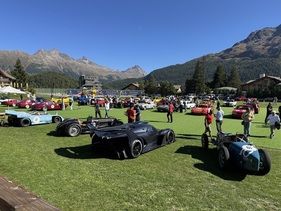
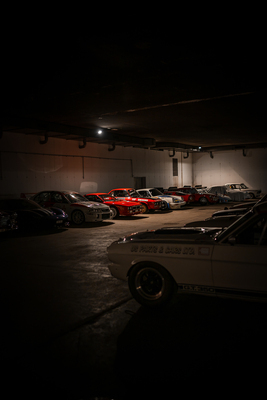
Let's start at the beginning: As early as Friday morning, the participants and their 50 or so vehicles gather for technical scrutineering on the panoramic mountain meadow of the Kulm Country Club in St. Moritz. Right at the entrance, three Bugatti gems are impossible to miss: The legendary 1927 Type 35B of Martin Halusa, who is one of only eight participants with a racing license - and alongside his wife Susanne Halusa in the Ferrari 250 SWB - in the Competition class. Next to it is the "Le Bolide", described by some as the "first potent Batmobile", with 1600 hp output and just as much NM torque from a 4-fold turbo W16 engine; that speaks for a whole new "trackday adrenaline level". But even this masterpiece is crowned by the admirable Type 59, "best of show" winner at Pebble Beach (2024) and also regularly used by its owner Fritz Burkard. However, Burkard did not drive his "Le Bolide" alone on the following days; there were also "driving lessons" from veteran Le Mans winner Andy Wallace, perhaps also for Bugatti CEO Mate Rimac - similar to "type-ratings" for pilots in aviation.
Fans of special pre-war vehicles will be spoiled with the sight of the 1928 Bentley 4½-liter or the legendary Alfa Romeo 8C (1932).
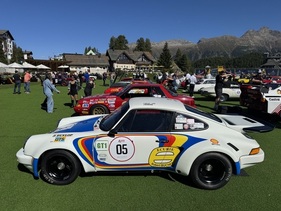
Further champagne truffles for the eye, for the still manageable number of visitors on Friday, are quickly identified: a Porsche 908, vintage 1971, owned by the private collector, art dealer and passionate racing driver Ernst Schuster. He drove the car seven times at Laguna-Seca alone in the 1970s. The "TZ2" Alfa Romeo Giluia with Zagato bodywork, which arrived from Germany with Martin Kapp, appears rare and even more enchanting to the observer in the autumn sun; for many with such a beautiful design that it can hold a candle to the most beautiful historic Ferrari models - and also looks appealingly slim and sporty.
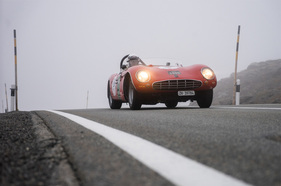
Even more exotic and previously unknown to many was the Triumph "Asper", christened the "Tasmanian Devil", which was built in 1957 for racing driver Geoff Taylor - based on a TR3 and fitted with a fiberglass body.
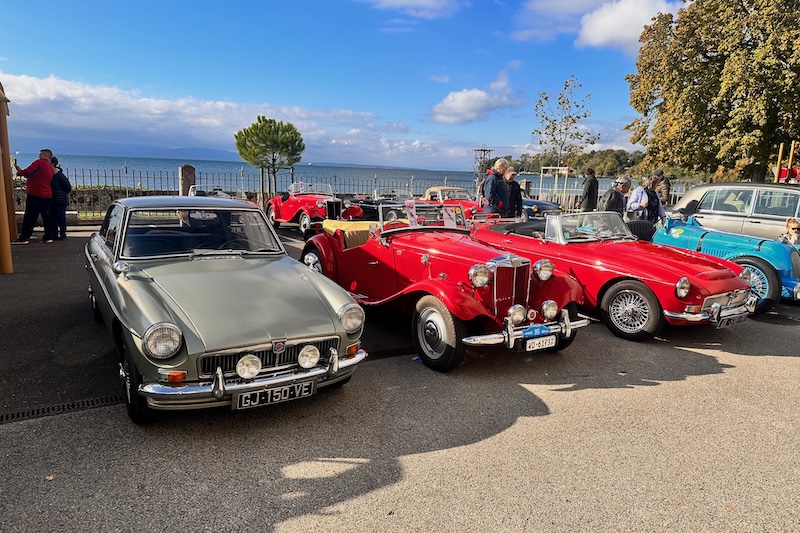
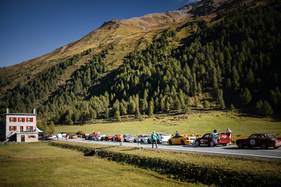
For a further description of the starting field, let's jump over to Saturday and directly to the legendary pass road, which the participants will drive uphill between Poschiavo and Pontresina or - even more precisely - starting in La Rösa and finishing at the Bernina Hospiz. The race starts in three classes: "Demonstration", "Competition" and "Regularity", where two thirds of the vehicles line up to tackle the 52 bends, 450 meters of altitude and 5.7 kilometers at a reasonable pace for the vehicle in question. All vehicles and classes can be found in the participant lists in the photo gallery; however, some vehicles were swapped by the drivers at short notice - such as Gian Battista Camenisch's MG Magnette K2 for his E-Type 3.8 "flat floor" or Kurt Engelhorn's Lotus Elite S2 for his early Lotus Seven S1.
Saturday - Ferrari, Bentley and the Big Block
A Ferrari 250 SWB Competizione (1962) from Scuderia Serenissima Venezia is striking and certainly one of the highlights of the field. Short wheelbase means a shorter wheelbase, better proportions and more agility when driving. The 3.0-liter V12 by Gioacchino Colombo - for many collectors the best Ferrari engine of its time - is a perfect match. Susanne Halusa is at the wheel, driving one of her first races with a fresh racing license.
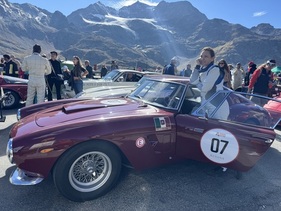
Considering that the Ferrari 250 was built at the time to stand out from Jaguar's new E-Type in terms of buyers' favor, the latter is a real bargain for around two to three percent of the Ferrari's current price tag of around 10 million euros. In the starting field at the Bernina Pass, they were once again right next to each other in a nicely comparable manner.
Ferrari is also represented in a more modern form: with a 430 Scuderia from 2007. 510 hp from a 4.3-liter V8, reduced kilos and extreme acoustics, it was regarded as Maranello's answer to Porsche's GT3 models. Owner Pierre Lonfat, otherwise known in the scene for his F40, uses his 430 with unmistakable verve.
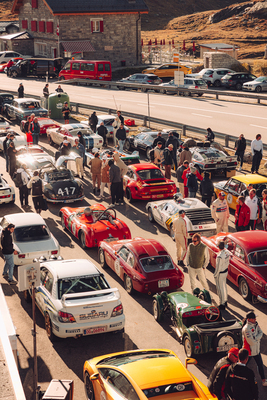
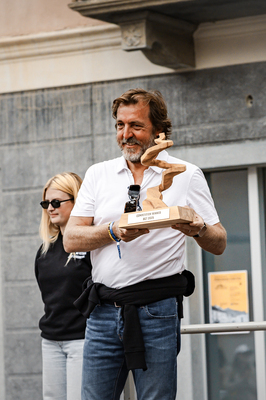
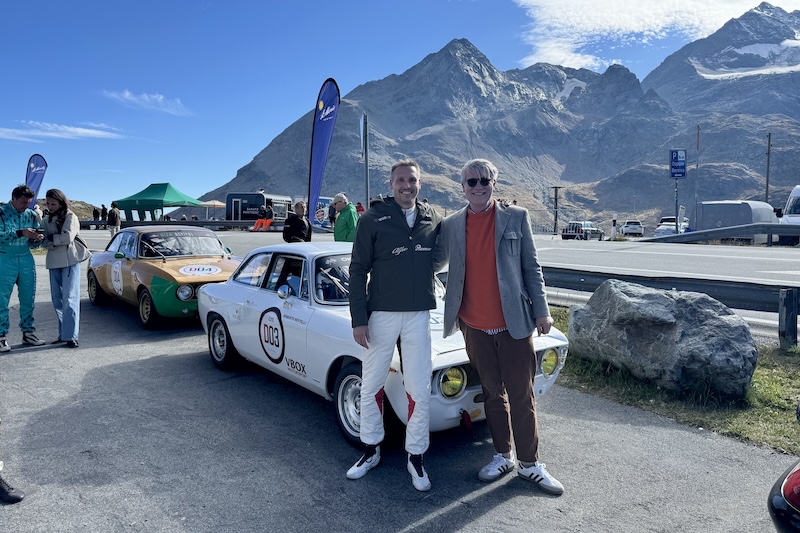
The term Ferrari finally brings us to a man who combines several roles in one for Bernina Gran Turismo: loyal supporter, passionate racing driver, agile "networker" and, incidentally, presumably also a model? Not many amateur drivers have the charisma of racing legends from the 70s or 80s in their racing overalls, but Ronnie Kessel does. And alongside Ferrari, he loves certain classics from Milan: the highly race-ready Alfa Romeo GTA/GTAm. In the 1960s, these lightweight touring cars made their mark on motorsport history. The flared fenders ("widebody") and the typical "dial" rims are striking. With their low weight, short gear ratios and solid engine performance, the GTAs became successful models. We took a ride in the GTAm 1.6 here - and were very impressed.

The American contribution provides volume and muscle power: the 1963 Ford Galaxie. The big block V8 with a displacement of 7.0 liters, two Holley carburettors and around 550 hp drives 1.7 tons over the pass. Driver Alex Boller describes the driving style simply as "steering with the gas pedal".
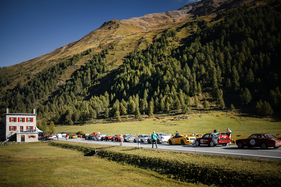
The Alfa Romeo 8C 2300 from 1932 with a Zagato body is another piece of pre-war history. "8C" stands for eight cylinders. Only 188 chassis were built and awarded to various coachbuilders. The 8C won Le Mans four times in a row and is still one of the most valuable Alfas ever.
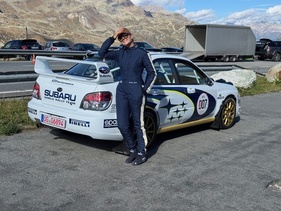
Its owner, Klaus Dold, also provides for young drivers: for the first time, his 19-year-old daughter Victoria Dold is actively involved in the rally-proven Subaru Imprezza WRX STI Prodrive (2006). In conversation, she is passionate about motorsport and highly motivated to learn. She is welcomed with open arms at events like this one.
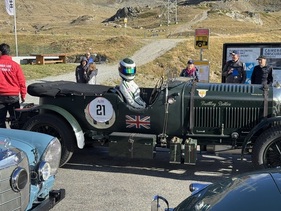
Also pre-war, and British to boot: the Bentley 4½ Litre (built in 1928). With 110 hp from a displacement of 4.4 liters, it was one of the fastest cars of its time. The famous "Bentley Boys" used it for long-distance races such as Peking-Paris. The supercharged "Blower" version even produced 175 hp. An example with the inscription "Bentley Belles" is coming to the Engadin, as this Bentley is always driven by Katarina Kyvalova from Hamburg, one of the most active and well-known women in the European classic car and racing scene and a six-time Mille Miglia winner.
A highlight for purists and all those who see the trophy of the overall winner of the world's most famous Concours "Pebble Beach" in California as the holy grail: The Bugatti Type 59 from 1934, with around 250 hp, a top speed of 250 km/h and victories at the Algeria, Pau and Reims Grand Prix. Fritz Burkard's example still wears the original paint from the 1930s: black with yellow stripes - once painted like this for King Leopold of Belgium. The vehicle has a kind of "well-kept patina", looks extremely authentic, honest, aged with dignity and therefore simply particularly beautiful - and it has an indescribable presence and charisma in the flesh: you would like to drive and experience it immediately - regardless of the fact that the Pebble Beach award has certainly increased its value in the collector's world by another 30 percent.
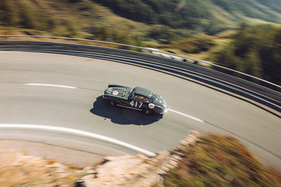
Two Mercedes-Benz Heritage vehicles come from Stuttgart: the 190 SL Rennsport, boosted to 150 hp and fitted with a roll bar and bucket seats, and the 300 SL "417". This vehicle took part in the 1955 Mille Miglia, delivering an impressive 231 hp at the time - and also won in the GT category.
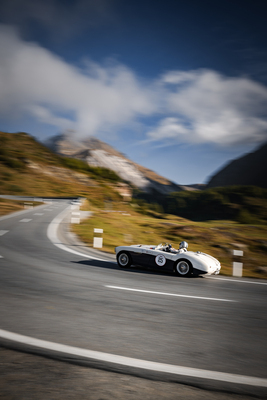
The art of British lightweight construction is represented by the Austin-Healey 100S, a rare factory racing model, and the Lotus Super Seven S1 - purist, extremely light and reduced to driving pleasure. Bernina Gran Turismo initiator Kurt Engelhorn enjoys this and, according to his own statement, he has set out with the aim of "driving the cheapest car of the event"; a likeable move that shows that he is primarily concerned with minimum weight, which has always characterized the Lotus DNA far more than luxury sports car price tags.
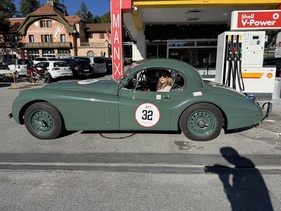
The Jaguar XK120 driven by Nico Patrone from Barcelona also comes from Engelhorn's garage. Friends of the family say you can tell by the green color. In the early 1950s, it was the fastest production car in the world and the Coupé (also known as the FHC - Fixed Head Coupé) in particular shows how Jaguar combined elegance and speed even back then.
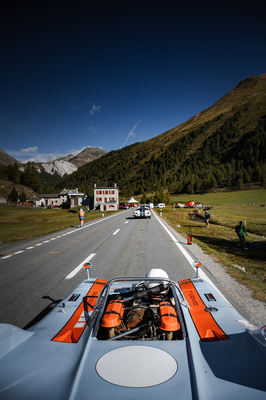
The crowning glory: the Porsche 908/03 Spyder. A fabulous 540 kg light, flat and rear-heavy, built for the Targa Florio. Once driven by Brian Redman, then for many years by the current owner Ernst Schuster and this year by the focused and knowledgeable old Schuster friend Franco Gansser. The car is equipped with an air-cooled eight-cylinder engine that delivers over 350 hp. Seeing, smelling and hearing the car "in action" makes motorsport history very tangible.
Sunday - the Bolide and the time chase
The second day brings not only classics, but also decisions. Daniele Perfetti took the lead in the Competition Class with a time of 3:16.404. Ronny Kessel follows in second place with a time of 3:37.121. The youngest driver here is also Victoria Dold: at just 19 years old, she drives her Subaru to the finish in 4:13 - remarkable for her debut.
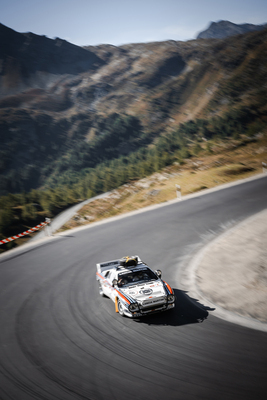
Other vehicles deserve a special mention: the Lancia 037 Rally in safari specification carries its spare wheel visibly on the roof - a relic of the 5,000 km stages across Africa. Here you tend to wonder whether the aerodynamics wouldn't be better without it and how much time it would cost? But with a supercharger instead of a turbo, mid-engine and rear-wheel drive, it won the 1983 World Rally Championship - the last two-wheel drive car ever to do so.
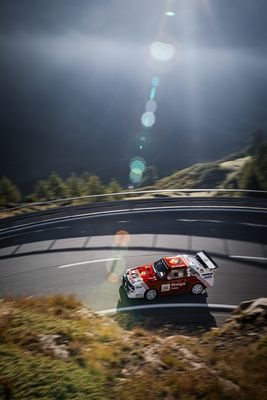
The Audi Sport Quattro S1 rolls up the mountain pass with a deafening turbo whistle. Its short base, huge supercharger and distinctive fan at the rear made it infamous. Walter Röhrl once described the car as "dangerous" - which only adds to its fascination.
A special driver: Erik Comas, ex-Formula 1 driver, steers the Alfa Romeo GTAm with wide fenders up the mountain pass. His career was marked by successes, but also by a serious accident - Ayrton Senna was the first to help him at the time. Today, Comas enjoys rallying.

Finally, the Porsche 911 3.0 RSR from the GELO Racing Team, built in 1974/75, is an example of 70s racing technology with its powerful sound and uncompromising mechanics.
There is also a Japanese splash of color: the Toyota Celica ST205, rally car of the 1994/95 season, which became legendary not only for its victories, but also for its disqualification in 1995 when a turbo restrictor manipulation was discovered.

And again the Bugatti Bolide. A W16 with four turbochargers and around 1,600 hp is at work under the carbon dress. First and second gear are sufficient on the mountain road. The car is uncompromisingly developed as a racing vehicle; no road approval, no compromises, maximum aerodynamics. Today, Fritz Burkard is at the wheel and sitting next to him is Andy Wallace, Le Mans winner and Bugatti test driver. It is perhaps one of the last times this hyper sports car will be driven on a public road.
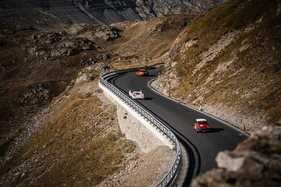
The organizers would like to thank everyone who made this passionate meeting possible. Without marshals, organizers and helpers, there would be no permit and no race - their role is essential. They work for free, unlike professional events such as the Le Mans Classic. Most of them are volunteers; out of passion and dedication. And that is precisely why we want to write about them here. We would also like to thank the local residents for their tolerance and patience in the face of the temporary closure of an important route from Italy to the Engadin.
In 2025, participants and visitors of the 10th Bernina GT of modern times were truly spoiled - by the weather, but also by the aesthetics of a colourful starting field, by dreamlike panoramic images in the mind and a perfect organization - all this paired with an almost familiar, warm atmosphere.
And the fact that young Ana Engelhorn and her team have taken over the organization alone could lead to even more younger participants and more than a handful of women wanting to take the wheel in the future. Perhaps we will now encourage our readers to do so - and registration for 2026 will certainly be possible soon.



-c-Erik-Fuller-Courtesy-RM-Auctions.jpg)