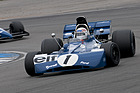
Technology in race cars (25): Lotus 63 - Connect four by four?


You have only
1 out of 43
images seen in high resolution


Summary
Two additional drive wheels were expected to provide more traction, higher usable engine power and therefore faster cars in the 1969 season. In addition to Lotus, three other manufacturers also tried out the unusual new technology. However, they quickly realized that the higher weight and tendency to understeer outweighed any hoped-for advantages. Episode 25 of the series "Technology in racing cars from 1958 to 1978" tells the story of the failure of four-wheel drive in Formula 1.
This article contains the following chapters
- A good idea in principle
- Lotus
- Two world championships given away
- McLaren, Matra and Cosworth
- Balance sheet
Estimated reading time: 9min
Preview (beginning of the article)
The years 1958-1978 were the two most creative decades in the history of racing technology. This series portrays the most innovative, pioneering and exotic designs of Formula 1, Indy cars, sports cars and Can-Am, and at the same time traces the major lines of development that still have an impact today. The series started with Lotus, one of the most important innovation drivers of these two decades. And the series will also finish with Lotus. This time, we recall the unsuccessful attempts to double the number of drive wheels. 1969 was a key year for the further development of Formula 1: it was the year in which the high downforce wings were banned after the violent Barcelona accidents . At the same time, it was the year in which the 4x4 Formula 1 cars created as Plan B for more grip failed. This meant that in future, there were only two ways to increase downforce apart from the wings and spoilers directly on the vehicle. The first was to trim the upper side of the vehicle body itself for downforce, which from 1970 - initiated by the Lotus 72 - resulted in the then widespread wedge shape. Secondly, from 1977 onwards, the underside of the car (underbody and sidepods) was redesigned close to the ground to generate downforce according to the aerodynamic Venturi principle. Today's racing cars combine these two methods to create a highly complex, three-dimensional structure that forces the air above and below the vehicle to produce as much downforce as possible with as little drag as possible.
Continue reading this article for free?
Images of this article