The Ferrari 340 America Vignale Spider Competizione that couldn't win


You have only
1 out of 21
images seen in high resolution


Summary
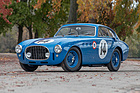
Aurelio Lampredi, a young designer, joined Ferrari in 1946 and Enzo was to owe one of his most successful engine designs to him. Installed in racing and sports cars, the V12 ensured great success. In the Ferrari 340 America, it guaranteed high power output and more than competitive driving performance and was thus used in the world's biggest racing events - Le Mans, Mille Miglia, Targa Florio - albeit not always successfully. This report describes one of the Ferrari 340 America Spider models with Vignale bodywork from 1952 and shows it in many pictures.
This article contains the following chapters
- Lampredi instead of Colombo
- Vignale instead of Touring
- Premiere with Taruffi
- Swiss start with Daetwyler
- Failure also at Le Mans and the Targa Florio
- A bigger car?
- New owners, new bodywork
- Back to the start
- Further information
Estimated reading time: 9min
Preview (beginning of the article)
The first sports car to bear the Ferrari name was the 125 S in 1947, powered by a 1.5-liter V12 engine designed by Gioacchino Colombo. This engine, later bored out to three liters, was the foundation of Ferrari's success for decades to come. However, the chosen engine design also had weaknesses, for example it was less suitable for supercharging. Aurelio Lampredi joined Ferrari in 1946 as a junior constructor, so to speak. Because Enzo Ferrari had realized that the Colombo V12 could not help him succeed in the large-volume or supercharged Formula 1 racing series, he commissioned Lampredi to design a large V12. In the initial configuration, this racing engine had 3322 cm3, but was above all longer and larger than the Colombo V12, which made it more robust and better suited to high power output.
Continue reading this article for free?
Images of this article

_RM.jpg)