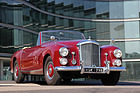
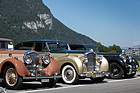
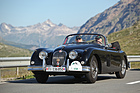
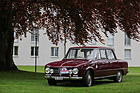
It's hard to imagine today, but just over half a century ago, the coachbuilding trade was flourishing in Switzerland. Around 40 well-known companies built elegant and special coachwork at the request of a wealthy clientele, most of which were truly unique.

If the successful doctor or owner of an industrial company wanted to give his wife an unusual present, he turned to Mr. Graber in Wichtrach or Walter Köng in Basel for advice on the choice of chassis and body. His wife brought along a fabric sample or another object to serve as a model for the choice of color.
From model to original
The coachbuilder then produced a style study on a scale of 1:10, which was then transferred to plan drawings in the original size and served as a template for the wainwright, who carpentered a wooden frame, which was placed on the chassis supplied. The tinsmith then drove the bodywork from sheet steel or aluminum, the saddler sewed together an interior, the painter carefully applied layer upon layer of paint and after several thousand hours of work, the collaboration of the various craftsmen resulted in a beautifully shaped and special automobile, which was then also gladly shown at Concours d'Elégance events.

Promoted by politics
While domestically produced chassis could still be used until the 1930s, chassis had to be imported from then on. To help the industry, in 1931 the Federal Council provided for customs relief for vehicle components and chassis in particular, which enabled Swiss coachbuilders to produce cars at competitive prices.
Well-known and lesser-known names

The best-known Swiss coachbuilder was probably Hermann Graber, whose designs were also in great demand internationally. Gangloff, Köng, Italsuisse, Beutler, Worblaufen, Langenthal, Tüscher and Reinboldt & Christé, to name just a few examples, also achieved international renown. However, there were also many small coachbuilding companies that primarily satisfied local demand, such as Alfred Hänni, Otto Heimburger, A. Ruckstuhl and Heinrich Eckert.
But by the 1960s at the latest, the handcrafted bodies were no longer competitive in terms of price, especially as series production became increasingly varied and special bodies became less important.
Only very few were allowed to continue their business into the modern era, some turned to commercial vehicle bodies, others diversified into the repair trade.
Almost 40 rare Swiss bodies in the Pantheon
Stephan Musfeld and the Swiss Car Register have brought together almost 40 vehicles from 15 coachbuilders for the special show at the Pantheon. However, it is not primarily the quantity, but the wealth of shapes and the diversity that inspire.
A journey through time and taste
Starting with a carriage by Reinbolt & Christé from 1870 and ending with the Graber Alvis TF 21 from 1968, the exhibition also covers a wide range of time periods and shows the development of the coachbuilding trade over time and how it has increasingly evolved from carriage building to haut couture.

However, it is also interesting to compare the styles of the various coachbuilders, most of whom used their own designs as the basis for their superstructures. Hermann Graber, for example, found a good mix between elegance and functionality, far removed from the opulent and extravagant styles of French coachbuilders such as Saoutchik or Figoni.
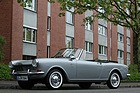
Some of the vehicles on display have hardly ever been seen before, making them special highlights. And with the Opel Kadett A Spider, designed by Pietro Frua and built by Italsuisse, there is also a pinch of "Italianita" in the exhibition.
For the sake of completeness, here is a list of the exhibited vehicles contributed by collectors and museums:
- Gebrüder Beutler, Thun
Lancia Aurelia 1955
Porsche 356/2 003 Gmünd 1949
VW 1959 - F. Brichet, Geneva
Delage DE 1923 - Gangloff, Geneva
Terraplane 1934 - Carrosserie Ghia SA, Aigle and Lugano
MG TD 1953 - Hermann Graber, Wichtrach
Packard 1101 1934
Delahaye 135 MS 1939
Bentley Mk VI 1952
Alvis TC 21 1953
Alvis TC 108 G Super 1957
Alvis TE 21 1964
Bugatti 57 1936
Alvis TF 21 1968
Rolls-Royce 20 hp 1926
Talbot-Lago Grand Sport 1953
Triumph Continental 1937
Bentley R-Type Continental 1955 - Jean Gygax, Biel
Vauxhall ASX 1933 - Alfred Hänni, Zurich
MG PA 1934 - Höhener, St. Gallen
Lancia Lambda 1929 - Italsuisse, Carouge
Opel Kadett A Spider (1964) (Pietro Frua) - Walter Köng, Basel
Bentley 4 1/4 Litre 1936
Delahaye 135 MS 1946 - Carrosserie Langenthal, Langenthal
Plymouth PE 1934 - Reinbolt & Christie, Basel
Carriage 1870
MG WA 1939 - Alfred and Fritz Tüscher, Zurich
SS 2 1/2 Litre Jaguar 1937
Delahaye 135 Coupe des Alpes 1938
Plymouth P6 Deluxe 1938 - Wenger, Basel
Salmson GSS 1926 - Fritz Ramseier & Cie, Worblaufen
Alfa Romeo 6C 2300 B 1938
Lancia Aurelia B52 1953
Citroën Traction Avant B52 1953
Peugeot 203 1949
A catalog of superlatives
As if the exhibition wasn't sensational enough, Stephan Musfeld and his team have also put together a 140-page catalog that alone is worth a trip to Muttenz (near Basel). It lists and characterizes all the renowned Swiss coachbuilders and, of course, contains many interesting facts about the exhibits, which are also photographed in the catalog. Many archive photos, company logos and other interesting details round off the catalog, which you will enjoy leafing through long after you have returned from the exhibition.