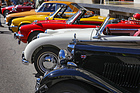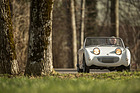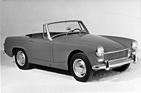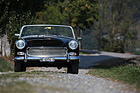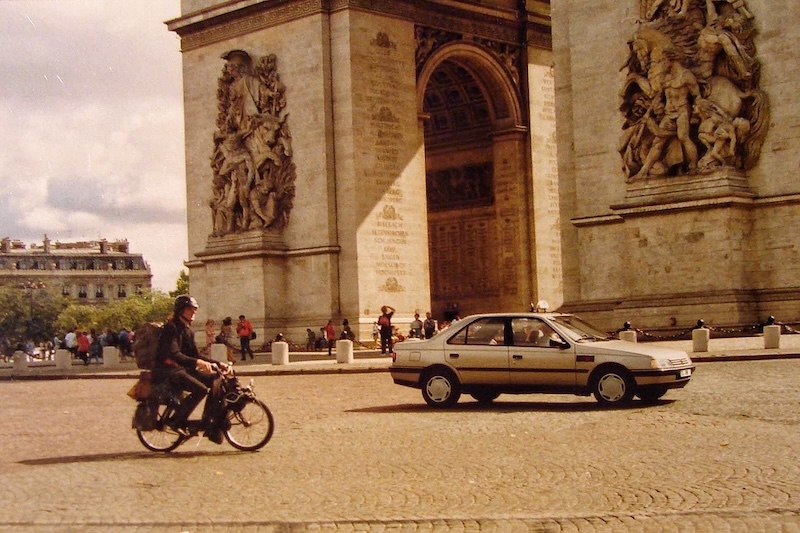
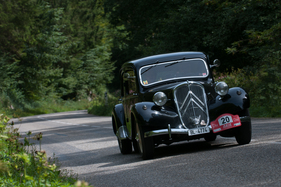
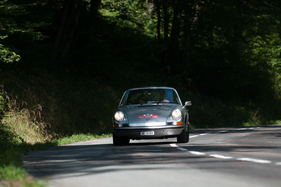
After the 2014 Raid ended in Brussels, the 25th edition on August 27-30, 2015, once again had Paris as its destination. However, this was far less important than the route. And this led from castle to castle, of which there are many in the land of the Gauls. However, the summer heat plagued a number of cars and their passengers - the TCS patrol on the road was very busy. Nevertheless, it was worth taking part. And we also got to wave ... extended ...
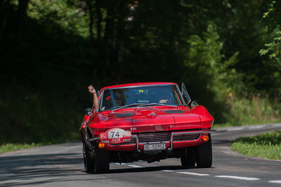
Anniversary ride
Hans André Bichsel and his team, which remains as active as ever, organized this classic car outing of a somewhat larger kind for the 25th time. From Thursday to Saturday, 150 classic cars of all kinds drove many hundreds of kilometers (the exact number will only be known afterwards) from Basel to Paris. Naturally only on charming side roads. Car roads or even railroads were taboo, traveling was, as always, more important than arriving.
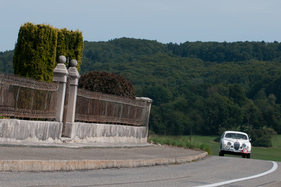
And for most of the participants, the most interesting part was meeting like-minded people. The spread was enormous in terms of price structure, type of car and vintage. Of course, the very old vehicles from before the First World War were missing, because the Raid demands a kind of "everyday speed" and the distances should not be underestimated.
Three categories
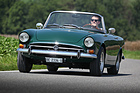
The 13-strong "Vétérans" category was led by a 1928 Rolls-Royce Phantom I, the oldest car in the field. As always, the largest category by far, with around 120 entries, was called "Tourisme". Together with the veterans, the cars were driven for minimal penalty points. Around 20 other vehicles took part in the "open raid", i.e. just for fun. The illustrious list of starters can be found on the Raid website.
Participation in the Alfa Romeo 2000 Touring Spider
We took part with the Alfa Romeo Spider 2000 with touring bodywork from 1960. The beautiful white vehicle belongs to the Italian Alfa expert and collector Renato Perucchini, who lives in Ticino. He bought it in semi-restored condition because the previous owner had run out of breath - or rather patience. The result of the restoration, which has now been completed, is fantastic. The Spider is like new. And that's how it felt and sounded.
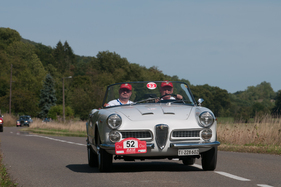
The 2000s started life in 1957 as a saloon and a Spider. The latter was designed by Carlo Felice Bianchi Anderloni, the son of the Touring founder. With 3445 units sold by 1962, the Spider was a moderate success and the saloon sold even worse. The 2000 is a very original and unadulterated car, also very pretty with its superimposed headlights and parking lights/indicator units as well as the simple overall shape.
However, one has to wonder how the price of 24,900 francs in 1960 could be justified. In terms of price, it was only slightly below the Jaguar XK150: certainly the main reason for its low popularity at the time. Today, the 2000 Spider is all the more sought after.
High seating position
The seating position is excellent, as is the view in all directions. The view over the hood with its two elongated air intakes and over the sculpted fenders is very attractive. Neither the steering, gearshift nor clutch require any effort. The performance of the 2-liter engine with two overhead camshafts and 115 DIN horsepower is impressive. Even more impressive, however, is its elasticity. The two Solex carburetors do not resent either very low revs or cheering up steep mountain roads. These are the best prerequisites for precise riding, as required on the Raid.
But Renato Perucchini waved me off: "We want to have fun without any ambitions for a top place, don't we?" I was relieved, because that's exactly how I saw it. As co-pilot, I would have had to calculate the average speed and therefore the arrival time at the next stage finish to the minute. Then I would have missed out on the beautiful landscape and the people waving at the side of the road. Incidentally, they were always full of enthusiasm, nothing of envy or anything like that. Only once did a farmer shout from his Lada Niva: "C'est 30 ici!" It's 30 km/h here. We looked at the speedometer and saw that everything was fine. Perhaps he was referring to the Porsche Speedster in front of us, which looked even faster in red than the white Alfa.
Difficult orientation
If anyone wants to know exactly where we drove through: we remember Delémont, Besançon and finally Dijon. That's the crux of driving according to the road book. You only ever have the next junction or turn-off indicated. The villages in between are usually unknown, and because you don't have a road map with you, you don't even know where you are.
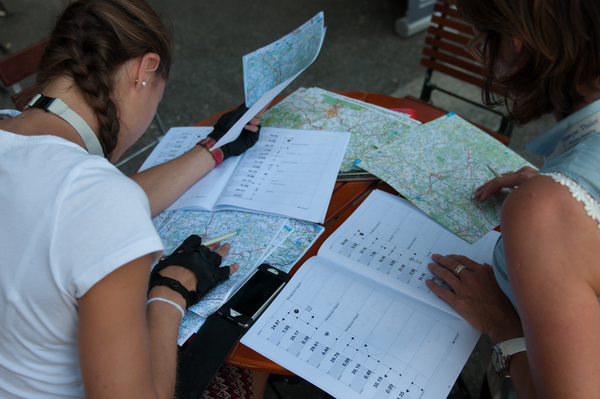
But that didn't matter. That's part of the Raid: just go for it and enjoy. Of course, we also took part in the hose tests, where we had to ride a certain distance between two measuring hoses in a precisely defined time. But we only estimated the times.
A lot of work for the suspension
The more beautiful the landscape, the worse the roads. Or the prettier the village, the more bumps on the road. The suspension with the rear rigid axle did its job amazingly well, the bumps and holes were easily absorbed and the cornering speeds on the open road were surprisingly high. The torsion of the self-supporting Touring aluminum body (which is not a Superleggera design, although this is noted on the car) is also far less severe than expected.
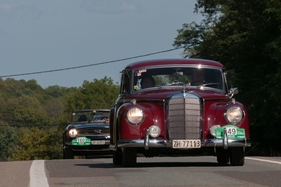
In general, the vehicle made a very solid impression. The only thing we found was that the seats were far too flat and the back support was too low.
Because there are no seat belts on board, there is no lateral support when cornering at speed. There is hardly anywhere to hold on to. But that wasn't Renato's problem, as he put the spurs to the horses and overtook slower competitors who were going too fast and needed to make time.
No sun visors
Towards evening, when the sun was low in the sky, you were puzzled to find sun visors on the windshield, which had been drawn in at the sides. The rear-view mirror is mounted on the cockpit. Everything else that is dispensable for pure driving pleasure is also missing. Our car also had no radio. Instead, the clock collection is complete and simply beautiful to look at in the completely black cockpit. This also applies to the Borrani spoke wheels with central locking, which the first owner ordered at extra cost.
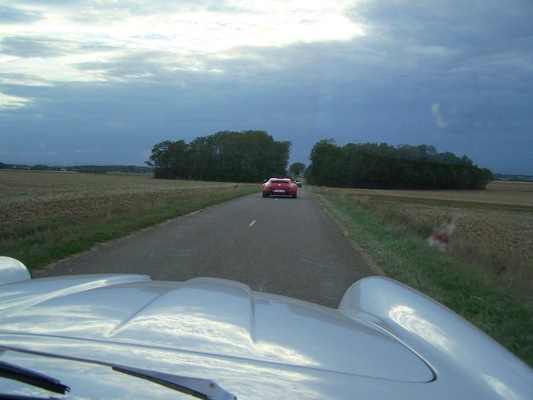
Especially with the huge brake drums, they give the Spider a special look. We were already looking forward to the triumphant arrival in Paris, as the touring body would have really come into its own among the elegant townhouses.
Clutch problems
Would? Yes, because unfortunately the Spider was unable to reach Paris. The explanation. The Spider had been parked for a long time before the raid. Trained car mechanic Perucchini, who does everything himself on his oldies, took it out of the garage, checked everything and drove around 200 problem-free kilometers to make sure that the Spider would make it through the raid.
He did just that until after the technical inspection and lining up for the start. But as soon as he drove onto the starting podium, nasty scraping noises came from the gearbox. The clutch did not release completely.
After the start, we left the route straight away to look for the problem at a friendly Alfa workshop in Pratteln. It was quickly found. A leaking hydraulic line had paralyzed one of two pumps. Nostalgic Perucchini, who prefers to only drive cars up to the end of the 1950s, once again sang the praises of the good old days when cars still had mechanical clutches. Even the electrics were never a major problem; it was the hydraulics that made the cars susceptible to damage.
Fortunately, a replacement was in stock. After 20 minutes, the Spider was able to drive again. However, the leak in the line remained undetected. The hydraulic oil had to be constantly topped up. On the first day of the raid, the Spider still ran smoothly and shifted gears well. But towards the evening, the longer the more this unpleasant feeling in the clutch foot reappeared. All the shifting was not healthy for the clutch and gearbox if the hydraulic line had a leak somewhere - despite constant refilling.
On Friday morning after breakfast, the decision was made: we would drive straight back from Dijon to Basel, where the van was waiting to take the bike back to Ticino. Despite all the disappointment, this is the best choice for man and machine. Then it was all straight home on the highway - where you hardly had to change gear. According to the AR catalog, the Spider, which was around 175 km/h fast, also felt right at home on the freeways, which had previously been considered taboo. It was predestined for the fast lane at the end of the 1950s and beginning of the 1960s, considering that other road users mainly drove Fiat 500s and 1100s or similar - at least in Italy. But the German Beetle or the French Dauphine did nothing to change this situation. The Alfa beat them all.
However, it has to be said that the engine is not a quiet performer and the body hardly filters the drive noise into the interior. In addition, the engine and gearbox also released their waste heat into the closed interior. So open the windows despite the high driving speed.
Closed back
It was important to capture this highway impression with the top down. Despite the disappointment that the hydraulics put a spanner in the works of the Raid adventure, the conclusion is very positive.
The Spider is an amazingly well-balanced and long-distance capable car with plenty of space and a large trunk. And it is a lot of fun to drive. The Raid does the same. The road book still had some catching up to do here and there, but otherwise the organization and route selection were successful. This was confirmed by other participants who completed the Raid.
Winner in the small Sprite
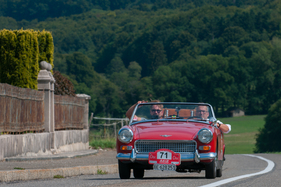
The winning team is Andreas Locher and Manuel Uhlmann in an Austin-Healey Sprite 2 from 1963 (starting number 71). With only 78 penalty points, the two Swiss drivers put in a brilliant performance.

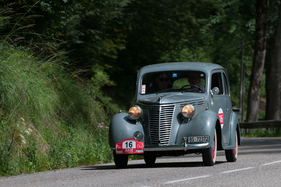
The 1939 Fiat 1100 with start number 16 driven by Reto Fontana and Patrick Geyer won the veterans' category.
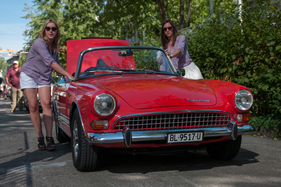
The best ladies' team was formed by Arlette Müller and Sabina Schneider with their 1967 Sunbeam Tiger Mk II (starting number 73).
Something is also being done for the next generation. The Young Riders Cup for participants under the age of 35 (with a reduced entry fee) was won by the 2014 overall winners Olivier Schneider and Mike Müller on the 1963 Triumph TR4.
And there was also an optional night stage, which was won by Roland and Moritz Geiger on the 1961 Alvis TD 21.
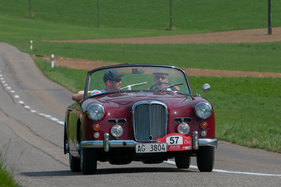
There is no record of the discussions that took place in the cockpit.
One or two marital quarrels may also have taken place. We don't know exactly, but there are couples who come back every year. Perhaps the relationship will last longer if it survives the raid...