After moving from Paaren/Glien, the classic car show Berlin took place for the third time from 18 to 20 May 2024 on the grounds of the ADAC driving safety center in Linthe, around 50 kilometers south of the capital.
Just two weeks after the Classic Days Berlin, the region's classic car scene came together again for a major event. The organizer's usual experienced organization guaranteed participants and spectators a smooth journey. As if by magic - well, with a lot of help from the marshallers - classic car after classic car was neatly lined up. Sometimes they seemed to be grouped together thematically, sometimes there were attractive contrasts.
Sometimes what can't go together goes together
Here you can find a series of air-cooled boxers of different performance classes, there David and Goliath were on a first-name basis. The fact that motorcyclists come together is not at all surprising; rather the frequency of huge US classics. A row of Chevrolet Bel Air and Impala, Chrysler New Yorker and Ford Mustang was rounded off by a Magirus-Deutz 125 D 10. At least the engine capacity category matched.

The author has experienced many a classic car meeting, but even here there were borderline experiences. There was a beautifully prepared Giulia next to an Alfa 75 with the magnificent two-liter DOHC engine. And it had an H license plate. Oh, was it that long ago again?
The post is here
The shaking of the head was replaced by a kind of clouding of perception. Something was driving: yellow, narrow, high, round headlights. Aha: Fridolin. Stop! No driver in it. But: right-hand drive. Brain and eye couldn't agree. Steering wheel on the wrong side, too narrow and the yellow too bright for the German Federal Post Office. No Fridolin. Second look. Did Peel ever build anything for Her Majesty's Post Office? Closer. Royal Mail is right, but wrong country. It was Sweden! It's a Tjorven 440 from 1970, built by Kalmar Verkstad for the Swedish Post Office, based on the DAF modular system; right-hand drive, but not because of the Swedish left-hand traffic, which was abolished in 1967, but so that the letterboxes could be emptied through the sliding door and without getting out of the vehicle.

The Lancia Flaminia (the chronicler's secret favorite) had a soothing effect with its superior, majestic design. The bizarre idea with the two rear window wipers came up again, at least later, in the Toyota Camry. But that was a station wagon that could make good use of the rear wipers.
Fewer Japanese, more French and Italians
Speaking of Japanese. There were soberingly few vehicles of this provenance to marvel at, and the few that were there were mainly from the 1980s. A Mitsubishi Galant can be found in our picture gallery. The Mitsubishi Debonair from our vehicle report from October 10, 2023 , which is unique in this country, was also on the square, but did not make it onto the camera sensor this time.

Our picture gallery may give the impression of a large proportion of Citroëns. In fact, there were also some Peugeots and Renaults. Simca, Matra or Panhard, on the other hand, were not to be found. There were surprisingly few Fiat models from Italy - and when there were, they were mostly licensed models from Lada or Zastava. The Alfa Romeo scene, on the other hand, made a decent showing, including on the club area, which was filled with Giulietta, Giulia, Spider, 145 and C4. Ferrari were thin on the ground.
Hardly any pre-war vehicles, many Americans
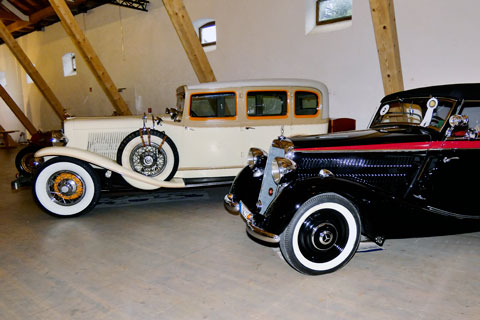
In general, the high-caliber cars: people usually travel to Linthe on their own wheels, which virtually rules out vehicles from the brass era per se. However, there were also few interwar models to marvel at, with Mercedes-Benz 230 and 290 from the 1930s regularly represented. There were also two Ford Model As: one as a standard three-window saloon, the other as a coupé converted into a hot rod.

Also interesting were cross-era combinations such as the NSU OSL 251, which had been built in the West before the war and to which a Falke sidecar from state-owned production was attached in GDR times.

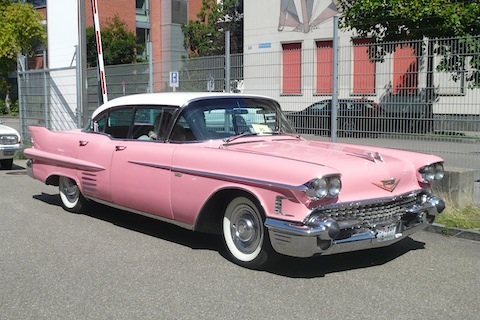
The sheer number of US vehicles is always impressive, with a clear concentration on the fifties to seventies. The desperate whine of revving starter motors could be heard almost constantly as they struggled against huge displacements. The first bassy ignitions then provided relief - and a pleasant massage for the eardrums and diaphragm.
Everyday cars and non-cars
The respectable field of exotic cars, which have not played a role on the roads for a long time or have never played a major role, was interspersed with plenty of everyday classics. They ranged from the rarely driven Mercedes-Benz W 123 to the "coati" VW Passat with frighteningly little horsepower, but all the more kilometers.

In addition to automobiles, the organizer has provided for every kind of (knowledge) thirst and (experience) hunger. There was a good selection of culinary delights to choose from as well as advice from expert organizations, such as the cooperation between FSP and TÜV. Classic Data was represented, as were insurance companies, restoration firms and dry ice blasters. Even spontaneous tattoo needs could be depicted in ink immediately and on the spot.
Competent vehicle presentation, impassive parts market
Drawing verbal pictures is the specialty of Johannes Hübner, who led the audience through the program in his usual entertaining manner. With wit, charm and an inexhaustible fund of anecdotes and factual knowledge, he presented the participants' vehicles in his very own, highly entertaining way.

The parts market seemed to run less smoothly. Anyone seriously looking for rare spare parts is more likely to find what they are looking for at the OMMMA in Magdeburg, if it's about sheet metal from the East, or when it comes to US parts at the rather special US meeting at Diedersorf Castle. The vendors also seemed to take this into account, with a fairly high proportion offering souvenirs rather than a large selection of brand-specific accessories.
Auction with few hammer prices
The impression of the auction also suggested that most of the public did not come to make major purchases. Despite the good mood of the auction team and a professional presentation of the lots, the brown Mercedes-Benz 450 SL as a US re-import, for example, did not even attract the starting bid of 21,000 euros.

The visitors had to make less effort than the auctioneer to create a good atmosphere. This came naturally with the large and colorful selection of vehicles and their informative owners. And so the classic car day ended with the realization that the classic car show in Berlin not only brings the tried and tested, but is also always good for surprises.