


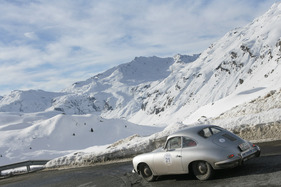


Taking part in a rally with a pre-war vehicle is always something special, but when the rally also takes place in winter and (partly) in the snow, it becomes a real adventure. This report summarizes the experiences of the crew of the oldest participating vehicle in this year's Winter Raid (2011).
The journey and the Lenzerheide - Klosters prologue
The journey (the Austin drives on the trailer) takes place on Wednesday afternoon in order to have enough time the following day for preparations and car inspection at the start location. We decided to drive directly to the destination of Lenzerheide and leave the towing vehicle and trailer there. The first surprise comes as soon as we load up the Austin 12/6: one of the three carburetors is leaking fuel. The reason: a tiny piece of rubber is obstructing the float valve and the carburetor is overflowing. This is quickly rectified and the journey to Lenzerheide can begin. The previously reconnoitred parking space is quickly found and the Austin 12/6 is unloaded in light snowfall.
On the way from Lenzerheide to the starting point in Klosters, the Austin suddenly loses a lot of power on the climbs to Alvaneu. At first we suspect that the engine is running too lean, so Pitt Jung adjusts the mixture. But eventually it becomes clear that a carburetor is not receiving any fuel. So the float valve is cleared and the engine finally runs at full power. This is very welcome, because in the meantime it has already become dark and it has started to snow heavily. Visibility with the relatively weak headlights and snow-covered goggles is anything but good. The rest of the ride is unproblematic, except for an impressive braking test that shows how the tires filled with slush slide almost without resistance on the spikes. This reminds the driver to drive very carefully in these conditions.
The first day: Klosters - Davos - Julier Pass - St. Moritz - Zernez - Livigno - Passo di Foscagno - Bormio - Tirano - Bernina Pass - Pontresina - St. Moritz
The change in the weather can already be clearly heard during the night - it is raining cats and dogs and continues to do so until midday. After the drivers' briefing in a well-heated shed, which soon gets the warmly dressed open-top drivers sweating, the race gets underway: the participants rush off in their vehicles and there's chaos before the technical scrutineering. Once the documents have been completed and technical scrutineering has been carried out - under the interested gaze of various journalists and television crews - the packed lunches can be grabbed and a hot punch enjoyed. As the oldest car, the Austin 12/6 is obviously an attraction for the media representatives present.
The start to Davos is at 12 noon sharp. The road over the Wolfgang Pass climbs quite steeply right at the start, so that larger-displacement pre-war vehicles that started later (Lagonda 4.5 liter and Alvis 2.5 liter) start to overtake after just a few bends. A first tubing test awaits the Austin crew on the natural ice track in Davos. The Michelin tires equipped with spikes do their job brilliantly, and we reach the finish line without spinning. It is already clear that navigation skills can compensate for a lack of engine capacity and power, as the Lagonda passes us again shortly after the ice test. After a special stage near Tiefenkastel, which is made more difficult for the Austin by an oncoming Postbus, the journey continues over the Julier Pass to St. Moritz for a stopover in front of Padrutt's and the first stage end in Zernez. The steering column comes loose on this stage, which Pitt is fortunately able to repair in Zernez.
In the single-track tunnel to Livigno, the sound of the small 1.5-liter six-cylinder engine comes into its own. After the tunnel, the weather also improves abruptly, and on the partially snow-covered Passo di Foscagno, the first winter rally atmosphere arises. Further special stages follow, such as a double tube stage in Tirano and a section of map-based driving controlled by the "Yellow Fox Transponder". Everything goes well, apart from one missed checkpoint. In the meantime, darkness has fallen and we ride up the Bernina Pass. This means that the radiator cover has to be rolled down again, because our Austin has no thermostat, which means that the engine is too cold when driving downhill with the radiator open and too hot when driving uphill with the radiator closed. To be able to drive in the optimum temperature range, it is therefore essential to open and close the specially made radiator cover manually.
The atmosphere reaches a climax shortly before the Bernina Pass, when we drive along meter-high snow walls in the moonlight and let the snow blow in our faces. This is what we imagined a winter rally to be like! The tires prove their worth, while other competitors have to fit chains. On the icy Lagalp parking lot, the next tube test awaits us, which poses no particular problems thanks to the spikes. The night ride continues to Pontresina, where we are greeted with applause at the end of the stage. However, we have clearly missed the required average speed on this steep stage. The little Austin lacks power for the steep uphill sections and many climbs can only be mastered in second gear; downhill, more powerful brakes would be desirable.
During the transfer to the Hotel Kempinski in St. Moritz, we refuel the Austin and top up with a surprising amount of oil. It turns out that the mountains have to be paid tribute to.
Second day: St. Moritz - Bernina Pass - Tirano - Passo del Aprica - Passo d. Tonale - Malé - Mezzolombardo - St. Michele a.A. - Avisio Valley - Pedrazzo - Passo di Valles - Passo di S. Pellegrino - Canazei - Passo Sella - Ortisei - Bolzano
The next morning we once again share the fate of many pre-war participants in multi-day rallies. We have to be the first to set off and we can't really enjoy breakfast at the posh Kempinski. The start is punctual at 8 a.m. and we set off towards the Bernina Pass in beautiful weather.
The first tubing stage goes well, but the subsequent special stage causes some confusion about the position of the finish post. Thinking positively and enjoying the flawlessly running Austin, we swallow our disappointment and set off towards Tirano. One of the steepest special stages awaits us, the Passo del Aprica, which the well-behaved Austin masters without any problems. Afterwards, the route leads towards Passo Tonale with an unscheduled detour to a mountain village and another tube test in a snow-covered parking lot at the top of the pass. We then head towards the stage finish in Mezzolombardo with the warm sun shining directly into our faces. We were missing a few protective sun visors in the backlight. At the stage finish we try in vain to refuel, but nothing works during the lunch break.
Lunch takes place in St. Michele a.A. where an extensive Italian meal with antipasto, risotto, pasta, main course, dessert and coffee awaits us. However, time is running out, we skip the main course and drink the coffee on the way out.
In the afternoon, there is a dynamic special stage at the start, where we have no chance with our 81-year-old small car. However, this does not detract from the driving pleasure, as the rapid drive through the Avisio Valley brings back impressions of the Monte Carlo Rally. The Valles and S. Pelligrino Pass push the Austin to its power limit again, but we don't want to overload the 1.5-liter machine and chug up the mountain unperturbed at 3000 rpm in second or third gear. This gives us plenty of opportunity to study the cornering technique of the numerous riders overtaking us. In Canazei, the route branches off over the Sella Pass into Val Gardena. The atmosphere under the Sella Towers and the view in the moonlight are breathtaking and, together with the warm welcome in Ortisei, make up for some of the hassle. Our laziness in not closing the radiator cover after the pass and on the transfer stage to Bolzano takes its revenge. The engine reacts with the first cylinder refusing to work due to a totally "drunken" spark plug. We miss the aperitif at the hotel, but arrive in time for dinner.
Third day: Bolzano - Mendel Pass - Gampenjoch - Lana - Adige Valley - Solden - Ofen Pass - Zernez - St. Moritz - Julier Pass - Lenzerheide
The start in Bolzano is again at 8 a.m. and in the fog, which we soon leave behind us on the wonderful route over the winding, great riding Mendel Pass and the Gampenjoch. We are accompanied and filmed by a television crew for long stretches. We drove at high speed to Lana and past Merano through the Adige Valley to Solden at the foot of the Stelvio Pass. Although the route to Solden is very steep, we manage to keep to the target stage time for the first time. Lunch is excellently cooked but a little short for hungry rally drivers. We skip dessert due to time constraints and drink our coffee on the fly again.
We swap places for the last stage. We head up the Ofen Pass to Zernez and St. Moritz. In between, there is another tube test, which shows once again that navigation also has its challenges. This is followed by the Julier Pass, where it gets really cold for the first time. After tightening the wheel nuts, we set off on the last special stage and finally master the climb to Lenzerheide. The radiator cover, still half closed from the descent, almost causes the engine to overheat. We receive a warm welcome in Lenzerheide and complete the additional tube stage, which was included in the rally instead of the ice slalom that was not held due to the high temperatures.
At the finish! Relieved to have finished without any accidents or breakdowns, we load up and head home. The car had been excellently prepared by Pitt and mastered the par force tour without any major problems. No mean feat, considering that the Austin had spent most of its time in Australia and was being driven over snowy Alpine passes for the first time. The small - and at least on the flat - sporty car from 1930 enjoyed the sympathy of the spectators. And the fact that it finished 18th is certainly worth mentioning, considering the fast competition, which included the Lancia Stratos.
And the results of the rally?
Fred-Marc and Silvia Branger won the rally in their 1977 Porsche 911. Reto Ganser and Harald Seibert came second in a 1959 Porsche 356 A. Stefano and Susanna Ginesi came third in a 1971 Alfa Romeo GT 1750, Daniel A. Pfirter and Kurt Schmidt came fourth in another 1969 Alfa Romeo 1750 GT Veloce and Ulrich and Chantal Körner came fifth in a 1967 Porsche 911.
The best pre-war cars were Louis Frey and Bruno Hürlimann in the Lagonda M35 Rapide Le Mans from 1934 in an excellent ninth place, while our Austin 12/6 finished in 18th place and thus second in the non-explicitly listed pre-war classification.
The detailed results can be viewed on the Winter RAID website. (http://www.raid.ch/s-winter/home.php)


_RM.jpg)