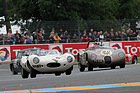
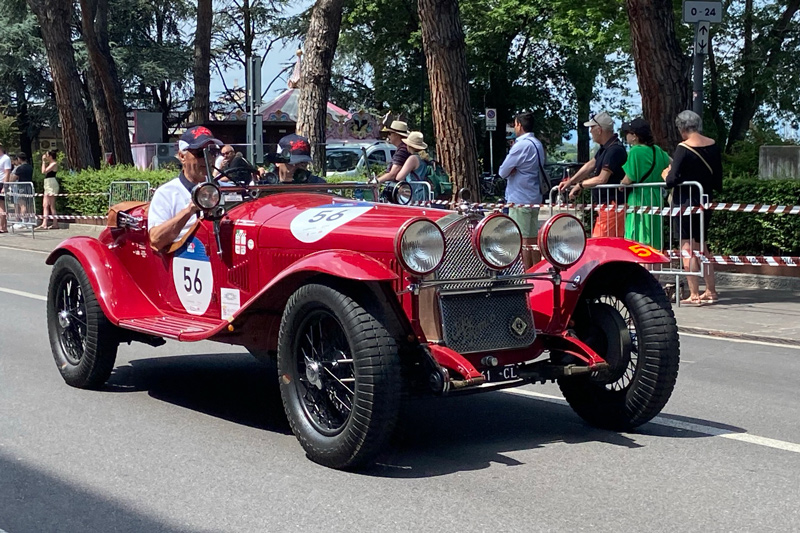
Let's imagine that we were staying at the Priva Alpine Lodge hotel in Lenzherheide and wanted to drive down to the village at around 1.30 pm on Saturday afternoon. Fresh out of the underground parking garage - nice and cool, by the way, the underground parking garage, with temperatures of up to 30 degrees in the Grisons high valley - a traffic cadet would have stopped us and shortly afterwards a Can-Am racer would have raced past us on the main road with an infernal roar, followed by a Cooper Formula Junior and other monoposti. We would have pinched our cheeks - because we are in a Swiss Alpine resort.

The idea seems surreal, but it was a reality on Lenzerheide from June 13 to 15, 2025. Of course, these are not races that have been held here every year since 2011. A pace car leads the fields and position changes are only permitted in a neutral zone. But the sound, the whole experience is the same as on the race track. In Lenzerheide, this consists of a connecting road to various hotels and a residential area of the village on the one hand and the main road from Valbella past the lake and the valley station of the Rothorn cable car on the other.

At 1478 meters above sea level, the organizers around OC President Hans Orsatti claim the title of "Europe's highest race track" for this circuit. Despite the fact that there is nothing to win, the carburetor settings are adjusted with great ambition in the paddock at this altitude. More air is the motto!

Three historical participants
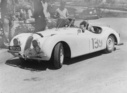
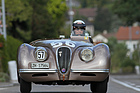
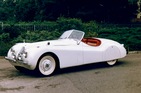
The first of two mountain races from Tiefencastel via Lantsch to Lenzerheide took place on August 26, 1951. The winner of the first edition was Albert "Bätsch" Scherrer with the Jaguar XK 120 Alu. This year, this vehicle was once again part of the action, as it was last year, with current owner Christian Jenny at the wheel. Marco Trevisan's Austin Healey 100 S was a participant in the 1957 race, which even counted towards the European mountain championship, and Jürg Kohler's AC Bristol also took part in a motorsport event on the Lenzerheide back in 1957.

There were a total of 11 race fields for 2025, with the race cabs, for example, joining another group, the local group only taking to the track a total of three times for a stint of around 20 minutes and the ACS group even making do with a single demo run on Saturday. All the other 8 fields had a total of four runs of two stints each on Saturday and Sunday. This means that the Lenzerheide Motor Classics offers a whole lot more driving time per participant than is the case with a hill climb or a slalom, for example. So it's not just the unique scenery in the mountains of Graubünden that is a good reason to drive up here - there are also clearly measurable reasons to sign up.

Even more attractive for viewers
For the same reasons, there is also more for spectators to see than in a race with a single start against the clock. The vehicles chase past you again and again and there is no need to take long breaks in between, during which the starting field has to be led back down a hill into the paddock. The change of starting field is almost "seamless" in Lenzerheide.

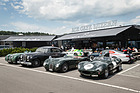
This year, the "infield" - if you can call the parking lot on the other side of the track near the Rothorn cable car that - was also made accessible for the first time with a pedestrian bridge. This allowed access at all times to this interesting area for partners and sponsors as well as for the food trucks. In general, an unbelievable amount of effort is made on Lenzerheide. The paddock, for example, is exemplary: a tent garage is available for every participant. Of course, there are other reasons for this: This is the most efficient way to set up the paddock in the limited space available. And on arrival, every "driver" - most men but also some women - was provided with plenty of goodies, jackets and the like.

Safety appeal
Hans Orsatti's briefing in the large tent in the infield, on the other hand, remained quite simple and was clearly formulated. The key points were safety - with an explicit mention of the no overtaking rule - and good sportsmanship. The message was clear and somewhat pithy: due to the unusual privilege that a whole group of motorsport enthusiasts can let off steam in the Alps, the unavoidable emissions should be kept to a minimum and any nonsense such as burnouts and the like should be avoided.

This was especially true for the visit of the Rennfelder in the village center of Lenzerheide on Friday evening. The vehicles, some of which were not road-legal, were each led by a police vehicle.

The organizers of the Lenzerheide Motor Classics showed exactly how to bring a small "motor festival" to a spa, hiking and vacation resort at the following kick-off in the village center. It felt like the whole village was on its feet - a great experience for everyone involved.

Ambitious to overambitious
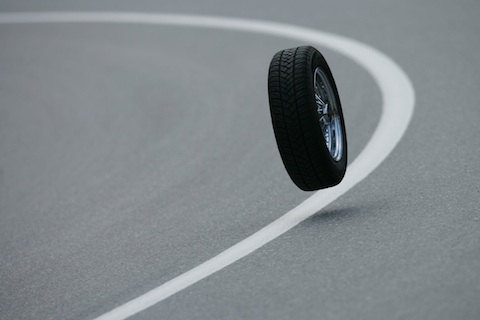
On Saturday morning, the first field - "Battle of the Dwarves" - started at 7.30 am due to the tight schedule. Unfortunately, this first stint did not go smoothly for all participants. In the bend before the Rothornbahn, which was a little tricky due to its slight edge at the transition from the main road to Quartierstrasse, the chassis of Kurt Balzers' Ford Anglia Cosworth was leveraged out and he crashed into the track boundary at an obtuse angle while driving on two wheels. Perhaps his search for the most spectacular driving style possible was his undoing. Conclusion: car clearly shortened and crooked, driver OK!
A few other cars also fell by the wayside, the front axle of Marco Martelosio's Lotus Elan S4 had a little too much "toe-in" on Saturday afternoon and the rim flanges of the pretty Lotus center lock rims all showed a dent... However, there were no really serious incidents. Quite the opposite: the experience will be remembered fondly by the drivers and spectators alike. The event showed a great deal of routine and for this reason made it all the more relaxed for everyone who took part.


However, the heat made itself felt. At around 30 degrees, it got extremely warm, especially in the closed cars, which was noticeable during the first full day of driving on Saturday from midday: More and more often, the drivers could be found in the protective shade of the paddock, relaxing in their camping chairs to cool off. The heat was also one of the organizers' concerns. However, water was always available in plentiful quantities and free of charge for the drivers.

The actual route safety was provided by the corresponding group from ACS-Mitte under the direction of Thomas Kohler. They worked professionally and efficiently and it was clear to the rescue team that this was not the first time they had carried out their tasks. Thanks to their work, there were only ever minor interruptions, which pleased both the drivers and the spectators.
Well anchored
It is clear that the Lenzerheide Motor Classic, which has been held in memory of the historic races since 2011, unites enthusiasts across all vehicle categories. It should be added that there are basically two target groups of spectators: Those who already know everything and usually made their way to the Rothornbahn first to witness the action in the paddock, and those who followed the action on the village side and along the track by the lake. In between - in the forest - you can find the best shady spots.

Lenzerheide remains a motorsport event of a special kind, and it is thanks to the incredibly elaborate organization that everything went more or less smoothly despite the many factors that had to be taken into account around the event - noise, access for local residents, driver and spectator safety, catering, (parking) space for participants and spectators, public transport and so on. Even the mountain bikers, who wanted to ride their bikes on the Rothornbahn downhill trail, managed to get around the event virtually without a hitch. Châpeau!