
Many a year the Jochpass Memorial has suffered from snowfall and bad weather, but this year everything was just right! Autumn showed itself from its most beautiful and warmest side and the 200 or so participants were able to take on a perfectly prepared route. Around 25,000 spectators (unofficial estimate) flocked to the event and combined the joys of hiking with historic motorsport.
A fascinating hill climb with a long tradition
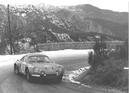
As early as 1923, daring racers drove up the originally 5.72 km long, very challenging route from Bad Hindelang to Oberjoch on the then still unpaved Jochpass road in the Allgäu for the first time. The so-called "Jochrennen" took place every year until 1930, followed by a break until 1954. The hill climb was part of the German racing calendar with interruptions until 1989. At the 1986 event, Fredy Amweg - who was at the start again this year - drove the track record of 3:08.26 minutes, which still stands today, in the Martini formula car, corresponding to an average speed of 107.45 km/h.
In 1999, the first edition of the Jochpass Memorial was launched, which took place for the thirteenth time this year.
The route still leads from the Hindelang district (a good 800 meters above sea level) to Oberjoch (almost 1,200 meters above sea level). The drivers and their aged racing and sports cars have to master 6.79 km, 105 bends and a difference in altitude of around 400 meters.
New chicanes and minimum times
In order to increase the safety of the event, two new chicanes were installed for the thirteenth edition, one in the middle of the start straight and a second in the finish area. These effectively reduced the speed, as the start chicane in particular was quite narrow. Nevertheless, the faster cars were able to undercut the specified minimum time (failure to do so would have been penalized with exclusion) and therefore had to slow down noticeably in the final area, which was certainly a disadvantage for the spectators at the top of the track.
Bends, bends
With 105 bends in less than seven kilometers, there is hardly much time to recover. Despite seven hairpin bends, however, it is still possible to drive quite smoothly and the curve radii are relatively large for a track of this type.
The entire route was recently resurfaced, which resulted in a "squeaky" surface, but thanks to the almost bump-free surface, it still led to faster average times overall.
Interesting vehicles
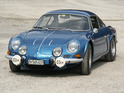
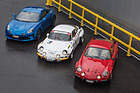
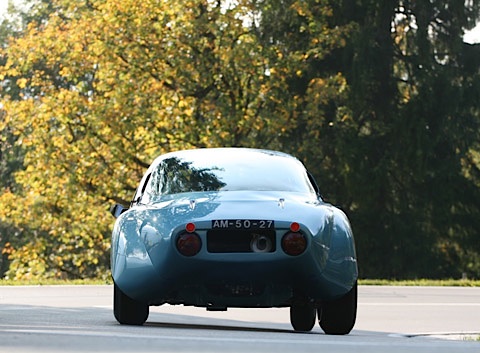
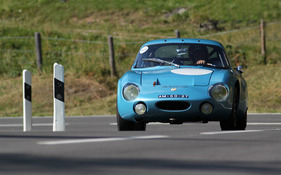
If you were waiting for a Bugatti 35 or a Ferrari 250 GTO, you were in the wrong place at the Jochpass Memorial 2011. Sports cars/prototypes and formula cars were also few and far between. However, there were plenty of rare vehicles to admire that were not entered at other events this year, such as the René Bonnet GT Aerodjet from 1964, a Morgan 4/4 from 1937, a Lancia Barchetta Aprilia from 1978, a TVR 2500 M from 1974, a BMW Alpina A4 from 1972, a Giannini 700 R from 1974 or a pretty Simca 1200 Coupé.
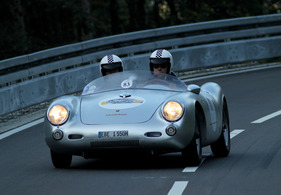
Vehicles up to and including 1979 that were road-legal or had a car pass were eligible. The fact that not every vehicle met with a sympathetic response from connoisseurs and that some replicas/continuations were joined by more or less tastefully "improved" vehicles did not detract from the enjoyment of the generally well-mixed field of vehicles. And the fact that a considerable number of BMW and Porsche vehicles appear at a German event of this kind also makes sense given the long tradition of the Jochpass race.
Large and attractive pre-war fraction
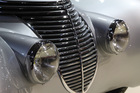
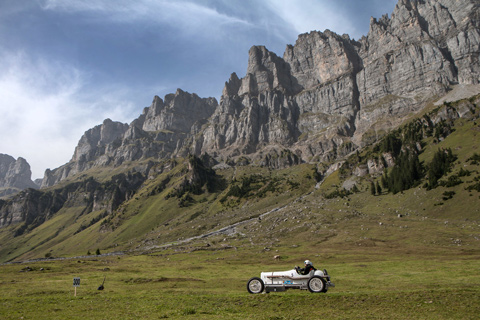
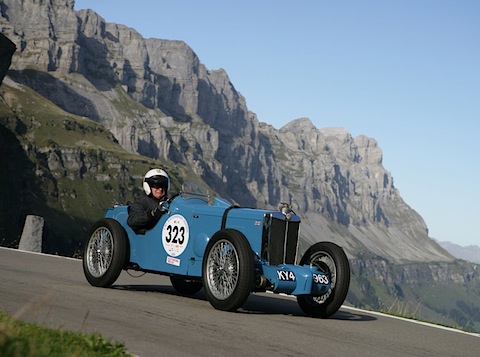
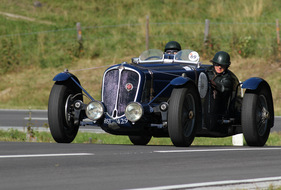
However, the pre-war faction, with over 20 well-equipped vehicles, was particularly eye-catching, shining not only with its beautiful bodywork, but also with its beguiling engine sound and spirited driving style. As many as three Lagonda Rapiers, an Alfa Romeo 6C 1750, a Delahaye 135 CS, a Talbot Darracq Sport and a whole horde of Alvis and Rileys could be admired by the public alongside the aforementioned Morgan and Lancia.
Walking and watching
For spectators, the beautiful fall weather offered the opportunity to walk from the bottom to the top near the track and enjoy the racing action at various points. Many did so, and many classic car enthusiasts and fans gathered along the entire route to enjoy the entertaining spectacle.
No boredom
There was hardly a sound to be heard in the tranquil spa town of Bad Hinterlang until 08:00 on Saturday/Sunday, when the engines began to roar and any spa boredom was wiped away. Motorcycles and cars started every thirty seconds and you could guess the course of the road just by listening.
Four training/racing runs took place without interruption on Saturday and Sunday, the descents were swift and long breaks due to minor accidents were the exception. Entertainment was also provided by a pack of "long boarders" who roared down the mountain in daring style.
The Jochpass Rally
A rally called the International Oberallgäu Historic Rally was held parallel to the memorial. This took place over many small country roads through beautiful landscapes and, apart from the occasional tractor and unexpected roadblocks, was a perfectly organized pleasure for the participants.
The winners
Of course, most of the participants had come for the beautiful and challenging route, but there were also winners and losers. The event mode allows the participants to announce their target time to be completed before each run, so consistency is measured in comparison to their own time announcement.
The winners Kurt Porsche /Herrmann Mair managed to record a total of only 54 hundredths of a second difference between the target times of the six scored mountain runs (the worst of the seven scoring runs was a scratch result) with their 1963 Porsche 356, and only 2 hundredths of a second difference in each of the best two runs.
Second in the overall classification with a total deviation of 59 hundredths was Herbert Müller Walterscheid in a 1969 BMW 2002, while Dr. Jürgen Reul and Johannes Reul in a 1965 BMW 2000 Tilux came third with a total deviation of 74 hundredths from the target times.
Ulrich Clauss and co-driver Renate Clauss came fourth and first in Group C (up to 1960) in a 1957 Mercedes Benz 300 SLS, completing the six scoring runs with a deviation of 123 hundredths.
Rüdiger Hartmann and Erich Leichte in a 1973 Porsche 911 T came eighth overall and won Group E with a difference of 146 hundredths.
The winners of Group B and fifteenth overall were Dr. Peter Sedlmeier and Heidi Sedlmeier in a 1937 Aston Martin 2 Liter Speedster, with a combined deviation of 210 hundredths from the target time.
Finally, Dr. Rainer Assfalg won classification group A in his 1928 Alvis Experimental , finishing 23rd overall with a difference of 332 hundredths.
The detailed results will be available shortly on the Jochpass Memorial website.
Picture galleries
Extensive photo galleries, organized by vehicle period, show the participating sports and racing cars in almost 300 pictures:
- Pre-war vehicles (up to 1940)
- Post-war vehicles up to 1965 (1945 - 1965)
- Post-war vehicles from 1965 (1965 - 1979)